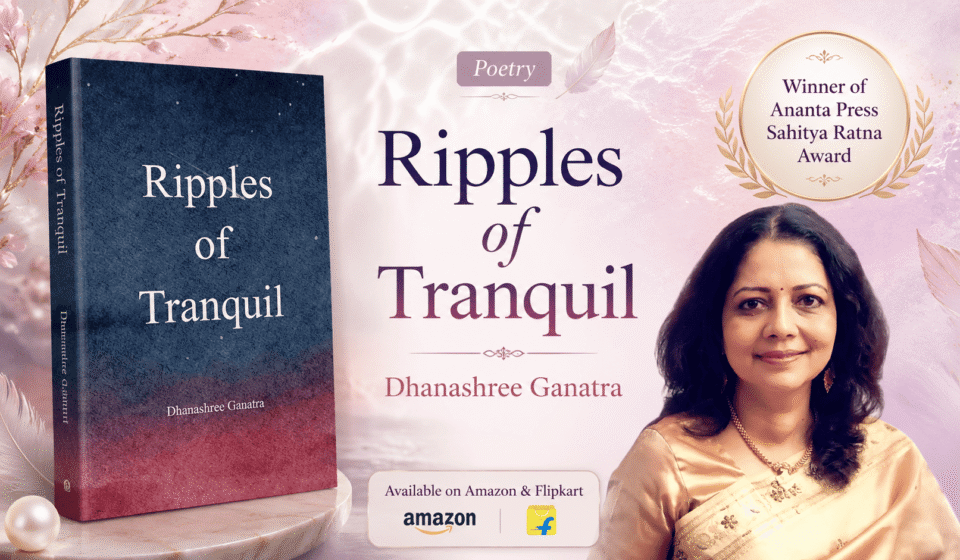

One of the enduring paradoxes of poetry is that the more sincerely a poet enters personal experience, the more widely the work can sometimes resonate. Readers do not necessarily connect because a poem describes their exact circumstances. They connect because it names a feeling, hesitation, hope, or silence they recognise in themselves. Ripples of Tranquil by Dhanashree Ganatra is built around this kind of recognition. Its subjects—love, dreams, silence, self-realisation, thought, hope, and the inner search for peace—are intimate, yet they belong to no single life. The collection’s strength comes from the way it treats personal reflection as a doorway to universal experience.
Ganatra’s artistic biography makes this quality particularly striking. She has been writing poetry since early childhood and has developed a creative life that includes music, songwriting, composition, and filmmaking. Such continuity suggests that expression is not an occasional activity for her but a way of understanding experience. Ripples of Tranquil can therefore be read not only as an individual publication but as the crystallisation of a long relationship with language, sound, feeling, and philosophical reflection. The collection appears to gather these strands into a poetic voice that is gentle in tone but ambitious in subject.
The book begins from an idea that is simple to state and difficult to practise: there is value in the silence between thoughts. That silence becomes a metaphor for a deeper mode of being. Human beings spend much of life identifying with whatever thought happens to be loudest—fear, expectation, memory, desire, comparison. By drawing attention to the space around thought, the collection introduces the possibility that awareness is larger than any single mental state. This gives the poetry a spiritual dimension without requiring formal religious language. The reader is invited into contemplation rather than belief.
The phrase “ripples from the calm waters of inner truth” captures the collection’s method. Inner truth is not delivered as a final declaration. It moves outward through images, moods, and reflections. This indirectness is one of poetry’s great strengths. A poem can approach a truth from the side, allowing the reader to discover rather than receive it. Ganatra’s preferred mode of “soft reflections” supports that process. The poems do not attempt to dominate interpretation. They make room for the reader’s own memories.
This openness helps explain the collection’s potential universal appeal. Love means something different to a young reader, a parent, a person grieving, a person beginning again, or a person learning self-compassion. Silence can represent peace, distance, mystery, prayer, loneliness, or freedom. Dreams can be hope, memory, ambition, or escape. By working with themes that contain multiple emotional possibilities, the collection can speak differently at different stages of a reader’s life. A book that changes with its reader is often a book that lasts.
The artistic journey of “Life is Beautiful,” the collection’s opening poem, is an important example of this reach. Ganatra transformed the poem into an original song that she wrote, composed, and sang. Its message of optimism, resilience, and gratitude reportedly received recognition at film festivals in multiple countries, including Italy, the United Kingdom, Turkey, Dubai, and the United States. The significance of this international response is not merely promotional. It demonstrates that an idea originating in a personal poem could travel through music and cinema into culturally diverse spaces. That movement mirrors the metaphor of the ripple with almost poetic precision.
The collection itself has also been associated with notable recognition, including the 21st Century Emily Dickinson Award and the Tagore International Cultural Award. Awards should be approached as context rather than proof; literature ultimately becomes meaningful in the encounter between text and reader. Yet these honours are relevant because they indicate that Ganatra’s work has been perceived as possessing literary and cultural value beyond a private circle. For an Indian poet writing from Pune while addressing universal emotional questions, such recognition signals the growing international visibility of contemporary Indian English-language poetic voices.
What makes Ripples of Tranquil distinctive within inspirational and reflective writing is its commitment to poetry as poetry. The book may provide comfort, but comfort is not its only purpose. It uses atmosphere, image, suggestion, and rhythm to create an aesthetic experience. This matters because literature becomes memorable not simply when it expresses a good idea but when the form of expression gives that idea emotional life. Many people can say that peace is important. A poet’s task is to make the reader experience the movement toward peace in language.
Ganatra’s multidisciplinary background assists that task. As a singer and composer, she understands that emotion often arrives through cadence before it is intellectually analysed. As a filmmaker, she understands that an image can carry a narrative without explanation. As a poet, she can combine these instincts in concentrated verbal form. The result is a collection whose conceptual identity extends beyond the printed page. It belongs to a larger artistic ecosystem in which word, music, image, and silence communicate with one another.
The book is also notable for the way it frames tranquility as something dynamic. The title does not say “still water” or “perfect peace”; it says “ripples.” Movement remains. The mind continues to change. Feelings continue to arise. This is a mature understanding of inner peace. Real tranquility is unlikely to mean that life stops producing emotion. It may mean that emotion can move through consciousness without destroying its centre. The ripple metaphor acknowledges disturbance while preserving depth beneath the surface.
That idea can make the collection meaningful to readers experiencing transition. Major life changes often destabilise identity: relationships shift, careers change, children grow, losses occur, dreams are revised. During such periods, overly certain advice can feel inadequate. Poetry may be more helpful precisely because it can remain beside uncertainty. It does not have to solve the reader’s life. It can offer language for staying present within it. Ripples of Tranquil seems suited to this companion role.
The collection may also serve as a bridge for readers who are curious about poetry but hesitant to enter highly experimental or academically dense work. Its themes are immediately recognisable, and its emotional orientation provides an intuitive entry point. At the same time, readers interested in philosophy can engage with questions of consciousness, identity, perception, and inner truth. This ability to function at more than one level increases the book’s value.
There is also something important in the author’s insistence, implicit in her creative journey, that poetry can continue beyond publication. A poem can become a song; a book can become a source of reflection; a personal insight can enter another person’s emotional vocabulary. Literature survives by transformation. Every reader creates a slightly different version of a poem through memory and interpretation. In that sense, the reader completes the ripple.
Ripples of Tranquil deserves attention not because it promises to remove every form of restlessness, but because it honours the human longing for a quieter relationship with the self. It treats inwardness as a source of creativity rather than isolation. It respects gentleness as an artistic force. It presents hope without turning away from complexity and spirituality without closing itself into doctrine. These qualities give the collection both warmth and breadth.
Dhanashree Ganatra’s poetic voice is ultimately most persuasive when understood as an invitation. The poems invite the reader to listen, notice, remember, and return. They invite a slower encounter with language and with one’s own consciousness. Their uniqueness lies less in an attempt to astonish than in an attempt to resonate. That is an important distinction. Astonishment is immediate; resonance continues. The best image for this collection remains the one contained in its title: a small movement beginning in stillness, widening quietly, touching distances that the original point could not predict. Ripples of Tranquil is a thoughtful, lyrical collection whose deepest promise is that a private moment of awareness can travel outward and become shared human meaning.
Buy / View on Amazon: https://amzn.in/d/0doJNpxh