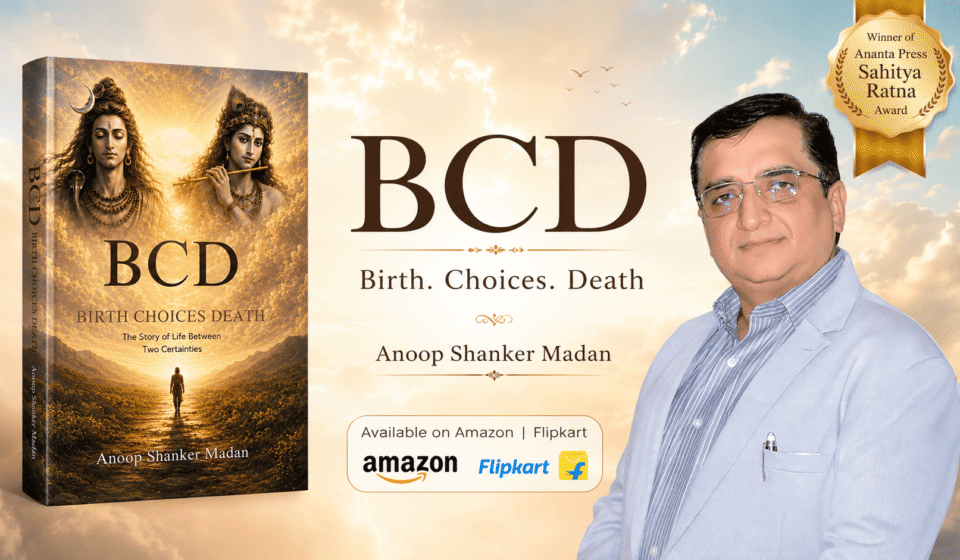

The most compelling idea in B.C.D – Birth, Choices, Death: The Story of Life Between Two Certainties is not that human beings are free to choose everything. It is almost the opposite. Anoop Shanker Madan begins by acknowledging that two of the most important facts of existence lie outside our control. We do not choose to be born, and death remains an unavoidable boundary. The space between those certainties is therefore precious precisely because it is limited. Within that space, the book argues, choices become the primary way in which a person participates in the creation of meaning.
This gives B.C.D an existential seriousness that distinguishes it from lighter motivational writing. The book does not promise unlimited control or permanent happiness. It recognizes uncertainty, circumstance and mortality. Yet its mood is not pessimistic. The recognition of limits becomes the foundation for responsibility. If life cannot be controlled completely, then the meaningful question is not, How do I guarantee the outcome I want? It is, How do I choose to live in the presence of what I cannot guarantee?
That shift is powerful because it relocates freedom. Freedom is not defined as the ability to design every circumstance. It is found in the capacity to respond consciously. A person may be unable to change what has happened, what another person has done, or what uncertainty remains. But there may still be a choice about attention, language, action, interpretation, discipline, courage or responsibility. B.C.D explores this practical zone of agency across the ordinary structures of human life.
The emphasis on ordinary life is essential. Meaning is often imagined as something discovered in extraordinary moments: a major success, a dramatic loss, a spiritual awakening or a decisive turning point. Madan’s framework suggests something more continuous. Meaning is built through repetition. The way we treat our bodies, manage our minds, respond to emotions, care for relationships, confront fear, handle ego, accept responsibility and maintain discipline all contribute to the direction of life. The important choices are not only the visible ones. Many are almost private.
This makes the book’s discussion of habit especially important. Habits are choices that have become easier to repeat than to reconsider. They reduce the need for conscious decision, which can be helpful when the habit is constructive and dangerous when it is not. B.C.D encourages readers to bring awareness back into these automatic areas. What began as one decision may now be shaping years of behaviour. A pattern of avoidance can become a personality story. A pattern of discipline can create capability. A pattern of blame can weaken responsibility. A pattern of reflection can create flexibility.
The book’s treatment of fear and courage fits naturally into this view. Fear is not necessarily a sign that the wrong choice is being considered. Sometimes fear appears precisely because a meaningful action involves uncertainty. Courage, then, is not the absence of fear but the willingness to choose with awareness while fear is present. This is a useful idea because it frees readers from waiting for perfect confidence before acting. Life between birth and death rarely offers complete certainty.
Ego is another theme that gains depth through the BCD framework. Ego often influences decisions without announcing itself. It can appear as defensiveness, comparison, the need to be right, resistance to apology or the desire to protect an identity. Reflection becomes crucial because the visible decision may hide an invisible motive. By asking why a choice was made, the reader begins to see whether the action emerged from awareness or from a need to defend the self-image.
This is one reason the book’s distinction between meditation and reflection is so valuable. Stillness can reduce noise, but reflection helps interpret what becomes visible when the noise decreases. A calm moment does not automatically transform a pattern. If a person repeatedly returns to the same anger, fear or blame, then the deeper work is to understand the mechanism of that return. Reflection turns spiritual experience into self-knowledge, and self-knowledge creates the possibility of a different choice.
The symbolic use of Shiva and Krishna gives this inner process a memorable form. Shiva represents the stillness that sees; Krishna represents the action that follows understanding. The two together suggest a rhythm of conscious living: become still enough to observe, reflect deeply enough to understand, then act responsibly within the world. This is a compelling reinterpretation of spirituality for readers whose lives are filled with practical obligations. The book does not ask them to escape responsibility in order to become spiritual. It asks them to make responsibility itself a field of awareness.
This approach is especially relevant to the author’s own perspective. Anoop Shanker Madan’s background in entrepreneurship places decision-making, uncertainty and responsibility close to the lived source of his reflections. Business life repeatedly confronts people with imperfect information, competing interests, consequences and the need to act before certainty is available. Those realities mirror the book’s larger philosophy. Human life itself is a decision-making process under incomplete knowledge.
Yet the book remains broader than professional or entrepreneurial experience. Its questions are universal because every person lives with conditions he or she did not choose. Family dynamics, health, social circumstances, opportunities, disappointments and losses can all create limits. B.C.D asks readers to acknowledge those limits honestly while resisting the temptation to make them the entire story. The existence of constraint does not eliminate the possibility of meaningful response.
Death gives this argument its emotional force. Many people live as though difficult conversations, personal changes, important relationships and meaningful projects can always be addressed later. Mortality breaks that illusion. The certainty of death does not tell us exactly what to value, but it forces the question. If time is finite, then what deserves our attention? What do we want to stop repeating? What do we want to repair? What are we willing to risk? What kind of presence do we offer to the people around us?
In this respect, B.C.D is not a book about death so much as a book about the value death gives to choice. A limited life makes every repeated pattern more significant. Years can be built from small acts of avoidance just as they can be built from small acts of courage. Mortality gives consequence to repetition.
The book’s accessible language strengthens this message. The BCD model is easy to remember and does not require the reader to adopt a complex philosophical system. The simplicity encourages application. During a conflict, one can ask what is given and what is still choosable. During fear, one can ask whether the next action will reinforce avoidance or courage. During meditation, one can ask whether stillness is becoming understanding. During success, one can ask whether ego is expanding. During failure, one can ask what responsibility remains.
This ability to return to the framework repeatedly is one of the book’s major strengths. It functions less like a one-time argument and more like a mental compass. The compass does not remove obstacles, but it can help orient the person moving through them. Birth marks where the journey begins. Death marks the fact that the journey is finite. Choices provide direction.
The book also carries a quiet challenge to contemporary culture. Much of modern life encourages external measurement: income, status, followers, achievements, possessions, recognition. B.C.D turns attention toward the inner quality of participation. Two people may achieve similar outcomes through very different patterns of fear, discipline, ego, responsibility or awareness. The visible result does not tell the whole story. Meaning is partly located in how the journey was lived.
This makes the book suitable for readers who are not looking for a quick motivational boost but for a framework that can support sustained self-examination. It does not flatter the reader with the idea that awareness alone is enough. Awareness must enter action. It does not promise that one good choice will erase old patterns. Choices must be repeated. It does not deny mortality. It uses mortality to sharpen attention.
B.C.D ultimately offers a philosophy of humble agency. We are not authors of every circumstance, but neither are we merely characters carried along by fate. We participate. We interpret. We respond. We repeat. We revise. The story between birth and death is shaped through these acts. That is why the book’s central idea feels both obvious and profound: what is given matters, what is inevitable matters, but what we choose still matters greatly.
For readers interested in philosophy, spirituality, self-awareness and practical personal growth, this book offers a clear and memorable way to hold those subjects together. Its uniqueness lies in reducing the enormous question of how to live into a framework that can accompany everyday decisions. Birth is the first certainty. Death is the final certainty. Between them, choice becomes not just an act but a form of authorship. B.C.D invites readers to become more conscious of what they are writing.
Amazon Purchase Link: https://amzn.in/d/0136zluj