Ashoka, Crescent and Dragon – An Ambitious Geopolitical Portrait of an Unfinished Question

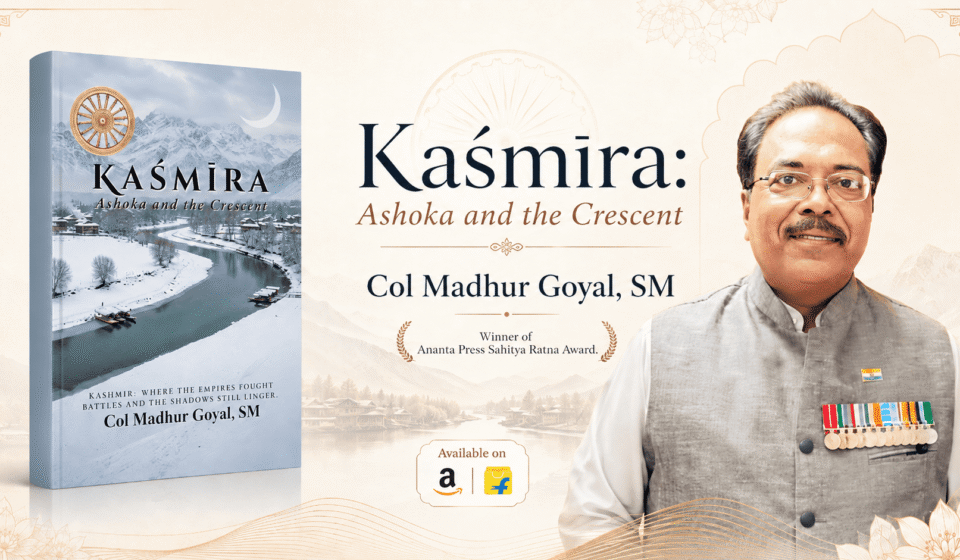
Book: Kaśmīra: Ashoka and the Crescent | Author: Col Madhur Goyal, SM
The title Kaśmīra: Ashoka and the Crescent immediately announces that Col Madhur Goyal, SM is interested in more than chronology. The book uses symbols to organise competing visions of Kashmir: “Ashoka” reflects India’s idea of unity, “the Crescent” represents Pakistan’s call for self-determination, and the “Dragon” enters as China’s strategic calculus. Around these symbols are the diverse voices of Kashmiris, whose own identities and aspirations cannot be reduced neatly to the objectives of surrounding states. This conceptual design is the book’s most distinctive feature because it turns a long historical narrative into an argument about how power sees the same land differently.
The first of these visions, represented through Ashoka, connects the modern Indian state to a much longer civilisational past. By beginning the story with geography and ancient dynasties, the book resists the idea that Kashmir can be understood only through the events of 1947. Buddhism, Hinduism, Sikhism, Islam and Sufism are all part of the valley’s historical formation. This depth gives “Ashoka” a symbolic role larger than one historical ruler. It evokes the idea of Kashmir existing within wider civilisational and political networks long before modern borders were established.
The Crescent introduces a different national imagination. Pakistan’s position in the book’s framework is associated with self-determination and the unresolved consequences of Partition. Maharaja Hari Singh’s decisions, the violence of 1947 and the first military conflict over the region become the central hinge between older history and contemporary dispute. From that point onward, Kashmir becomes inseparable from India-Pakistan rivalry, and subsequent wars in 1965 and 1971 reinforce the durability of the conflict.
Yet the book is careful not to stop at this familiar binary. The Dragon changes the geometry. Aksai Chin, the legacy of the 1962 India-China war and the strategic significance of the China-Pakistan Economic Corridor demonstrate that Kashmir and its surrounding territories sit within a broader Asian contest. Once China is included seriously, the region can no longer be described only as an issue between two successor states of British India. It becomes a three-sided strategic environment involving territorial claims, military infrastructure, connectivity and competing national security priorities.
This is where Kaśmīra becomes particularly relevant to readers interested in geopolitics. Maps that appear static are shown to contain moving systems of power. Roads alter military access. Corridors connect economic and strategic interests. Mountain passes shape logistics. Glaciers become military positions. Diplomatic partnerships modify calculations. The region’s importance lies not only in what it represents historically, but also in where it sits geographically: near the intersection of India, Pakistan and China, all nuclear-armed states with deep security concerns.
The book broadens this further by considering the interests of global powers such as Washington and Beijing. Kashmir’s significance is therefore linked to wider rivalries and regional stability. The point is not that outside powers control every development, but that no major strategic issue in South Asia exists in complete isolation. Relations among India, Pakistan, China and the United States can change the context in which Kashmir is discussed. This wider frame helps explain why the issue continually attracts international attention even when the most immediate consequences are local.
Col Goyal’s military background gives the geopolitical analysis a grounded texture. He served in Siachen and in the Kashmir Valley and was awarded the Sena Medal for Gallantry after an anti-terrorist operation in Budgam. As a result, the book’s strategic language is balanced by awareness of the physical reality behind it. The “Frozen Battlefield” of Siachen is not merely a location of national prestige or territorial denial. It is a place where cold, altitude, frostbite and avalanche are constant threats. Strategy at that height is inseparable from human endurance.
The same is true of Kargil. Strategic analysis often celebrates the clarity of hindsight, but soldiers experience conflict in uncertainty. Terrain, weather, intelligence, logistics and leadership are not abstract variables to those carrying weapons and climbing mountains. A veteran’s perspective can therefore remind readers that geopolitical decisions eventually become tasks assigned to human beings. Every line on a map may imply someone living, patrolling or dying beside it.
The book’s account of militancy beginning in 1989 and the exodus of Kashmiri Pandits introduces the internal human crisis that accompanies interstate rivalry. Security competition does not remain confined to borders. It enters neighbourhoods, institutions and communities. The exodus in particular represents a profound rupture in Kashmir’s social fabric, while decades of violence have produced suffering across multiple sections of society. By including these developments, Kaśmīra avoids treating geopolitics as a chessboard without people.
This human dimension also complicates the symbolism of Ashoka, Crescent and Dragon. States tend to seek coherent narratives because coherent narratives are useful for policy and legitimacy. People, however, live more complicated lives. Kashmiri identities can be regional, religious, linguistic, familial, political and national in different combinations. The book’s acknowledgment of diverse Kashmiri voices is therefore crucial. Without them, the three major state visions would dominate the story so completely that Kashmir itself would disappear beneath the strategies formed around it.
The religious and cultural chapters also help prevent this disappearance. Shrines, traditions and centuries of faith remind the reader that the valley’s meaning exceeds its strategic value. A place can be vital to military planners and sacred to communities at the same time. It can be contested by states and remembered intimately by families. Kaśmīra is strongest when it allows these scales to coexist: the grand strategy of governments and the lived reality of people.
Operation Sindoor and the book’s movement “as we know now” extend the narrative toward the contemporary moment, underscoring that Kashmir’s strategic history remains unfinished. This creates a particular challenge for any work of current non-fiction: the subject continues to evolve while the book is being read. Yet that is also part of its value. Rather than presenting history as a closed archive, Kaśmīra shows how older events continue to influence new crises. The past is not behind the region; it remains one of the forces acting on the present.
What makes the book unique is the way it connects several different time scales. There is geological and geographical time in the mountains and glaciers. There is civilisational time in ancient dynasties and religious traditions. There is national time in Partition and the wars after independence. There is operational time in individual battles and security campaigns. And there is contemporary strategic time in infrastructure projects, great-power competition and shifting alliances. These layers create a richer understanding of why Kashmir remains so difficult to explain through a single event or ideology.
The final question – whether a land of faith and fire can find peace beyond the shadows of history – functions almost as a test for every framework in the book. India’s unity, Pakistan’s self-determination narrative, China’s strategic interests and the aspirations of Kashmiris all generate political claims. But a durable peace would require some way of managing claims without returning endlessly to violence. The book does not provide a simplistic formula, and that restraint is appropriate. Conflicts that have lasted generations are rarely solved by a clever sentence.
For readers of history, defence studies and international relations, Kaśmīra offers an ambitious synthesis. It brings ancient Kashmir into conversation with modern warfare and places bilateral rivalry inside a larger triangular and international strategic picture. For general readers, the symbolic framework makes a difficult subject easier to enter without pretending it is simple. For those already familiar with Kashmir, the value lies in the connections the book draws between terrain, identity, military history and great-power politics.
Kaśmīra: Ashoka and the Crescent ultimately succeeds as a portrait of an unfinished question. Its title names two visions, its narrative introduces a third, and its human focus reminds us that none of them can fully contain the reality of Kashmir. The valley is simultaneously historical inheritance, strategic frontier, cultural homeland and political aspiration. Col Goyal’s book asks readers to see all of these dimensions together. In doing so, it offers not a final verdict but something more useful for a contested subject: a broad framework for understanding why the argument has endured, why the stakes remain high and why peace requires more than the victory of one symbol over another.
Amazon: https://amzn.in/d/2VeZbFr