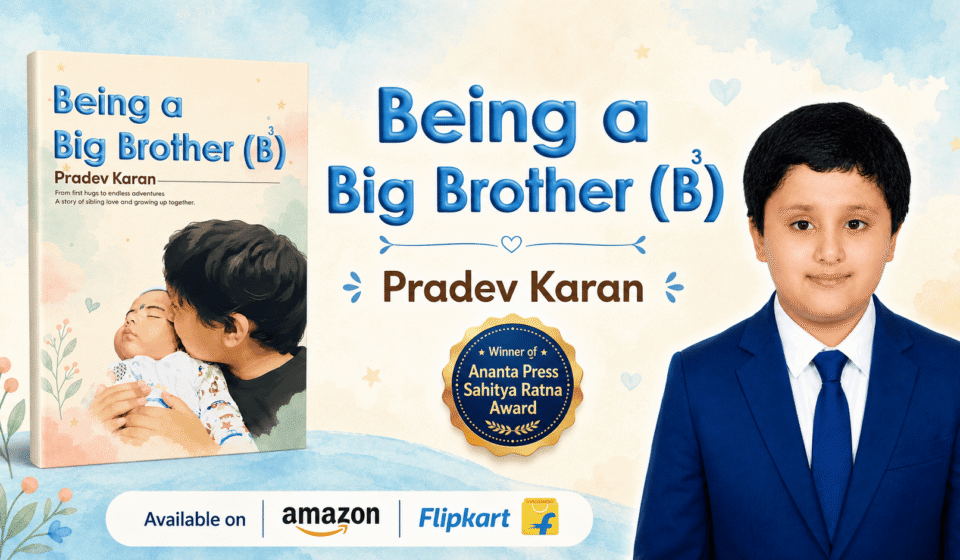

Being a Big Brother by Pradev Karan is a book about sibling love, but it is also an invitation. It invites children to speak honestly, parents to listen attentively, families to value their shared stories, and readers of every age to reconsider what young people are capable of expressing. Written by an eleven-year-old from his own experience as an elder brother, the book combines personal memory with a wider message about confidence, empathy, and the importance of giving children a voice.
The most memorable quality of the book is its openness. Pradev does not present himself as a perfect brother who always knows what to do. The described range of stories—funny moments, adventures, disagreements, affection, and daily memories—suggests a portrait of childhood that is complete because it includes contradiction. He can be loving and still frustrated, responsible and still learning, proud and still uncertain. This emotional range makes the book believable.
For young readers, that honesty is liberating. Children are frequently told to be kind, patient, and helpful, especially when they become older siblings. Such expectations may be reasonable, but they can make difficult feelings seem unacceptable. Being a Big Brother creates room for those feelings without allowing them to define the relationship. It shows that growth does not require a child to deny frustration. It requires the child to understand it, communicate, and continue caring.
This is where the book’s theme of empathy becomes especially strong. Empathy is not portrayed as passive sympathy. It is an active effort to notice another person and respond with consideration. In a sibling relationship, this may involve recognising that a younger child experiences the world differently, needs more help, or cannot always express herself clearly. The elder sibling also needs to feel seen. A healthy family must make space for both children’s perspectives. Pradev’s account can encourage such mutual awareness.
The book’s intergenerational value is one of its greatest strengths. Children may read it for companionship and recognition. Adults may read it for insight. A parent can learn from what the young narrator chooses to remember. The stories may reveal which kinds of moments create security, which changes feel difficult, and how deeply children observe adult behaviour. The book therefore becomes a possible starting point for family conversations that might not otherwise occur.
A shared reading could lead to simple but meaningful questions: What is the best part of being an older or younger sibling? What feels unfair? When do you feel proud of one another? What memory makes you laugh? What do you wish your family understood? These questions do not require a formal lesson plan. They arise naturally from the book’s subject and can strengthen communication at home.
Pradev’s voice is essential to this effect. Because he writes as a child rather than about children from an adult distance, his message carries a special credibility. Young readers may feel that the author understands them. Parents may hear thoughts that children do not always communicate directly. The voice is not valuable because it is polished into adulthood, but because it remains recognisably young—curious, observant, playful, and sincere.
The book also offers an inspiring model of creative confidence. Many children have stories, but they may assume those stories are not important enough to write down. Pradev’s publication challenges that assumption. He demonstrates that a young person’s experience can become a book when supported by attention, discipline, and belief. This does not mean every child must become a published author. It means every child can learn that personal expression matters.
That message aligns with Pradev’s broader identity as a young changemaker. His involvement in community service through Positive Alliance Trust has helped cultivate compassion, leadership, and social responsibility. These qualities are visible in the themes he chooses to explore. The book does not preach about changing the world in grand terms. It begins with the relationship closest to him. This is an important insight: positive change often starts in how people treat family members, respond to differences, and take responsibility for their actions.
The author’s family background also supports the book’s atmosphere of purpose. He has grown up around values of education, integrity, professional discipline, compassion, and service. His father’s steady guidance and his mother’s work in social impact provide examples of commitment in different fields. Yet the book is not simply an extension of adult achievement. Pradev finds his own form of contribution through storytelling. His younger sister Preetha becomes both his inspiration and the emotional centre of his first published work.
The nonfiction category is well chosen. Real-life stories allow the book to communicate without creating distance between message and experience. Readers know that the author is not inventing a relationship to illustrate a lesson. He is reflecting on a relationship that continues every day. This ongoing quality gives the book hope. The story of being a brother is not finished at the final page. The author and his sister will continue to change, and their memories will gain new meanings over time.
The book’s accessible approach also makes it suitable for educational settings. Schools increasingly recognise the importance of social-emotional learning, student voice, reflective writing, and family engagement. Being a Big Brother touches all four areas. Teachers can use it to discuss perspective, autobiographical writing, emotional vocabulary, and conflict resolution. Students may be encouraged to write about someone who has influenced them or a small event that taught them an important lesson.
Libraries and literary organisations can also use Pradev’s example to celebrate young authorship. Children benefit from seeing writers who are close to their own age. Representation is not only about background or identity; it is also about stage of life. A child who encounters an eleven-year-old author may begin to imagine that creativity belongs to the present, not only to a distant adult future.
The book’s uniqueness therefore lies in several connected qualities. It is personal without being narrow, educational without becoming didactic, and inspiring without presenting achievement as effortless. It honours a specific sibling bond while opening a larger discussion about childhood, family, and expression. It allows humour and disagreement to sit beside affection. It treats children as emotionally complex people whose observations deserve serious attention.
There is also a quiet courage in writing about one’s own family. Fiction allows an author to hide behind invented characters. Personal nonfiction asks for vulnerability. Even joyful memories reveal something intimate about relationships. By choosing this form, Pradev shows trust in his readers and confidence in the value of his experience. That courage can inspire not only young writers but anyone who has hesitated to tell a personal story.
Being a Big Brother ultimately succeeds because its central message is lived rather than announced. The importance of kindness appears through a relationship. The value of responsibility appears through a role. The power of resilience appears through everyday recovery. The need to hear children’s voices appears through the existence of the book itself.
Pradev Karan’s debut is a meaningful addition to general nonfiction for families and young readers. It celebrates the joy of having a sibling while respecting the challenges. It shows that growing up is a shared process in which children teach, learn from, and transform one another. Above all, it reminds us that age does not determine whether a story matters. When a young person writes with honesty, warmth, and purpose, readers are given something rare: the chance to see family life through eyes that are still discovering it. Being a Big Brother asks us to value that discovery—and to listen.
Purchase the book on Amazon: https://amzn.in/d/0bT3hytF