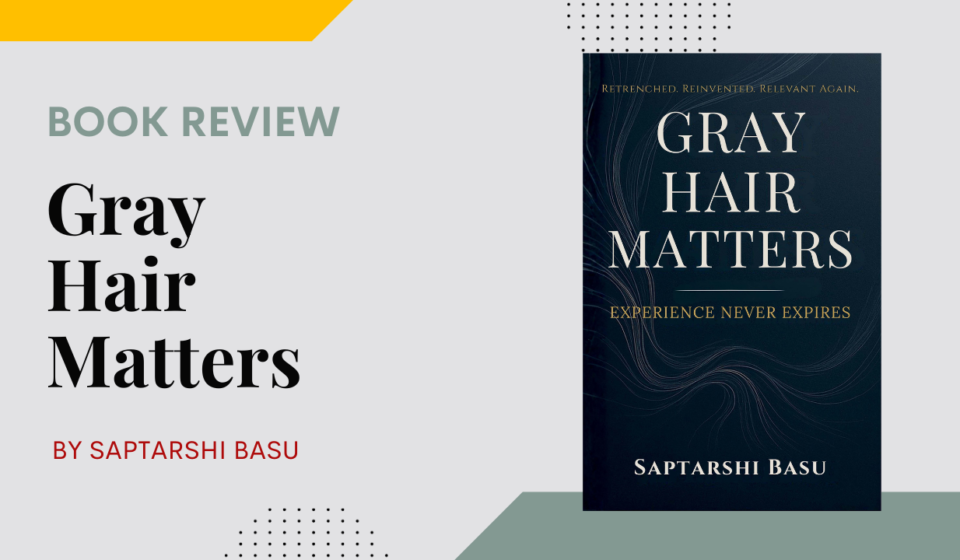
A Timely and Thought-Provoking Guide to Reinvention in the Second Half of Life-Book Review “Gray Hair Matters”

In an era where conversations about artificial intelligence, automation, and digital transformation dominate the corporate world, one important topic often remains overlooked—the future of experienced professionals. Gray Hair Matters by Saptarshi Basu brings this neglected issue into the spotlight with remarkable clarity, empathy, and conviction. Rather than presenting aging as a professional disadvantage, the book argues that experience, wisdom, and resilience remain valuable assets in a rapidly changing workplace. From the opening chapters, the author establishes that this is not merely a book about job loss or retirement but a thoughtful exploration of identity, reinvention, and the changing nature of work.
One of the greatest strengths of the book is its ability to combine research with personal storytelling. Basu draws upon his own professional experiences and those of fellow executives who suddenly found themselves excluded from the workforce despite decades of achievement. These real-life stories create an emotional connection that makes the statistics more meaningful. Instead of presenting numbers in isolation, the author demonstrates how age discrimination, restructuring, automation, and changing hiring practices affect real people with families, ambitions, and valuable expertise. This balance between data and human experience makes the book engaging as well as informative.
The book also deserves appreciation for challenging several misconceptions surrounding older professionals. In many organizations, experience is often mistakenly associated with resistance to change, higher costs, or outdated skills. Basu questions these assumptions with practical examples and global research, arguing that seasoned professionals frequently possess stronger judgment, crisis-management abilities, leadership skills, and institutional knowledge than younger counterparts. Rather than portraying experienced workers as victims, he encourages readers to recognize their continued relevance and adapt their expertise to new professional realities. This optimistic perspective gives the book a refreshing tone that distinguishes it from many career-transition guides.
Another impressive aspect of Gray Hair Matters is its global outlook. Instead of limiting the discussion to one country or industry, the author examines workforce trends across regions such as Singapore, Europe, the United States, Australia, and Asia. Through carefully presented statistics and policy discussions, readers gain a broader understanding of how demographic shifts, aging populations, automation, and labor market changes influence employment opportunities for experienced professionals. This international perspective makes the book relevant for readers across different countries and professional backgrounds.
The organization of the book is equally commendable. Rather than focusing solely on the challenges faced by mature professionals, Basu gradually shifts the discussion toward practical solutions. The table of contents itself reflects this thoughtful progression—from understanding the invisible exit and structural workplace changes to rebuilding professional identity, strengthening networks, and eventually creating portfolio careers, consulting businesses, mentoring opportunities, and knowledge-driven enterprises. This structure allows readers to move from reflection to action, making the book both motivational and practical.
Perhaps the book’s most valuable contribution lies in its message that career reinvention is no longer optional—it is becoming essential. Instead of encouraging readers to chase traditional employment indefinitely, Basu introduces the concept of transforming accumulated experience into new forms of value through consulting, advisory roles, coaching, teaching, fractional leadership, and entrepreneurship. The emphasis on building a “knowledge business” reflects the realities of today’s evolving economy, where expertise can often create greater impact outside conventional organizational structures. This forward-looking approach makes the book especially relevant in an age where flexible careers are becoming increasingly common.
The writing style is clear, accessible, and easy to follow despite dealing with complex workplace issues. The author avoids excessive academic language while maintaining credibility through references to workforce studies, organizational psychology, and international labor reports. Readers without a management background will still find the content approachable, while business leaders and HR professionals will appreciate the research supporting the author’s arguments. This balance between simplicity and substance significantly enhances the book’s readability.
Another noteworthy strength is the compassionate tone maintained throughout the narrative. Basu never encourages resentment toward organizations or younger generations. Instead, he presents retrenchment and workforce restructuring as structural challenges rather than moral failures. This balanced perspective allows the discussion to remain constructive rather than confrontational. By acknowledging both organizational realities and individual struggles, the author creates space for meaningful dialogue rather than blame.
If there is one area where some readers may require patience, it is the book’s extensive use of statistics and research findings in the early chapters. While these sections strengthen the book’s credibility, readers seeking a fast-paced narrative may occasionally find the detailed data somewhat dense. However, this is a minor observation rather than a significant drawback, as the research forms the foundation for the practical guidance that follows.
Ultimately, Gray Hair Matters succeeds because it addresses an issue that affects millions of professionals yet receives surprisingly little attention in mainstream career literature. It reminds readers that experience should never be viewed as a liability but as a resource capable of generating new opportunities when combined with adaptability and continuous learning. More importantly, the book inspires confidence by demonstrating that career transitions after fifty are not signs of decline but opportunities for meaningful reinvention.
Final Verdict
Gray Hair Matters is an insightful, research-backed, and deeply encouraging guide for professionals navigating career transitions in an age of rapid workplace transformation. By combining personal stories, global workforce research, and practical strategies for reinvention, Saptarshi Basu delivers a book that is both timely and empowering. It is highly recommended not only for experienced professionals but also for HR leaders, business executives, policymakers, and younger managers seeking to understand the true value of experience in the modern workforce.
Rating: ⭐⭐⭐⭐⭐ (5/5)
Title: Gray Hair Matters
Author: Saptarshi Basu
Publisher: Evincepub Publishing
Buy Book on Amazon