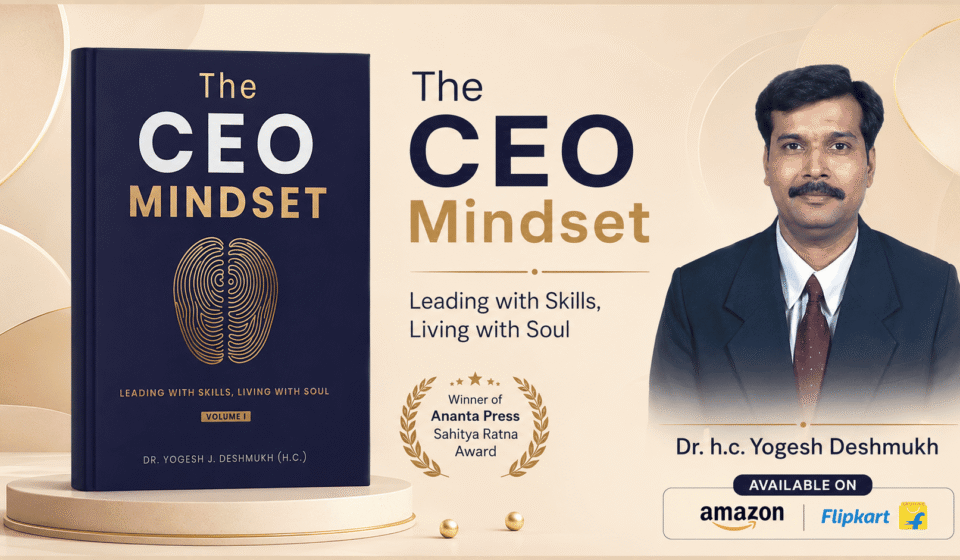
A Book for the Leader You Are Becoming — Practical Wisdom for Managers, Engineers, and Executives

The CEO Mindset: Leading with Skills, Living with Soul, Volume I can be read as a senior executive’s reflection on leadership, but its most useful audience may be much wider. The book speaks to the manager who has just begun leading a team, the engineer moving into programme responsibility, the entrepreneur building a culture from the ground up, the project director coordinating specialists, and the experienced executive wondering how to remain effective without becoming disconnected from people. Dr. h.c. Yogesh Deshmukh writes about the CEO mindset as a form of responsibility rather than merely a title, and that choice gives the book broad practical value.
Many professionals discover a difficult truth when they move into leadership: the skills that made them successful individually are no longer enough. A technically excellent engineer may struggle to align teams. A strong analyst may find conflict emotionally draining. A high performer may be uncomfortable delegating. A decisive manager may learn that people stop sharing information when every disagreement is treated as resistance. Career progression changes the nature of the problem. The leader is no longer responsible only for the quality of personal work; they are responsible for the conditions under which other people work.
The CEO Mindset addresses this transition by expanding the reader’s understanding of competence. Technical expertise, strategic thinking, commercial awareness, and execution remain essential, but they are joined by qualities that traditional management cultures have sometimes undervalued: empathy, humility, listening, resilience, ethical judgment, and self-awareness. The book’s argument is not that these are “soft” additions to serious leadership. It is that they influence serious outcomes. Teams communicate better when they trust their leader. Problems surface earlier when people are not afraid of blame. Collaboration improves when specialists feel respected. Decisions become more robust when leaders are willing to hear what they do not want to hear.
This is where Deshmukh’s career becomes an important part of the book’s credibility. He brings over thirty years of experience across railway signalling, high-speed rail, metro systems, software engineering, renewable energy, and major infrastructure. His roles with global organisations including Siemens Mobility, Hitachi Rail, Bombardier, and GE’s John F. Welch Technology Center place him within environments that demand precision, coordination, safety awareness, and disciplined execution. He is currently involved in India’s Mumbai-Ahmedabad High-Speed Rail Project, with expertise in system integration and multidisciplinary interface management. This background matters because the book’s human message is coming from someone immersed in complex technical work, not from someone dismissing the importance of systems or performance.
Readers from engineering and project-management backgrounds may therefore feel particularly seen. Technical professionals are often trained to solve definable problems: identify inputs, analyse constraints, model alternatives, choose a solution, and verify results. Human organisations do not always behave so neatly. The same conversation can motivate one person and discourage another. A decision can be rational yet communicated poorly. A project may have strong processes but weak trust. Leadership requires comfort with this ambiguity. Deshmukh’s phrase “the engineer and the empath” captures the challenge: retain the discipline of analysis while developing the capacity to understand people.
The book is also valuable for its realistic view of when leadership is tested. It is easy to appear composed when the project is on schedule and the team is energetic. The harder moments come when a deadline slips, a stakeholder becomes difficult, a failure occurs, or people are tired. Deshmukh draws attention to these pressure situations because they reveal whether a leader’s stated values survive contact with reality. A respectful culture is not proved by a values poster; it is proved by the way mistakes are handled. An open culture is not proved by an invitation to “speak up”; it is proved by the leader’s reaction when someone actually challenges a preferred plan.
For an emerging manager, this is an important lesson. People remember patterns. A single moment of public humiliation can undo months of encouragement. A leader who consistently takes responsibility while sharing credit can create loyalty that no incentive programme can manufacture. A leader who asks good questions rather than immediately asserting an answer can improve both learning and ownership. The CEO Mindset encourages readers to recognise these everyday leadership signals.
The book’s emphasis on continuous learning also makes it relevant to professionals at every stage. Seniority can create dangerous certainty. As people gain authority, fewer colleagues may openly correct them. The result can be a widening gap between how a leader sees themselves and how others experience them. Deshmukh’s model resists this trap by presenting leadership as a continuing practice. The effective leader remains a student of systems, people, context, and self.
That learning orientation connects naturally to the author’s academic work. Dr. Deshmukh is a DBA researcher at XLRI/IPAG Business School, focusing on strategic coherence, governance, and project lifecycle management in mega infrastructure projects. He also created the ORBIT framework, an original Strategy-to-Delivery governance model. While The CEO Mindset should not be mistaken for a technical guide to that framework, this research background helps explain the author’s concern with alignment and drift. Organisations can drift away from strategy; leaders can also drift away from values. Both forms of drift require awareness, feedback, and corrective action.
A particularly useful idea for working managers is the book’s view of authority. Authority can make people comply, but compliance and commitment are not the same. A team may follow instructions while withholding creativity, concerns, or discretionary effort. Trust changes that relationship. When employees believe leadership is fair, competent, transparent, and willing to listen, they are more likely to contribute beyond the minimum. This is why the book’s call for leaders to become custodians of culture is so important. Culture determines what people do when the boss is not in the room.
The book also invites readers to consider personal values as an operational resource. Values may seem philosophical until a leader faces a decision where all options have consequences. Under pressure, values act as a compass. They help determine what will not be sacrificed for convenience. Integrity reduces the gap between declared principles and actual behaviour, making leadership more predictable in the best sense. People know where they stand. In environments of constant change, that consistency can become a stabilising force.
Another strength is the book’s rejection of one-dimensional toughness. Modern leadership requires resilience, but resilience is not emotional numbness. It is the ability to remain purposeful while absorbing difficulty, learning from setbacks, and continuing to relate constructively to others. Similarly, humility is not weakness; it is the capacity to recognise limits. Empathy is not avoidance of standards; it is understanding the human reality in which standards must be achieved. The CEO Mindset repeatedly encourages this kind of integration.
From a reader’s perspective, the book works best as a reflective companion rather than a quick-fix manual. It encourages pauses. A chapter or idea can prompt a manager to think about a recent meeting, a conflict, a decision, or a difficult conversation. This makes it suitable for leadership development programmes, management discussions, or personal professional reflection. Teams could use its themes to discuss questions such as: What does trust look like here? How do we handle bad news? Are people safe to challenge seniority? What behaviours do we unintentionally reward? How do we balance urgency with respect?
The book also has cross-industry relevance. Although the author’s expertise comes substantially from infrastructure, rail, software, and engineering, the human questions are universal. A hospital, technology startup, university, government department, manufacturing plant, consulting firm, or family business all depend on people interpreting goals and coordinating action. Wherever responsibility and interdependence exist, the book’s central message applies.
What makes The CEO Mindset unique is not a claim that strategy no longer matters. It is precisely the opposite: strategy matters too much to be left disconnected from culture and character. Execution happens through people. Ethical failures become strategic failures. Poor communication becomes operational delay. Fear becomes hidden risk. Trust becomes speed. Learning becomes adaptability. By showing these connections, Deshmukh turns human-centered leadership into a management argument rather than a purely inspirational one.
The book ultimately offers a useful standard for readers at different stages of leadership: become more capable without becoming less human. Grow in authority without losing curiosity. Build systems without forgetting the people who inhabit them. Pursue results without allowing results to erase purpose. These principles are simple to state and difficult to practice, which is exactly why they deserve sustained attention.
For anyone preparing for greater responsibility, The CEO Mindset is a timely reminder that leadership development is not just the accumulation of tools. It is the formation of judgment and character. Dr. h.c. Yogesh Deshmukh brings technical depth, long professional experience, and a reflective understanding of people into the same conversation. The result is a management book that encourages readers not only to ask whether they are ready for the next title, but whether they are becoming the kind of leader others can trust when the stakes are high.
Purchase on Amazon: https://www.amazon.in/dp/9371399201