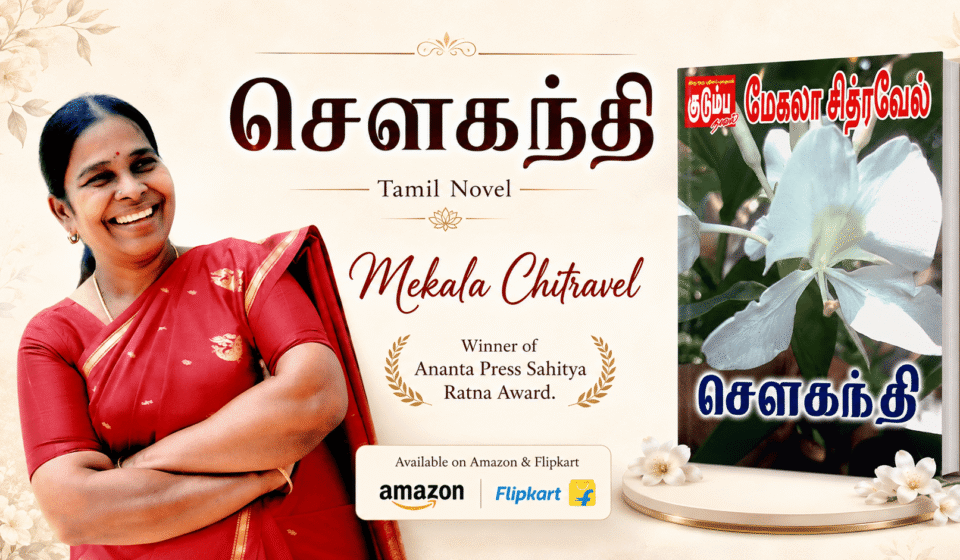
A Mature Voice in Tamil Writing – Reading Sowganthi in the Context of Mekala Chitravel’s Literary Journey

Sowganthi becomes especially interesting when read in the context of Mekala Chitravel’s remarkable literary journey. A writer who has completed one hundred books in Tamil does not arrive at a family novel with only the experience of fiction. Her work spans novels, children’s books, cookery, folk stories, spiritual writing, biographical work on Indira Gandhi, books related to kolam, and eleven works on the legendary MGR. That breadth immediately tells us something about her relationship with writing: for her, Tamil literature is not a narrow profession but a lifelong field of communication. Sowganthi, with its focus on the divine affection between a mother and son, feels like a natural expression of a writer who has spent decades engaging with family, culture, education, tradition, and human values.
The novel’s central idea is uncomplicated. Sowganthi is a mother who receives what every mother hopes for: love and care from her son. Rishi is the son who gives that affection. Yet the simplicity of this idea should not be confused with shallowness. Some of the strongest emotional themes in literature are simple when reduced to a sentence. Love, loss, loyalty, gratitude, jealousy, forgiveness, and duty are not complicated concepts, but writers return to them because human beings never finish understanding them. The mother-son bond in Sowganthi belongs to this category. It is familiar enough to be universal and personal enough to remain emotionally charged.
What gives the story a distinctive identity is its positive emphasis. A great deal of contemporary fiction derives energy from broken families. Neglect, resentment, generational conflict, and emotional estrangement create obvious drama. Mekala Chitravel chooses to centre a relationship in which care is present. Sowganthi is described as fortunate because Rishi loves and looks after her. This creates a novelistic space where affection itself becomes worthy of attention. That choice is quietly radical. It says that literature does not always have to celebrate damage in order to be serious. A healthy bond can also reveal character, values, and emotional truth.
The title deepens this idea beautifully. Sowganthi is connected to a divine flower mentioned in the Mahabharata, brought from heaven by Bhima for Panchali. In Indian culture, flowers are more than decorative objects. They are associated with worship, welcome, celebration, remembrance, beauty, and offering. A heavenly flower carries an additional sense of rarity. By giving the mother a name linked to such a flower, the novel creates a subtle symbolic dignity around her. She is not simply “the mother” as a functional role. She is someone precious, someone whose presence has value and fragrance.
The epic association also creates a bridge between classical cultural memory and present-day family life. This is one of the features I find most appealing. The novel does not need to retell the Mahabharata to benefit from its symbolic world. A single reference can carry a long cultural echo. Bhima’s act of bringing a rare flower for someone he cares about becomes an image of effort made for love. Rishi’s care for his mother can be understood in a similar spirit. The modern “offering” is not a supernatural flower but attention, responsibility, and affection. That gives the title a thematic purpose rather than leaving it as a decorative choice.
Mekala Chitravel’s educational career also matters when considering the novel. With M.A., B.Ed., and Ph.D. qualifications, she has been deeply connected to learning. She ran a matriculation school and educated hundreds of students, many of whom now hold good positions. A person who spends years teaching sees childhood and adulthood as part of a continuous process. Teachers encounter children when they are still forming habits and identities; later they watch them enter professions and families of their own. This long view of human development naturally raises questions about gratitude, responsibility, and the influence of elders. Sowganthi’s theme fits that perspective very well.
Her experience as a stage debater on nearly a thousand stages and as a storyteller is equally significant. Stage speaking creates a different relationship with language from solitary writing. The speaker sees immediately whether an audience is listening, confused, moved, or bored. Over hundreds of appearances, one develops a strong instinct for what reaches people directly. Sowganthi’s emotional clarity may be understood in that light. The central idea can be grasped instantly, but it continues to deepen as the reader connects it with personal experience. This is similar to the best oral storytelling: the story is accessible at first hearing, yet its meaning grows afterwards.
The author’s knowledge of Tamil, English, and Malayalam also suggests a wider linguistic awareness. Even when a book is written in Tamil, multilingual experience can shape a writer’s sense of expression, cultural comparison, and audience. Her interests in drawing, painting, embroidery, and cooking further reveal a creative personality that works across forms. These arts all involve patience, pattern, detail, and the transformation of ordinary materials into something meaningful. One can see a parallel with the novel’s subject. The mother-son relationship is one of the most ordinary structures of human life, yet through storytelling it becomes something to observe and value anew.
It is also notable that three researchers from different universities have completed Ph.D. work on Mekala Chitravel’s novels. This academic engagement suggests that her fiction offers material for deeper study – whether in relation to society, gender, family, culture, character, or Tamil literary practice. Sowganthi can therefore appeal on more than one level. A general reader may approach it for its emotional story, while a researcher might be interested in how motherhood, filial duty, cultural symbolism, and positive family values are represented.
One of the most important themes the novel raises is reciprocity. Parenthood begins as an unequal relationship. The child receives far more than it can possibly return: food, protection, instruction, emotional reassurance, time, and sacrifice. The imbalance is natural. But adulthood creates the possibility of a new balance. The child becomes capable of giving. That does not mean “repaying” a mother as though love were a debt. It means recognising that relationships remain alive only when care is allowed to move in both directions. Rishi’s affection represents this mature reciprocity. He does not erase his mother’s earlier sacrifices; he honours them by ensuring that she feels loved in the present.
This is where the book can become personally challenging. Many people love their parents in principle but postpone the actions that would make that love visible. A phone call can wait. A visit can be delayed. A conversation is shortened because work feels urgent. Slowly, affection becomes an assumption rather than an experience. Sowganthi reminds the reader that parents do not live inside our intentions; they live inside the time and attention we actually give them. That is a valuable message, particularly in societies experiencing migration, nuclear families, and increasingly demanding professional lives.
I also appreciate the dignity the theme gives to motherhood. Mothers are frequently praised in idealistic language while their everyday needs are ignored. Society can glorify “motherhood” as an abstract concept and still fail individual mothers in practical ways. A novel about a mother who is genuinely cared for brings the discussion back to reality. Respect is not a slogan. It is behaviour. Gratitude is not a ceremonial speech. It is consistency. Rishi’s love is meaningful precisely because it is directed toward a real person, not an abstract idea of the mother.
The novel’s positivity may be particularly attractive to readers who are tired of fiction that assumes darkness is the only sign of seriousness. There is emotional depth in reassurance too. Watching a parent feel secure in a child’s love can be moving because readers know how easily the opposite can happen. Hope has meaning when we understand the fear it answers. Sowganthi’s good fortune therefore carries emotional weight. It offers a model of family life in which affection survives growth and changing roles.
As part of Mekala Chitravel’s one-hundred-book literary journey, Sowganthi demonstrates the value of staying close to fundamental human emotions. A writer may explore many genres and subjects, but certain themes remain inexhaustible because they belong to everyone. The mother-son bond is one of them. The novel’s uniqueness comes from the combination of emotional simplicity, positive family values, culturally resonant symbolism, and the mature perspective of an author with extensive experience in literature, education, storytelling, and public life.
I would recommend Sowganthi to readers of Tamil fiction who appreciate family-centred narratives, cultural references, emotional warmth, and stories that encourage gratitude. It may also appeal to readers interested in the broader work of a prolific Tamil author whose career crosses popular writing, educational service, and academic attention. The book leaves us with a graceful image: a mother named for a divine flower, cherished by a son who understands her worth. In the end, that image captures the novel’s central belief – love becomes most beautiful when it is not merely felt, but returned.Amazon Purchase Link: https://www.amazon.com/%E0%AE%9A%E0%AF%8C%E0%AE%95%E0%AE%A8%E0%AF%8D%E0%AE%A4%E0%AE%BF-Tamil-Megala-chitravel-ebook/dp/B08QHXX1YX/ref=sr_1_1?crid=14UCY7JUZSG76&dib=eyJ2IjoiMSJ9.T9HpY4IwtsVh4EPOLSOJOw.elPq1AOHf0OkGkPQwJUvaX8h39c6ftPIQISOfgKV5A4&dib_tag=se&keywords=megala+chitravel&qid=1779947276&s=books&sprefix=megala+chitravel%2Cstripbooks-intl-ship%2C366&sr=1-1