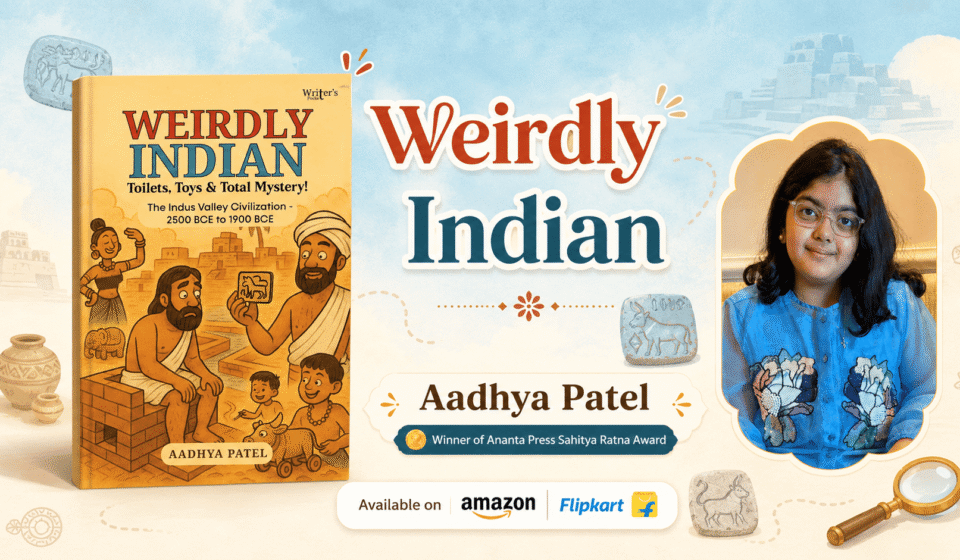

Weirdly Indian – Toilets, Toys & Total Mystery! is remarkable not because a twelve-year-old wrote a history book, but because the book makes a persuasive case for why a young person’s perspective can change the way history is told. Aadhya Patel’s age is certainly part of the story, yet the stronger achievement lies in the quality of her approach. She notices what many adults writing for children can overlook: young readers are not naturally uninterested in history. They are often uninterested in the version of history that excludes the questions they actually want to ask.
Patel’s response is to build the book around those questions. Instead of centring the Indus Valley Civilization on kings, wars, and formal dates, she looks at toilets, drains, toys, homes, seals, jewellery, farming, food, trade, city planning, and the unresolved mystery of the script. These topics create a vivid sense of life. They invite the reader to enter the civilization at ground level, through things a person might use, touch, wear, build, clean, trade, or play with.
That choice is more than a stylistic gimmick. It changes the reader’s relationship with the past. A date such as 2500 BCE can feel impossibly distant, but an ancient toy can feel immediate. A carefully planned drain makes engineering visible. A bathroom makes urban life imaginable. A seal covered in unread symbols creates a puzzle that feels personal. Through such details, the civilization stops being a chapter heading and becomes a world.
The book’s voice is equally important. It is curious, humorous, and willing to be surprised. Patel does not write as if she possesses a podium and the reader occupies a desk. She writes more like someone who has found a box of strange clues and wants company while opening it. This sense of shared discovery is especially effective for children because it creates intellectual equality. The author may have done the research, but the reader is invited to participate in the thinking.
The word “mystery” in the title is therefore central. The Indus Valley Civilization is unusually suited to a mystery-driven approach because several major questions remain unanswered. The script has resisted accepted decipherment. The nature of political authority is uncertain. The reasons for the civilization’s decline are complex and debated. Patel does not conceal these gaps. She turns them into narrative energy.
This is one of the most mature features of the book. It would be easy to assume that a children’s history text should eliminate ambiguity, but Weirdly Indian respects young readers enough to do the opposite. It distinguishes discovery from certainty. Archaeologists can uncover a seal, map a city, identify drainage systems, examine goods, and compare patterns, yet still disagree about interpretation. The child reader learns that knowledge has edges.
That lesson matters well beyond history. In an age when children encounter endless confident statements online, the ability to recognise uncertainty is essential. The book quietly models a better way of thinking: look at evidence, ask what it supports, consider alternatives, and do not invent certainty where none exists. There is no lecture on critical thinking, but critical thinking is woven through the experience.
The story of the civilization’s rediscovery adds another layer of fascination. Ancient bricks were reused by railway workers before their significance was understood, a detail that captures both the accidental nature of discovery and the fragility of heritage. It shows that the past can literally lie beneath ordinary activity and that people may fail to recognise it. For young readers, this makes archaeology feel adventurous and relevant. The world still contains things waiting to be noticed.
The focus on everyday objects also gives the book a democratic view of history. The Indus Valley Civilization is not made interesting by attaching it to one celebrated personality. Its achievement is collective. The cities themselves, their systems, the craftspeople who produced objects, the families who lived in houses, the traders who exchanged goods, and the children who played all contribute to the story. This helps young readers understand that history is not only made by people whose names survive.
That perspective is particularly meaningful in a book written for Indian children. Heritage can sometimes be presented as something to admire from a respectful distance. Weirdly Indian makes it something to engage with. The past can be questioned, laughed about, investigated, and imagined. This is a more intimate form of cultural connection. A reader does not simply hear that the civilization was advanced; the reader is shown drains, planning, tools, trade, and objects that make the claim concrete.
Patel’s own background deepens the significance of this perspective. She is a student from Indore who has developed interests across writing, public speaking, performance, music, and karate. Her supplied author profile notes recognition including an Amazon India No. 1 bestseller position in Children’s Books, the Dickens Medal, Young Author of the Year at the Kolkata Literary Carnival 2026, recognition at Junior Miss India 2026, participation in the Scholastic Writers Program, and selection among young writers by TheKids_Tales. Such achievements are impressive, but they are not the reason the book works. If anything, the author’s own motto—“Awards are nice. Curiosity is better”—provides the more useful frame.
Curiosity is visible in the book’s willingness to pursue small questions until they become large ones. A toilet leads to sanitation. A drain leads to city planning. A toy leads to childhood. A seal leads to trade and writing. A brick leads to archaeology and preservation. A disappearance leads to environmental and social theories. This ability to move from the specific to the systemic is one of the book’s strongest intellectual qualities.
The illustrations and playful presentation help ensure that this thinking never becomes heavy. A young reader can enjoy the visual humour while absorbing information. The design implied by the book’s concept—bright, approachable, full of characters and material details—matches its educational philosophy. History should be looked at, not merely recited. The visual world gives children another set of clues to interpret.
The book also has the potential to support family reading. Parents may find themselves learning or rediscovering details alongside their children. A discussion about an undeciphered script can lead to questions about language. A drainage system can lead to a comparison with modern cities. A toy can prompt children to think about which present-day objects might survive for archaeologists thousands of years from now. These conversations transform the book from a one-way reading experience into a shared inquiry.
For teachers, the same qualities offer classroom possibilities. Students could create their own archaeological “evidence tables,” separating what an object shows from what they merely infer. They could design a seal, debate theories of decline, compare ancient and modern sanitation, or write diary entries carefully distinguishing evidence from imagination. Because the book is already built around questions, it naturally encourages activities rather than passive worksheets.
Its broader literary quality comes from voice. Children’s non-fiction can sometimes sound either too adult or artificially childish. Patel’s tone avoids both extremes. The humour feels connected to the subject rather than pasted onto it. The excitement feels earned by genuinely strange discoveries. The questions do not appear as decorative prompts; they are part of the author’s way of seeing.
That authenticity is why the book has a strong identity. It is not simply “a book about the Indus Valley Civilization.” It is a book about what happens when a young Indian reader encounters the Indus Valley Civilization and refuses to stop at the standard answers. The result is personal without becoming self-centred, educational without becoming textbook-like, and patriotic without losing intellectual openness.
There is something especially fitting about a young author writing about a civilization whose script cannot yet be read. Both situations point toward the future. One reminds us that the past still has questions waiting for new generations of researchers. The other shows that young readers are already capable of asking worthwhile questions now. Weirdly Indian places those ideas beside each other.
By the end, the book’s greatest achievement is not that it makes children remember that the Indus Valley Civilization had impressive sanitation or fascinating toys, though it likely will. Its greater achievement is that it makes the reader want to know what else is hidden in the evidence. What did those symbols mean? What happened in those streets? How did people organise their communities? Why did the cities change? What have archaeologists missed? What could the next discovery reveal?
That desire to continue asking is the strongest recommendation for the book. Weirdly Indian – Toilets, Toys & Total Mystery! treats young readers not as future thinkers but as thinkers already. Aadhya Patel gives them a past full of clues and then trusts them enough to wonder about it. In children’s non-fiction, that trust is both rare and powerful.
Amazon Purchase Link: https://amzn.in/d/0aBM1ljI