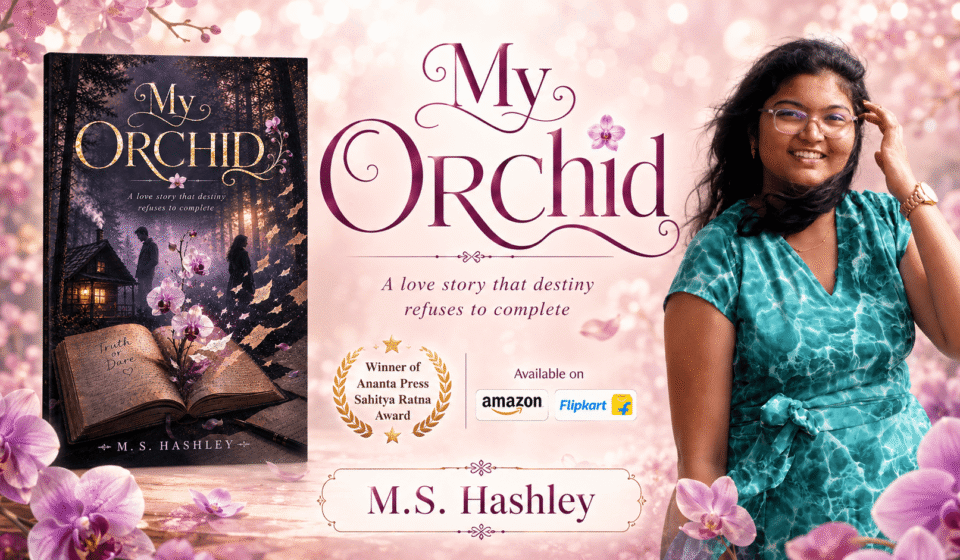

I went into My Orchid expecting a straightforward romantic novella, and I came away feeling that it is much more emotionally crowded—in a good way—than the premise first suggests. On the surface, the hook is easy to explain: a young man recovering from heartbreak goes to a secluded cabin, finds a diary called Truth or Dare, and begins exchanging anonymous entries with a mysterious girl. That alone is enough to build a sweet romance. But the book keeps adding layers: a close uncle-nephew bond, a hidden love story from the previous generation, writing dreams, family misunderstandings, friendship trauma, secrets, guilt, sacrifice, and finally grief. It is the kind of book that starts playful and slowly reveals that it has been carrying heavier emotional material all along.
Hardhik is not introduced as a perfect romantic hero, and I think that helps. He is impulsive, dramatic, stubborn, and sometimes unfair. His breakup with Sana exposes how much he thinks in terms of effort and ego. He wants mutual respect, which is reasonable, but he also becomes obsessed with who should reach out first. His uncle Ro keeps pushing him to ask a harder question: is this really love, or is it simply attachment mixed with habit and pride? Hardhik does not transform overnight. He drinks too much, lashes out, says hurtful things, and has to sit with the consequences. That messiness makes his later emotional growth feel more earned.
Ro was probably the character I enjoyed most. The banter between him and Hardhik gives the story a lot of life. Their relationship feels lived-in because it includes silly arguments and daily routines alongside serious emotional support. Ro is one of those characters who seems simple at first—the cool uncle, the wise older friend—but becomes increasingly complex as his past is revealed. Hardhik thinks he knows everything about him, then discovers an entire love story involving Lavanya and a version of Ro shaped by regret. The book is at its best when it shows that adults can carry unresolved heartbreak for decades while still functioning normally on the outside.
The move to the cabin changes the tone nicely. The woods, the quiet, the books, the treehouse, and the handwritten diary create a cozy atmosphere that contrasts with Hardhik’s earlier chaos. I liked that the romance does not begin with a face. It begins with curiosity. The Truth or Dare diary makes the characters work for every new piece of information. There are clues, little puzzles, dares, gifts, and references to things they have told one another. Some of it is deliberately cute and cheesy, but that is part of the charm. It feels like two people building a private world out of jokes, coded messages, and tiny traditions.
Orchid becomes interesting because she is both open and guarded at the same time. Through writing, she can be vulnerable. In real life, she is afraid of what vulnerability might cost. Her broken friendship with Maria has made her terrified of another deep attachment. I appreciated that the book gives friendship heartbreak real weight. People often act as if romantic breakups are the only relationships that can destabilize someone, but losing a best friend can be just as painful. Orchid’s fear therefore does not feel artificial; she has already experienced the emotional consequences of losing someone she trusted completely.
Her relationship with writing is also important. She has written Drifting Away but lacks the confidence to publish because she feels unseen by her parents. The distinction she makes between having a father and mother and craving a dad and mom is one of the more emotionally revealing ideas in the book. Material presence is not the same as emotional presence. Hardhik becomes important to her because he pays attention. He reads what she writes, notices details, remembers what matters, and gives her the feeling that her inner life is worth someone’s time.
That same quality is what makes Hardhik’s growth believable. At the beginning, he is focused on what he is not receiving from Sana. With Orchid, he gradually becomes more focused on understanding what another person needs. He still has a dramatic personality, but his attention shifts. He learns that love is not just about being chosen; it is about choosing to notice. The diary makes this almost literal. If he fails to read carefully, he misses the clue. If he remembers, the connection deepens.
Then the story drops one of its biggest surprises: Orchid’s identity is connected to Lavanya, the woman from Ro’s past. This twist works because it does not feel random. The book has already spent so much time on Ro and Lavanya that their story feels emotionally important before it intersects with the main romance. Once the connection is revealed, Hardhik is forced to understand that people cannot be reduced to rumors. What he believed about Ro was incomplete, and the truth is more selfless and painful than he expected.
I liked the theme of misunderstandings because it appears in several forms. Sana and Hardhik do not understand each other’s priorities. Orchid and Maria allow a friendship to collapse. Lavanya does not know the full reason Ro leaves. Hardhik judges Ro based on half-knowledge. Orchid’s parents do not fully understand what their daughter needs from them. Again and again, silence becomes dangerous. That makes the diary symbolic: it is a place where people actually write the things they are afraid to say.
The novel’s final act is much darker than the middle. Readers who prefer guaranteed happy endings should know that the subtitle is not a bluff. The story is determined to make its point about destiny, sacrifice, and memory. The tragedy is sudden and emotionally direct. I found it heartbreaking partly because the chapters just before it allow Hardhik, Orchid, and Ro to enjoy a warm, almost family-like happiness. They talk about future children, share meals, tease each other, exchange handmade gifts, and behave as if the difficult part is finally behind them. That normal happiness makes the loss hit harder.
At the same time, I respect that the book does not end with pure despair. The epilogue matters. Hardhik and Ro lean on each other. Ro allows himself to form a new family bond through adoption. He reconnects with Lavanya. Hardhik finally publishes his book under his own name and dedicates the first copy to Orchid. These choices give the ending a sense of continuation. The characters do not “get over” their loss; they learn to live in a way that does not waste the love they received.
From a style perspective, My Orchid is easy to read and strongly dialogue-driven. The voice is informal, youthful, and sometimes intentionally over-the-top. Readers who like polished literary minimalism may find it more emotional than restrained. Readers who enjoy contemporary Indian romance, banter, dramatic revelations, and heartfelt conversations are more likely to connect with it. The book is not embarrassed by sentiment, and I think that is one of its strengths. It wants to make you smile at the cheesy lines and then hurt when those same lines return later with a different meaning.
The book also has a nice self-referential quality because both central characters are writers. Hardhik goes to the cabin to write a story and ends up living one. Orchid’s unpublished work becomes part of how he understands her. The final image of Hardhik becoming an official author gives the novel a satisfying circular structure. The love story that could not be completed still completes something inside him: the courage to claim his own voice.
Would I recommend My Orchid? Yes, especially to readers who like romance with emotional twists and strong family subplots. Its biggest strengths are the diary concept, the Hardhik-Ro relationship, the parallel love story with Lavanya, and the theme of memory as something that can either imprison us or become a source of meaning. The book has rough edges in the way real conversations have rough edges, and its characters do not always make sensible choices. But those imperfections are also part of what makes it feel personal.
By the end, My Orchid left me with a simple thought: some people do not stay in our lives for as long as we want, but they can still permanently change the way we live. Hardhik cannot keep the future he planned, yet he keeps the courage, the memories, the writing, and the emotional lessons that Orchid gave him. That is why the story is hard to forget. It is not only about a love destiny refuses to complete. It is about what a person chooses to do with an incomplete love after the final page has already been written.
Amazon Purchase Link