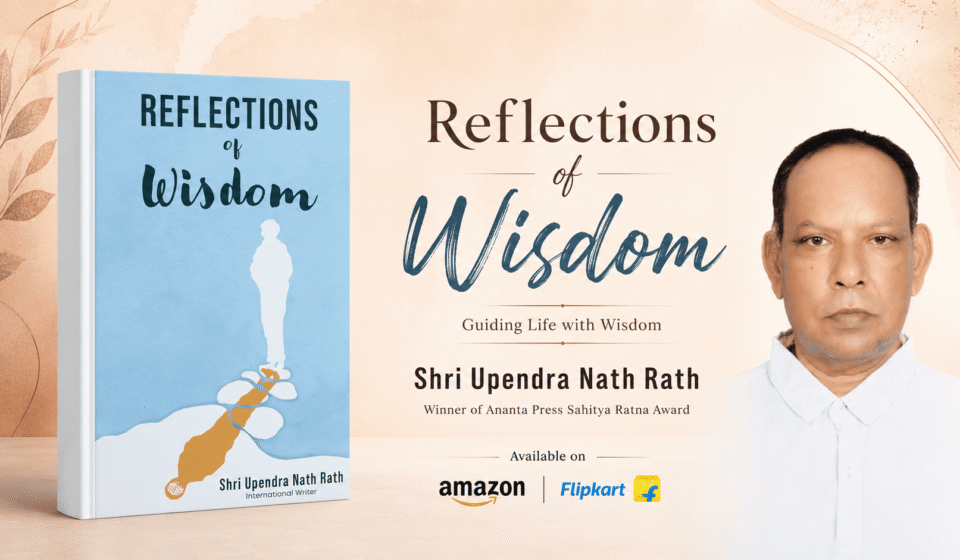

We live in an age of speed. Advice arrives in short videos, notifications compete for attention, opinions are delivered instantly, and people are encouraged to optimize nearly every part of life. In this environment, a book called Reflections of Wisdom makes a countercultural proposal: slow down enough to think about how you are living. Shri Upendra Nath Rath’s nonfiction work, centered on healthy lifestyle, manners, way of living, and social behavior, belongs to a quieter tradition of writing—one that values character, balance, experience, and social responsibility over novelty for its own sake.
The word “reflection” is important because reflection requires time. It is difficult to reflect while constantly reacting. Modern culture often asks, “What should I do next?” before asking, “Why am I doing what I am doing?” A reflective book creates room for the second question. It encourages a reader to examine habits that have become automatic and values that may have become merely verbal.
This quality gives Reflections of Wisdom a particular relevance for readers who feel overwhelmed by the pace of contemporary life. Healthy living is increasingly difficult when routines are fragmented. Manners become harder when communication is hurried. Social behavior becomes harsher when people interact through screens and public debates reward outrage. A thoughtful way of living becomes harder when success is measured mainly through productivity, income, visibility, or comparison. The book’s themes address these pressures at their roots.
One of its strongest ideas is implicit in the combination of its subjects: well-being is not one-dimensional. A healthy person is not simply someone who follows a diet or exercises. Health also involves rhythm, self-control, emotional steadiness, respectful relationships, and the quality of one’s environment. Similarly, good manners are not only decorative rules for special occasions. They are daily habits that make relationships less exhausting and public life more humane.
The author’s life gives these themes the weight of experience. Shri Upendra Nath Rath was born in Odisha and grew up with a strong affection for village atmosphere, plants, animals, birds, and nature. He pursued higher education across English, History, Political Science, Education, and Human Resource Development, then spent thirty-six years as an English teacher in Kendriya Vidyalaya. He also developed a long association with Scouts and Guides and conducted numerous training programs. This is the background of someone who has spent much of life thinking about learning, behavior, discipline, communication, and community.
Teaching for decades changes the way a person sees time. Teachers observe generations. They witness trends come and go while fundamental human needs remain: encouragement, boundaries, respect, attention, purpose, belonging. A book written from such a background can provide a useful antidote to advice that is fashionable but shallow. Reflections of Wisdom is rooted in themes that remain relevant regardless of technological change.
The author’s broad social activities reinforce this timelessness. He has participated in plantation programs, cleanliness drives, anti-polythene campaigns, unity rallies, support for disadvantaged people, assistance to fire victims, and free academic help for students. These actions point toward an idea of wisdom that is practical. Wisdom is not only what one says; it is what one repeatedly does. Service becomes a form of philosophy when it is sustained over years.
This is one reason the book can resonate with readers tired of self-help that feels excessively commercial or self-centered. Its subject matter suggests that a good life includes consideration for others. Personal development is incomplete if it produces only greater efficiency without greater empathy. Confidence without courtesy can become arrogance. Discipline without compassion can become rigidity. Success without social awareness can become isolation. Reflections of Wisdom, by bringing manners and social behavior alongside health, offers a more balanced moral vocabulary.
There is also a gentle ecological dimension to the author’s worldview. His love of flora and fauna and his leadership in plantation drives show that nature is not incidental to his idea of life. This matters because modern lifestyles often create distance from natural rhythms. People spend long hours indoors, consume rapidly, and experience the environment as background rather than relationship. A healthier way of living may require recovering attention to air, trees, animals, seasons, cleanliness, and shared surroundings. The author’s environmental work gives practical credibility to this concern.
The book’s social emphasis also feels timely in a period when loneliness and fragmentation are widely discussed. It is possible to be connected digitally and disconnected socially. Manners—greeting, listening, acknowledging, helping, thanking, respecting—may seem small, but they create human recognition. Social behavior is one of the everyday technologies of belonging. When it deteriorates, people can feel invisible even in crowded places. A book that reminds readers of these fundamentals is performing important cultural work.
Reflections of Wisdom can also be approached as a book about legacy. What does a person leave behind after a career, a title, or an award? The author’s biography includes recognition from educational and international bodies, participation in public service, publication, and even opportunities connected with major book events. Yet the deeper legacy suggested by this book is not a list of achievements. It is the transmission of values. Teachers leave impressions in students. Scout leaders leave habits in trainees. Community workers leave examples. Writers leave words that may continue to influence readers they never meet.
This gives the book an intergenerational quality. Older readers may recognize values they were taught and ask whether they still practice them. Younger readers may encounter those values in a form that encourages independent reflection rather than mere obedience. Parents and teachers may find language for conversations they want to have but do not always know how to begin. Community leaders may see reminders of the small behaviors that sustain trust.
The uniqueness of the book lies partly in its refusal to chase a narrow niche. It addresses life as a whole. Many contemporary books specialize intensely: productivity, fitness, communication, leadership, mindfulness, relationships. Specialization has benefits, but human beings do not live in isolated categories. The same person who wants better health may also need better social habits. The same professional who wants leadership skills may need humility and courtesy. The same student who wants academic success may need discipline and balance. Reflections of Wisdom recognizes this interconnectedness.
Readers should also appreciate the book for its potential to encourage repeated self-examination. Wisdom is not a destination reached once. A person can understand a principle and still fail to practice it under pressure. Manners are tested when we are tired. Patience is tested when we are angry. generosity is tested when giving is inconvenient. Healthy routines are tested when schedules become difficult. Social responsibility is tested when no one is watching. Reflection matters because it helps close the gap between intention and behavior.
The author’s experience with peace promotion provides a larger frame for this idea. Peace is often imagined as a global political condition, but it is built from local habits of coexistence. Families, classrooms, offices, neighborhoods, and online communities all depend on people’s ability to manage difference without dehumanizing one another. Courtesy, empathy, restraint, and fairness are therefore not merely private virtues. They are the social infrastructure of peace.
The book can be especially meaningful for readers in education. Schools are increasingly expected to prepare young people for an unpredictable future, yet the most durable preparation may still be character. Technology will change. Professions will change. Social platforms will change. But the need for self-discipline, respect, adaptability, cooperation, health, and responsibility will remain. A work centered on these values can therefore remain useful beyond a particular trend or decade.
The same is true for professional life. Workplaces often speak about culture, but culture is made from behavior. Do leaders listen? Do colleagues communicate respectfully? Are people reliable? Do they take responsibility? Do they treat support staff with dignity? Do they maintain healthy boundaries? Do they contribute to collective well-being? Reflections of Wisdom can encourage professionals to consider these questions at a human level rather than only as management concepts.
What I find most appealing about the book’s premise is its scale. It does not need to promise that every reader will transform overnight. The more believable promise is smaller: a reflection may change a habit; a habit may change a relationship; a relationship may change a household; a household may influence a community. Wisdom often spreads quietly. The author’s own life of teaching and service illustrates this cumulative pattern.
In a noisy age, quiet books can matter deeply. Reflections of Wisdom does not need to compete with sensational claims because its subject is permanent. People will always need to ask how to live well, how to treat others, how to care for themselves, how to contribute, and how to remain humane under pressure. These are questions that no technology can answer on our behalf.
For readers seeking thoughtful nonfiction grounded in values, education, service, healthy living, and social awareness, Reflections of Wisdom offers a meaningful invitation. It encourages a return to fundamentals—not as nostalgia, but as renewal. A society that forgets manners becomes harsher. A person who ignores health becomes weaker. A community that loses responsibility becomes fragmented. A life without reflection becomes automatic.
Shri Upendra Nath Rath’s book reminds readers that wisdom is often found by paying attention to what has always mattered. To live well is to live consciously. To be healthy is to seek balance. To have manners is to recognize dignity. To behave socially is to accept that one’s actions affect others. And to reflect is to give oneself the chance to improve. That is why Reflections of Wisdom stands out: it asks for no grand performance, only a more thoughtful life—and that may be one of the most demanding and valuable goals of all.Amazon / Purchase Link: https://share.google/vXOiJuSkHlGvVx2ny