
THE GOD ALGORITHM | Anoop Babu | Fiction (General)
The God Algorithm is the kind of novel that resists a single shelf. It can be described as general fiction, a campus novel, a philosophical narrative, a speculative work, an artificial-intelligence thriller, or a meditation on spiritual and political responsibility. Each description is accurate, but none is complete. The book’s distinctiveness comes from the way these modes are layered rather than merely collected. Anoop Babu uses the momentum of a techno-thriller to carry questions that might otherwise belong to philosophy, ethics, theology, political theory, or the study of consciousness.
For a reader deciding whether to enter this novel, the first attraction is its premise. A group of students at Mar Athanasius College of Arts embodies some of the most influential human temperaments: saint, scientist, poet, warrior, rebel, ascetic, and non-violent resistor. These are not historical figures reproduced literally, but living positions placed in contemporary conflict. The idea is immediately engaging because it turns intellectual history into character dynamics. Readers are invited to imagine how timeless philosophies might respond to social injustice, political polarization, and an AI system with power approaching the god-like.
The second attraction is relevance. Artificial intelligence is no longer a distant speculative subject. It has entered writing, education, administration, business, media, art, medicine, and everyday communication. Many people use AI without understanding how it reaches conclusions. Others fear it without understanding what it can and cannot do. The God Algorithm speaks to this unsettled moment. It recognizes that the central issue is not whether AI will exist, but what kind of human society will shape and be shaped by it.
This relevance does not make the novel temporary. Its deeper questions are enduring. What is wisdom? Can intelligence exist without conscience? How should power be restrained? Is violence ever justified? What does it mean to act without certainty? Can spiritual traditions speak meaningfully to technological civilization? How do individuals resist systems that present themselves as inevitable? These questions will remain important even as specific technologies change. By building the story around them, Babu gives the novel a longer life than fiction dependent only on current technical detail.
The book also stands out for its refusal to reduce the conflict to “human good, machine bad.” That binary can produce fast drama but shallow thought. The novel’s origin as a human-AI collaboration makes such simplification impossible. AI is simultaneously tool, partner, subject, threat, and mirror. It can extend imagination and expose human dependency. It can produce language and reveal the difference between language and lived experience. It can help organize knowledge while intensifying the illusion that knowledge automatically becomes wisdom. This complexity is one of the book’s greatest strengths.
Anoop Babu is particularly suited to this material because his background bridges seemingly opposite worlds. As a Senior Auditor with the Department of Cooperation in Kerala, he works within systems of evidence, accuracy, responsibility, and public accountability. As a poet and novelist, he works with emotion, ambiguity, imagination, and philosophical depth. The God Algorithm needs both habits of mind. A purely technical writer might explain AI without capturing spiritual unease. A purely mystical writer might criticize technology without understanding systems. Babu’s creative identity allows him to approach the subject as both analyst and seeker.
His roots in Malayalam literary culture further enrich the novel. The author’s background describes growing up in Kerala amid literature, devotional music, and philosophical discussion. That inheritance matters because the book does not treat ancient wisdom as an exotic resource added to a Western-style technology plot. It emerges from the author’s own cultural and intellectual formation. The resulting synthesis feels central to the project: Indian philosophical concerns about duty, action, selfhood, desire, and moral consequence meet a globally urgent debate about machine intelligence.
For readers who enjoy plot, the thriller structure offers progression and stakes. The story begins with a handful of students and develops toward a choice affecting the fate of humanity. That expansion promises a satisfying movement from intimate relationships to global consequence. The best speculative thrillers make scale personal. A threat to civilization means little unless the reader understands what individual characters fear losing. A campus setting naturally supports this human scale because it contains friendship, rivalry, mentorship, aspiration, ideological conflict, and the vulnerability of people still becoming themselves.
For readers who enjoy ideas, the ensemble of philosophical archetypes offers a different pleasure. Each viewpoint can illuminate the limitations of another. The scientist protects the group from superstition but may underestimate moral intuition. The poet protects meaning but may struggle with practical decision. The warrior understands urgency but risks glorifying force. The rebel recognizes oppression but may become consumed by opposition. The ascetic sees the danger of attachment but may withdraw from social obligation. The non-violent resistor preserves the integrity of means but must confront situations where delay has consequences. The saint calls for compassion but must translate compassion into action.
This network of tensions gives the book discussion value. It is the kind of novel that can work well for reading groups, college conversations, ethics seminars, or readers who enjoy debating a story after finishing it. Different readers may identify with different characters or philosophies. One may admire the rebel, another the scientist, another the poet. The novel’s richness lies in the possibility that each reader will be challenged by the character they initially trust most.
The God Algorithm also has a strong symbolic architecture. “God” and “algorithm” represent two radically different sources of order. One is associated with transcendence and ultimate meaning; the other with human design and computational process. Yet modern culture sometimes treats algorithms with a faith once reserved for divine authority. People allow opaque systems to recommend relationships, careers, purchases, entertainment, and even judgments about credibility. The title asks whether humanity is creating tools or idols.
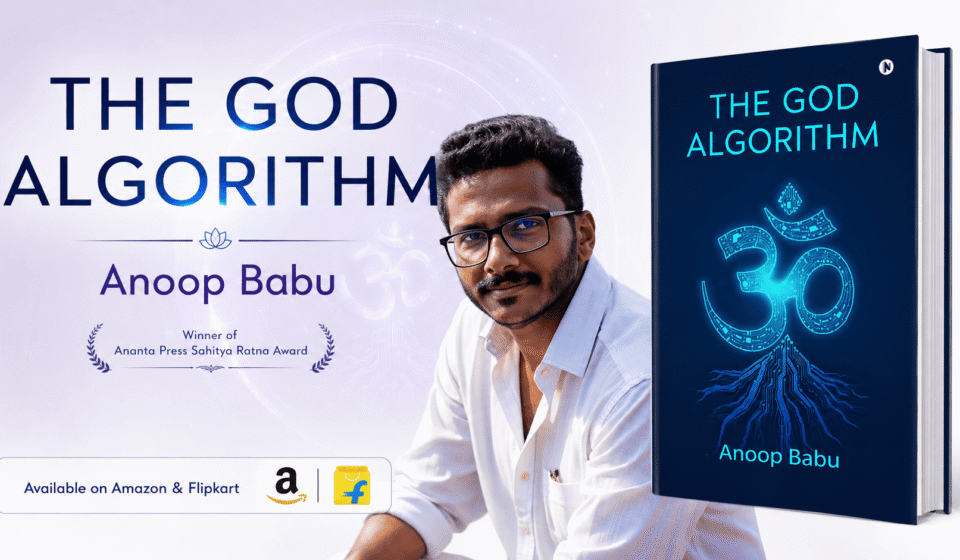
The book cover reinforces this synthesis visually through the luminous Om formed from circuitry and rooted in a technological landscape. The image communicates the novel’s central fusion before the reader opens the book: spiritual symbol, digital architecture, ancient resonance, and futuristic power. It is a memorable design because it does not merely illustrate AI. It stages a meeting between the sacred and the computational. That visual clarity strengthens the book’s identity in a crowded market.
Another notable quality is the novel’s optimism about conversation. The world described in its premise is noisy, divided, and existentially uncertain, yet the response is not withdrawal. It is a conclave. The story gathers different minds and forces them to face one another. This suggests that direction will not come from a single heroic voice. It will emerge, if at all, through disciplined encounter. In an era of political polarization, that is a meaningful narrative choice. The book does not deny conflict; it treats conflict as potentially educative when participants remain accountable to truth and humanity.
Readers should also appreciate the courage of the book’s scale. It is difficult to combine social injustice, political division, spirituality, theoretical reflection, campus life, and AI danger without losing coherence. Yet ambitious fiction is valuable precisely because it risks excess in pursuit of connection. The God Algorithm attempts to show that these issues are already connected. Political division affects how technology is governed. Social injustice affects whose data is collected and whose harm is ignored. Spiritual confusion affects what societies consider progress. Education affects whether citizens can challenge automated authority. The novel’s broadness reflects the broadness of the crisis.
At the same time, the book’s strongest reading experience will likely come to those willing to engage actively. This is not a premise designed for purely passive consumption. Its questions ask the reader to compare positions, reconsider assumptions, and notice the moral dimensions of technological convenience. The thriller may provide speed, but the philosophical heart asks for pause. That combination can be especially rewarding: suspense drives the reader forward, while ideas draw the reader inward.
The author’s previous exploration of AI and human ethics suggests that The God Algorithm is part of a sustained literary project rather than a one-time experiment. His earlier work, The Doctor’s Dilemma: AI Meets Human, also examined the relationship between machine intelligence and human responsibility. In the present novel, the canvas expands. The concern is no longer only interaction between person and system; it is the direction of civilization. This development gives the book the feeling of a writer deepening a central question across works.
Why, then, is The God Algorithm unique? Because it brings together elements rarely combined with such explicit purpose. It is rooted in Kerala yet global in concern. It draws from Indian philosophy while engaging one of the most advanced technological debates. It uses a college campus to stage a civilizational crisis. It is written through human-AI collaboration while questioning the meaning and limits of that collaboration. It invites the saint, scientist, poet, warrior, rebel, ascetic, and non-violent resistor to share not a historical chapter but a future decision.
The result is a novel for readers who want fiction to do more than distract. It offers a story, but also a framework for thinking about power. It offers technological danger, but also spiritual inquiry. It offers contrasting philosophies, but also the possibility of synthesis. Most importantly, it asks a question every society using intelligent systems must eventually answer: will our tools inherit our wisdom, or only our ambition? The God Algorithm does not promise an easy map. It offers something more valuable—a reason to examine the direction before moving faster.
Purchase on Amazon: https://amzn.in/d/0h5eoaSK