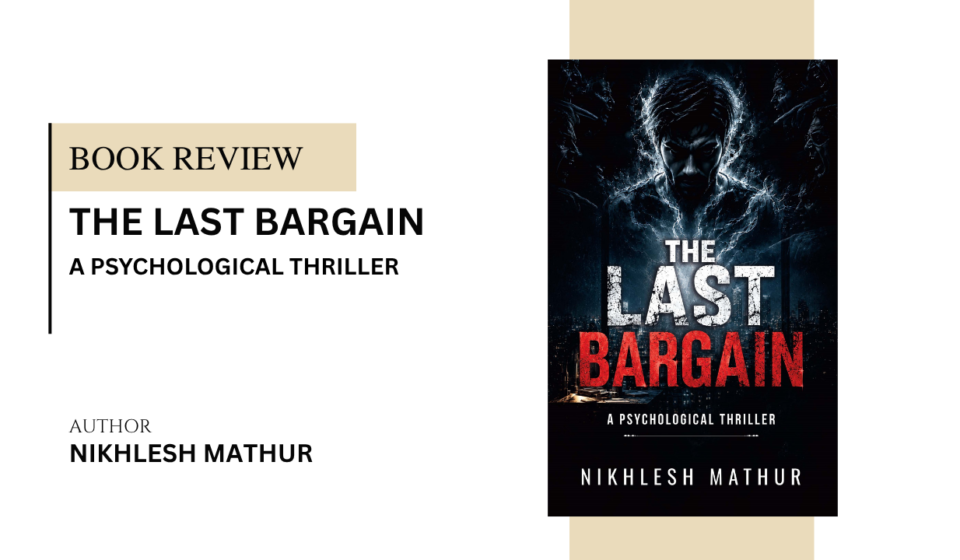
Power, Humiliation and Retribution: A Critical Review of Nikhlesh Mathur’s The Last Bargain

Many thrillers begin with a crime. The Last Bargain begins with something more ordinary and, in its own way, more dangerous: humiliation.
Nikhlesh Mathur’s protagonist VK has spent years collecting small injuries to his pride. He is ridiculed at work, dominated by stronger personalities, bullied by an old acquaintance and painfully conscious that even his wife does not regard him as a particularly courageous man. These experiences do not disappear after they happen. They accumulate.
That accumulation is what makes the novel psychologically interesting.
VK does not initially dream of saving the world. He dreams of not being weak anymore.
The difference matters.
His antagonist Mahendra represents one obvious source of humiliation. Strong, aggressive and verbally cruel, he repeatedly mocks VK and has little difficulty physically overpowering him. VK privately fantasises about defeating him but knows that he lacks the strength to do it. His resentment eventually becomes one of his strongest desires.
And then, inexplicably, that desire seems to become reality.
The same timid VK suddenly attacks Mahendra with extraordinary physical confidence. More troublingly, VK later appears to have been sleeping at home during the very hours when these actions occurred.
This is where Mathur transforms a familiar story about an oppressed man retaliating against his tormentors into a much stranger examination of desire and responsibility.
If a hidden part of you performs an act that your conscious self secretly wanted to perform, are you innocent?
That question quietly follows VK through the novel.
It becomes increasingly difficult because the people around him are not presented as abstract villains. They are connected to his everyday life. Rana is his superior. Sahani is his colleague. Mahendra belongs to his past. Sareeta is his wife. Ruhani is the woman toward whom he develops increasingly complicated feelings.
This proximity gives the violence a personal quality.
VK’s relationship with Sareeta is particularly uncomfortable and therefore narratively useful. Their marriage contains affection, sexual frustration, resentment, guilt and failed communication. Sareeta’s jokes about VK’s weakness repeatedly wound him, but the book later complicates the first impression of her. She is not simply the mocking wife assigned to make the protagonist miserable. She worries about him, attempts to rebuild their relationship and becomes one of the few people capable of understanding how strange his condition truly is.
Ruhani occupies a very different emotional space. VK sees her as an escape from the disappointment he associates with married life. His attraction to her is not innocent; the manuscript openly acknowledges his fantasies and his awareness that pursuing them would amount to adultery.
Yet Mathur eventually gives Ruhani a more substantial function. She investigates the suspicious activities surrounding scientist Rajshekaran and discovers evidence about a series of human experiments. This shift is important because it prevents the novel from remaining merely a domestic triangle wrapped around a thriller.
Rajshekaran changes the scale of the story.
His experimental programme introduces the possibility that VK’s bizarre experiences have been intensified—or even made possible—by scientific interference. VK becomes involved in trials using a dangerous compound, eventually discovering that several previous subjects have died while others were classified as unstable and terminated. VK is Subject 009, apparently the first unusually viable subject.
The experiment supposedly produces a dissociative condition in which consciousness can function separately from the body.
It is an audacious premise.
Mathur does not treat it as hard science fiction in the conventional sense. Instead, the concept becomes a bridge between biology and older spiritual ideas about the body and soul. Medical readings, physical evidence and laboratory experiments sit beside scenes that appear impossible under normal explanations.
The ambiguity gives the story its distinctive character.
At one point, while VK is hospitalised, medical equipment apparently records an extended flatline even though he later appears alive and relatively stable. Sareeta’s interpretation is immediate: perhaps his soul had once again left the body.
A laboratory may describe the event as neurological dissociation. A spiritual explanation might call it separation of soul and body. The novel deliberately allows these languages to overlap.
But the science-fiction premise is not the book’s only concern.
The story also develops into a critique of power. Rajshekaran’s research has backing. Political figures have interests to protect. Evidence does not automatically lead to justice because institutions themselves can be manipulated. Sahebji, the influential political figure in the novel, demonstrates how information can be suppressed and inconvenient events reframed when people in authority need them to disappear. Even Rajshekaran’s death is eventually absorbed into a manufactured public story while his research continues to remain valuable to others.
That detail strengthens the title.
The “bargain” is not only VK’s.
Almost everyone in the novel is bargaining with something: ambition, morality, loyalty, science, political influence, personal desire or survival.
VK’s bargain, however, remains the most intimate. He desperately wants the ability to answer those who have humiliated him. Once he receives something resembling that power, revenge becomes frighteningly easy.
The most revealing moment comes when VK recognises that he has not simply become like the people he despised. In his own estimation, he has become worse.
That realisation is essential because it prevents The Last Bargain from being read merely as wish fulfilment. The novel understands the appeal of revenge but refuses to pretend that revenge repairs humiliation.
Stylistically, the book favours movement over stillness. Chapters frequently introduce new clues, confrontations, discoveries or reversals. Police investigations run alongside VK’s personal struggles; scientific revelations interrupt domestic tensions; and political intrigue gradually expands what initially appears to be one man’s mysterious psychological problem.
Readers who enjoy genre purity may find it difficult to classify. Readers who enjoy cross-genre storytelling may consider that one of its strengths.
At different moments, The Last Bargain resembles a revenge drama, a murder mystery, a psychological thriller, a medical conspiracy novel and a supernatural story.
Underneath all of them, however, lies a surprisingly human concern.
What happens to a person who spends years being told that he is powerless?
And what happens if, one day, something finally answers his wish?
Mathur’s novel suggests that the second question may be far more dangerous than the first.
Title: The Last Bargain
Author: Nikhlesh Mathur
Publisher: Evincepub Publishing
Buy book on Amazon