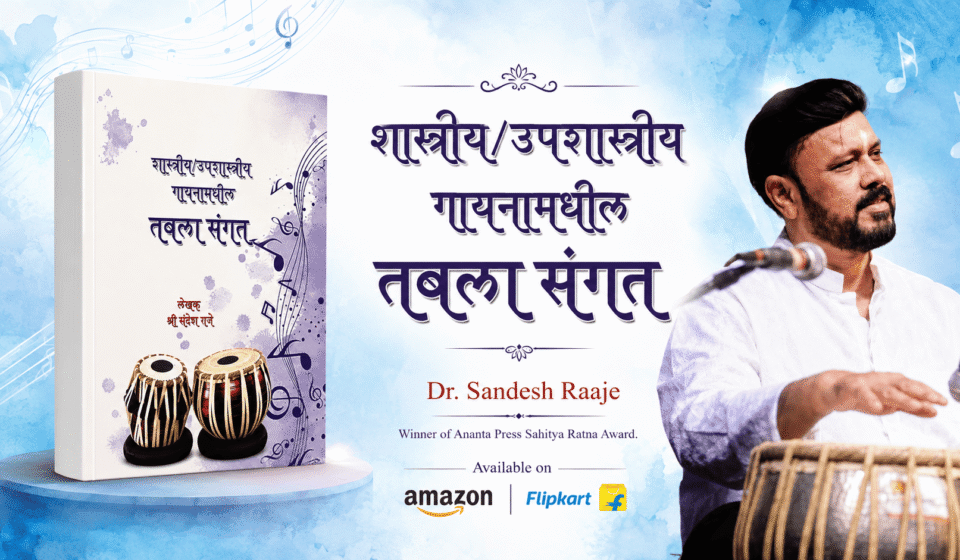

The most valuable specialist books are often those that take a familiar subject and reveal an aspect of it that deserves far more attention. Dr. Sandesh Raaje’s “Shastriya/Upashastriya Gayanamadhil Tabla Sangat” does exactly that. Tabla is one of the most recognized instruments in Hindustani music, and a substantial body of literature already discusses its history, structure, technique, compositions, and solo traditions. Yet the instrument’s role as an accompanist—particularly in classical and semi-classical vocal music—contains its own artistic challenges. By making that role the center of his book, Dr. Raaje offers readers a focused and useful contribution.
The book is especially significant because accompaniment is one of the places where musical knowledge is tested in real time. A student can learn a tala correctly, memorize compositions, and develop excellent technique, but accompanying a vocalist demands much more than reproducing learned material. The player must listen continuously. The tempo must be stable but never stiff. The rhythmic texture must have life but not become distracting. Variations have to suit the moment. The accompanist must understand when the vocalist needs space, when energy should increase, and how to support points of arrival. The quality of these decisions separates functional accompaniment from artistic accompaniment.
Dr. Raaje writes from a background that makes this subject especially meaningful. He belongs to a family with a strong tradition of tabla and pakhavaj, and he studied for twenty-eight years under the legendary Pt. Bhai Gaitonde, recipient of the Sangeet Natak Akademi Award. Long discipleship under a master musician is one of the most important sources of practical knowledge in Indian classical music. It provides access not only to repertoire but to musical values—how to listen, how to behave on stage, how to accompany different artists, and how to think about one’s responsibility within the tradition.
The author’s formal accomplishments add another dimension. His qualifications include a B.Com from Mumbai University, a Master of Performing Arts from Shivaji University, Kolhapur, B High grade from All India Radio, and Sangeet Alankar from ABGMV. He has also received the Rashtriya Gaurav Award from IIFS Delhi and an honorary doctorate in Music and Performing Arts from WCAEPC Delhi. These achievements show that his musical life has crossed traditional, academic, and institutional settings. That breadth is useful for an author attempting to explain an applied performance subject to different kinds of readers.
One of the book’s strongest qualities is its clearly defined purpose. Dr. Raaje does not ignore earlier tabla literature. He openly recognizes the important work already done by stalwarts who have written about the instrument’s evolution, creation, construction, structure, compositions, and related areas. His contribution begins from a question: has the subject of tabla accompaniment, especially in Hindustani classical and semi-classical singing, been explored as deeply and illustratively as it deserves? The book is his effort to answer that need.
This focused intention makes the volume useful to several audiences. For tabla students, it can help transform technical training into performance awareness. For active accompanists, it can encourage self-reflection about choices on stage. For teachers, it can offer a basis for explaining principles that are often taught orally. For vocalists, it can deepen understanding of the rhythmic partner’s responsibilities. For general music lovers, it can reveal why two accompanists playing the same tala may create very different musical experiences.
The book’s subject also encourages a more mature understanding of virtuosity. In percussion, virtuosity is often associated with speed, complexity, clarity, and command of repertoire. These qualities are certainly important. But accompaniment introduces another kind of virtuosity: restraint. To play exactly what the music needs—and no more—is difficult. To keep theka vibrant without drawing unnecessary attention is difficult. To respond to an improvising vocalist without sounding pre-planned is difficult. To support a lyrical semi-classical passage with sensitivity is difficult. Such refinement may be less dramatic than a solo display, but it is central to professional musicianship.
This is one reason the book can be important for younger players. Contemporary learners have access to vast amounts of video content and short-form teaching. They can quickly encounter impressive compositions and advanced techniques. What is harder to obtain from fragmented media is a coherent philosophy of accompaniment. A book gives the subject continuity. It allows the learner to pause, reflect, compare ideas with actual listening, and return to concepts after gaining more stage experience.
The inclusion of semi-classical music broadens the scope in a meaningful way. Semi-classical forms bring their own expressive priorities and may require different rhythmic behavior. A tabla player who has learned to accompany one vocal genre cannot assume that the same density, touch, or style will work everywhere. The accompanist must understand character. This adaptability is one of the marks of a sensitive musician, and the book’s coverage can help readers think beyond one standardized approach.
The work also demonstrates the value of documentation in an oral tradition. Hindustani music is sustained through direct teaching, listening, repetition, and performance. None of that can be replaced by text. But writing can preserve observations and organize experience. It can help students recognize patterns in what they hear from their gurus and senior artists. It can also make specialized knowledge available to readers who may live far from major centers of training.
Dr. Raaje’s motivation gives the book an emotional and ethical dimension. He describes how his family’s musical legacy, the teaching of his guru, and association with many artists created a sense of social, moral, and artistic bonding with the field. That sense of belonging led him to think about how he could contribute. The book emerges from that desire. Seen in this light, it is an offering back to the tradition rather than merely a professional publication.
There is an additional reason the subject matters: accompaniment teaches musicians how to share artistic space. The tabla player has an individual voice, but that voice must function within a larger whole. Good accompaniment requires humility, confidence, attentiveness, and timing. These are musical virtues, yet they are also human qualities. A successful concert depends on mutual trust. The accompanist must trust the vocalist’s direction, and the vocalist must trust the rhythmic foundation. When this relationship works, the audience experiences coherence.
Readers who are primarily music lovers may find the book changes how they listen. Once one becomes aware of the accompanist’s role, many details become audible: the subtle shift in energy as the vocalist approaches sam, the way theka is shaped according to tempo, the decision to remain simple during an expressive line, or the tasteful answer that completes a musical thought. Appreciation deepens because the listener starts hearing intention rather than merely sound.
The book also has long-term value for music education. It can be used in formal courses, private teaching, workshops, or independent study. A teacher might assign a concept from the book and ask students to observe several concerts. A student could maintain listening notes on how different accompanists handle similar situations. A vocalist could study the material to improve rhythmic communication. In this way, the book can become not only something to read but something to work with.
What makes “Shastriya/Upashastriya Gayanamadhil Tabla Sangat” stand out is therefore the combination of specialization, experience, and purpose. It does not try to cover every aspect of tabla. Instead, it takes one essential function and treats it as worthy of dedicated attention. That focus is a strength. The author’s lineage, long training under Pt. Bhai Gaitonde, academic qualifications, and commitment to musical service give the subject credibility and warmth.
For anyone who believes that accompaniment is merely secondary to the main performance, this book offers an important correction. Accompaniment is a discipline in its own right. It requires knowledge, discipline, aesthetic judgment, adaptability, and deep listening. The tabla player must understand both rhythm and relationship. Dr. Sandesh Raaje’s book brings that reality to the forefront and, in doing so, contributes something genuinely useful to tabla education and Hindustani music literature. It is a book with relevance for students today and with the potential to remain meaningful as future generations continue to learn the refined art of supporting the human voice through rhythm.