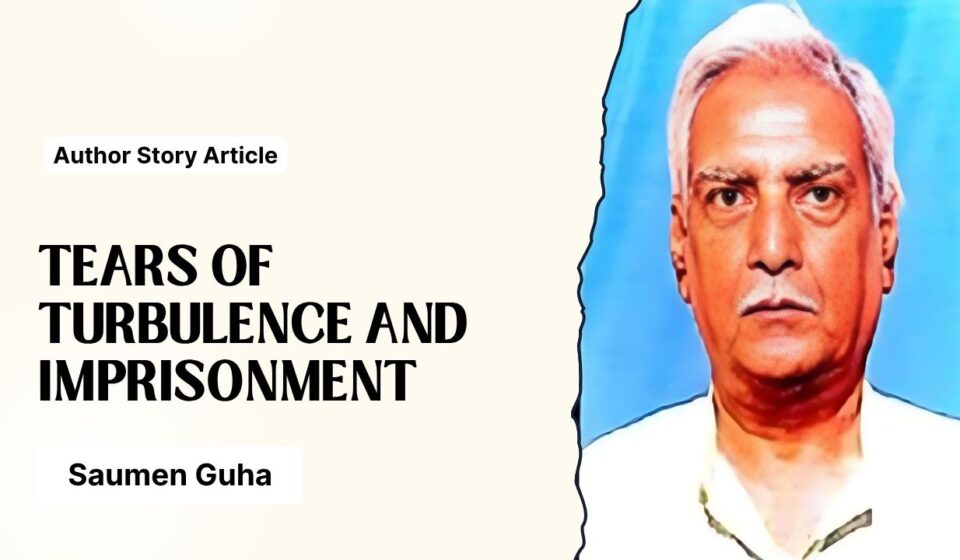

Title: Tears of Turbulence and Imprisonment
Author: Saumen Guha
ISBN: 9789373356594
Publisher: Evincepub Publishing
Poetry often becomes most powerful when it emerges from real life experiences. Some poets write from imagination, while others write from the depths of pain, struggle, hope, and personal history. Saumen Guha belongs to the second category. His poetry collection Tears of Turbulence and Imprisonment is not merely a book of poems. It is a reflection of a remarkable life shaped by displacement, poverty, political struggle, imprisonment, and an unending search for justice and humanity.
Saumen Guha’s journey began in 1947 in East Pakistan, which is now known as Bangladesh. Like countless families during those turbulent years, his family experienced displacement and uncertainty. Eventually, they settled in West Bengal as refugees. Life as a refugee was not easy. Poverty was a constant companion during his childhood. Growing up under difficult circumstances, young Saumen learned early that life could be harsh and unforgiving. Yet, these struggles also gave him an uncommon sensitivity towards human suffering. The experiences of deprivation, insecurity, and social inequality deeply influenced his thinking and later found expression in his writings.
Although literature would eventually become an important part of his life, Saumen Guha initially pursued science and engineering for his livelihood. He received formal training in these fields and secured a respectable position as an Engineering Overseer in the Calcutta Metropolitan Development Authority. For many, such a job would have been the fulfilment of personal ambitions. However, Saumen was not satisfied with a comfortable professional life while witnessing widespread poverty and injustice around him. The social realities he had observed since childhood continued to disturb him. He felt compelled to engage directly with the struggles of ordinary people.
In 1970, he took a life-changing decision. He left his government job and chose to work among poor peasants in rural areas as part of the Communist revolutionary movement popularly known as the Naxalite movement. This decision transformed the course of his life forever. It was a path filled with sacrifice, danger, and uncertainty. Yet, for Saumen Guha, commitment to social change was more important than personal comfort. His political beliefs were rooted in the dream of a more equal and just society. This dream would eventually bring severe consequences.
The early 1970s were among the most turbulent years in West Bengal’s political history. The state witnessed intense conflict between revolutionary groups and the government. In 1974, because of his political involvement, Saumen Guha and several members of his family, including his wife, were arrested. They were subjected to brutal torture by the police and remained imprisoned for three years. Such experiences can break the spirit of many individuals. Yet, in Saumen Guha’s case, suffering strengthened his determination rather than weakening it.
The poems included in Tears of Turbulence and Imprisonment carry the emotional weight of these experiences. The title itself suggests a journey through conflict, sorrow, and resilience. The collection includes poems on varied themes and emotions. Some are English versions of earlier poems written by the author, while others emerge directly from social realities, revolutionary ideals, and deeply personal experiences. Particularly moving are the poems written during imprisonment in the 1970s. These poems provide readers with a rare glimpse into the inner world of a prisoner who endured physical and emotional hardship yet refused to surrender hope.
What makes this collection unique is its wide emotional range. The poems are not confined to political themes alone. Love, loneliness, memory, friendship, loss, hope, faith, and self-reflection also occupy important places in the collection. In many poems, readers encounter an individual searching for meaning amidst suffering. There are moments of despair, but there are also moments of tenderness and beauty. This balance gives the collection its human warmth.
Several poems reveal the poet’s deep attachment to humanity and relationships. Even in the darkest situations, Saumen Guha continues to search for compassion, love, and understanding. His poetry frequently returns to memories, lost dreams, and unanswered questions. Yet these reflections are never merely personal. They often connect individual experiences with larger social realities. Through this approach, the poet transforms private pain into a universal human experience.
Another important aspect of the collection is its social and revolutionary consciousness. Saumen Guha’s life as a political activist naturally influences his literary voice. Many poems question injustice, oppression, and social inequality. The poet repeatedly expresses solidarity with ordinary people, workers, peasants, and those living on the margins of society. His poetry reflects a deep concern for human dignity and freedom. Even when expressing personal sorrow, the poet remains aware of the collective suffering around him.
However, Tears of Turbulence and Imprisonment should not be viewed merely as political poetry. The collection also demonstrates Saumen Guha’s philosophical temperament. Many poems explore questions related to existence, truth, mortality, memory, and the human soul. The poet often reflects upon life’s uncertainties and contradictions. These meditative qualities add depth to the collection and invite readers to engage with the poems on multiple levels.
The author’s long association with literature, music, painting, and intellectual pursuits is clearly visible throughout the collection. Saumen Guha is not only a poet but also an essayist, editor, painter, and music lover. Over the years, he has written extensively on diverse subjects including human rights, films, music, socio-economics, literary biography, and environmental concerns. This wide range of interests enriches his poetry. His verses frequently combine personal experience with historical awareness, artistic imagination, and social observation.
One cannot discuss Saumen Guha’s life without mentioning the historic Archana Guha Case. He is widely recognised as the architect of this internationally significant legal battle against torture in police custody. The case, regarded as one of the world’s longest struggles for justice, represents his lifelong commitment to human rights. Even decades after the original events, he continues his crusade for justice. Such perseverance reflects extraordinary courage and moral conviction. It also explains why themes of justice, dignity, and resistance appear so strongly in his poetry.
Tears of Turbulence and Imprisonment is the author’s second book of English poems, following Deep in the Broken Words. While the earlier collection introduced readers to his poetic voice, this second volume further establishes him as a writer whose work is deeply rooted in lived experience. The poems do not attempt to impress readers through complex language or elaborate literary techniques. Instead, they communicate through honesty and emotional sincerity. This simplicity allows readers from different backgrounds to connect with the poems.
The collection also serves as a valuable historical and cultural document. Through these poems, future generations can gain insights into a significant period of Indian political history and understand the emotional consequences of ideological struggles and state repression. At the same time, the poems remind readers that behind every historical event are real human beings with dreams, fears, relationships, and emotions.
Perhaps the greatest strength of Saumen Guha’s poetry lies in its authenticity. The poems are born from real experiences. They carry the voice of someone who has witnessed poverty, displacement, imprisonment, and injustice firsthand. Yet they also carry the voice of someone who continues to believe in humanity, love, and hope. This combination of pain and resilience gives the collection its lasting impact.
In an age when much writing often remains detached from lived realities, Tears of Turbulence and Imprisonment stands apart as a deeply personal and socially relevant work. It invites readers not only to appreciate poetry but also to reflect upon human suffering, resistance, and the enduring strength of the human spirit.
Saumen Guha’s life story itself reads like an extraordinary narrative of courage and conviction. Through this collection, he transforms that life into poetry, ensuring that memories of struggle are not forgotten. His poems remind us that even in times of turbulence and imprisonment, the human spirit can continue to dream, resist, create, and hope.