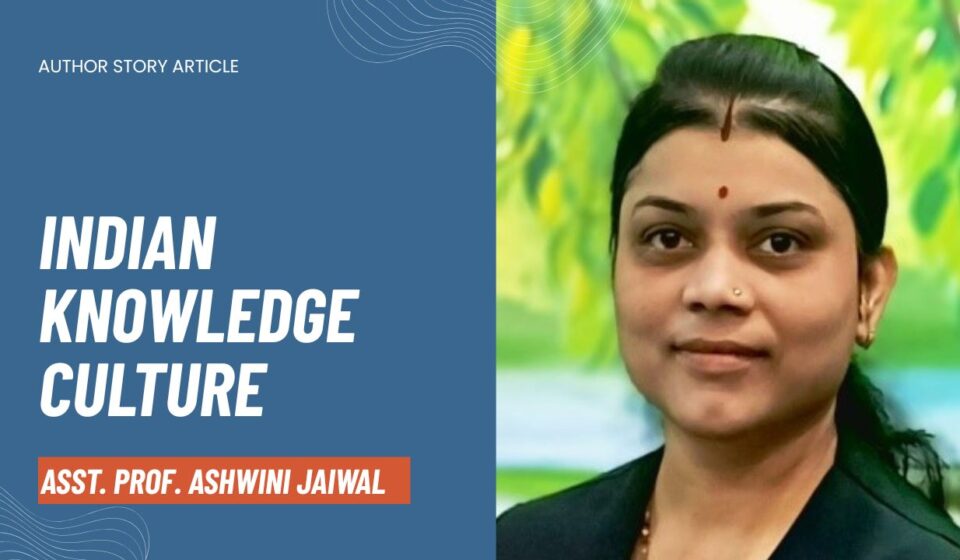
From Tradition to Transformation: The Educational Vision of Asst. Prof. Ashwini Jaiwal

Title: Indian Knowledge Culture
Author: Asst. Prof. Ashwini Jaiwal
ISBN: 9789373359717
Publisher: Evincepub Publishing
Education is not only about classrooms, books, and examinations. True education has the power to transform individuals, societies, and even nations. It can challenge old beliefs, create equal opportunities, and inspire future generations to build a better world. This belief lies at the heart of Indian Knowledge Culture: Education, Society and Global Transformation, a thoughtful and meaningful work by Asst. Prof. Ashwini Shivaji Jaiwal.
The book reflects the author’s deep understanding of education, social justice, inclusive growth, and sustainable development. More importantly, it reflects a lifetime of dedication to teaching, research, and nation-building. Through this work, Asst. Prof. Ashwini Jaiwal presents not just academic ideas, but a vision for a more equitable and peaceful society.
For over thirteen years, Asst. Prof. Ashwini Shivaji Jaiwal has been serving as an Assistant Professor at Foster Developments B.Ed. College, Chhatrapati Sambhajinagar. During these years, teaching has become much more than a profession for her. It has become a mission to shape future teachers and prepare them to face the challenges of modern education.
Her educational background itself speaks about her passion for learning. Holding Master’s degrees in English, History, and Political Science, along with B.Ed., M.Ed., and SET qualification in Education, she has built a strong academic foundation across multiple disciplines. This diverse educational journey has enabled her to understand education from various perspectives and connect historical wisdom with present-day realities.
As an educator, she has always believed that teaching is a continuous process of learning. Every classroom interaction, every student question, and every discussion with colleagues has contributed to her growth as a teacher and researcher. These experiences have also inspired many of the themes explored in her latest book.
Indian Knowledge Culture: Education, Society and Global Transformation is not a book confined to a single topic. Instead, it is a comprehensive exploration of several important issues that influence education and society today. It discusses Indian Knowledge Systems, academic leadership, student diversity, inclusive education, women’s empowerment, stress management, environmental concerns, world peace, and contemporary global challenges.
One of the most remarkable aspects of the book is its attempt to bridge the wisdom of the past with the needs of the present. In a rapidly changing world dominated by technology and globalization, there is often a tendency to overlook traditional knowledge systems. However, Asst. Prof. Ashwini Jaiwal reminds readers that India’s rich intellectual heritage still holds valuable lessons for modern society.
The author strongly believes that traditional wisdom and modern science should not be viewed as separate entities. Instead, they should complement each other. By combining ancient knowledge with contemporary educational practices, societies can create sustainable and inclusive models for development.
This approach is particularly relevant in today’s world, where nations are facing complex challenges such as climate change, social inequality, mental stress, and global conflicts. The book encourages educators, policymakers, and researchers to think beyond conventional boundaries and search for integrated solutions.
A significant inspiration behind this work comes from the classroom itself. As a teacher educator, Asst. Prof. Ashwini Jaiwal has closely observed the changing nature of students and educational institutions. She has witnessed the diversity that exists within classrooms, where students come from different social, cultural, economic, and educational backgrounds.
These experiences motivated her to write extensively about student diversity and inclusive education. She believes that every learner deserves equal opportunities, irrespective of caste, gender, language, ability, or social status. Inclusive education is not merely about admitting diverse students into classrooms. It is about creating an environment where every learner feels respected, valued, and supported.
Her concern for diverse learners reflects her broader commitment to social justice. Throughout the book, readers can see a consistent emphasis on equality, empowerment, and human dignity.
The influence of great social reformers, especially Mahatma Jyotirao Phule and Savitribai Phule, is also clearly visible in her writing. The author draws inspiration from their lifelong struggle for education, equality, and social reform.
Mahatma Phule considered education as the most powerful tool for social transformation. He believed that education could eliminate social evils and create a just society. Asst. Prof. Ashwini Jaiwal carries forward this vision by highlighting the continuing relevance of Phule’s educational philosophy in modern India.
The author emphasizes that education should not be limited to the transmission of information. Instead, it should encourage critical thinking, social awareness, and ethical values. According to her, education must empower learners to question injustice and contribute positively to society.
Another important theme explored in the book is women’s empowerment. Despite significant progress, women continue to face numerous social and educational challenges. Through her writings, the author highlights issues related to gender inequality, educational disparities, and women’s safety.
However, rather than presenting only problems, she also focuses on solutions. She believes that education remains the strongest instrument for empowering women and ensuring their active participation in social and economic development. An educated woman strengthens not only herself but also her family, community, and nation.
Her commitment to empowerment is evident not only in her writing but also in her professional activities. Over the years, she has actively conducted workshops aimed at improving communication skills, teaching skills, and digital literacy among students. These initiatives demonstrate her belief that education must prepare learners for real-world challenges.
The role of technology in education is another area that deeply interests Asst. Prof. Ashwini Jaiwal. In today’s digital age, technology has become an essential component of teaching and learning. Recognizing this reality, she has consistently promoted the effective use of digital tools in educational settings.
She has organized various workshops to help students and teacher educators develop digital competencies. Her efforts reflect an understanding that modern educators must be equipped not only with subject knowledge but also with technological skills.
At the same time, she advocates for a balanced approach. Technology, according to her, should support educational objectives rather than replace the human values that form the foundation of teaching.
Research has always played an important role in her academic journey. With fifteen research papers published in international journals, she has contributed significantly to educational scholarship. Her active participation in national conferences based on the National Education Policy 2020 further highlights her commitment to academic excellence and educational reform.
She has also attended Faculty Induction Programmes focused on NEP 2020 and continues to guide teacher educators in understanding and implementing the policy effectively. This involvement demonstrates her dedication to keeping herself updated with emerging educational trends and national priorities.
Recognition for her work has come in many forms. She has received national awards for innovative contributions to education. In addition, she was granted a patent by the Government of India for a device designed to assist examinations. Such achievements showcase her creativity, innovation, and problem-solving abilities.
Her active participation in NAAC accreditation processes further reflects her dedication to institutional quality enhancement. She understands that educational excellence requires continuous evaluation, improvement, and accountability.
Apart from academic publications, Asst. Prof. Ashwini Jaiwal has also contributed articles to prestigious newspapers on educational, cultural, and social issues. Through these writings, she has extended her influence beyond academic institutions and engaged with broader public concerns.
What makes Indian Knowledge Culture: Education, Society and Global Transformation particularly valuable is its practical relevance. The book does not remain limited to theoretical discussions. Instead, it encourages readers to reflect, question, and act.
The author describes the book as a call to action. She invites educators, researchers, and policymakers to rethink existing educational practices and work collectively towards building a society that is inclusive, sustainable, and peaceful.
Her message is simple yet powerful. Education must go beyond academic achievement. It must nurture responsible citizens who respect diversity, promote equality, protect the environment, and contribute to global peace.
In many ways, the journey of Asst. Prof. Ashwini Shivaji Jaiwal represents the journey of an educator committed to meaningful change. Through years of teaching, research, innovation, and social engagement, she has demonstrated that education remains one of the most powerful instruments for national development.
Indian Knowledge Culture: Education, Society and Global Transformation stands as a reflection of this lifelong commitment. It is a valuable resource for teacher educators, research scholars, students, and policymakers who seek to understand the changing relationship between education, society, and global transformation.
More importantly, it reminds readers that while the world continues to change rapidly, the fundamental purpose of education remains unchanged: to enlighten minds, empower individuals, and create a more humane society.