Breaking Free from the Rat Race: An Inspiring Conversation with Author Sanjay Kumar Gupta

Author Introduction
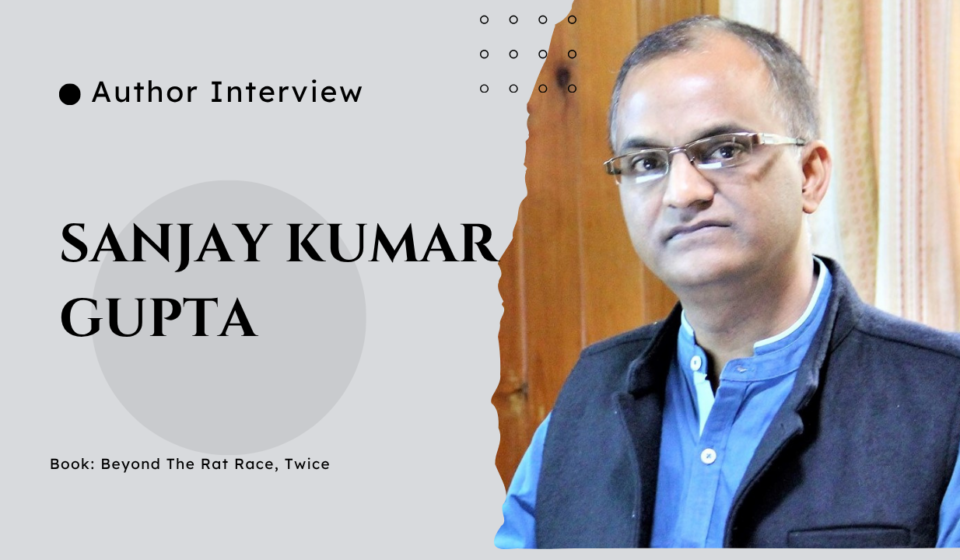
Sanjay Kumar Gupta is an international development consultant whose work with ADB, FAO, IFAD, UNDP, and the World Bank has taken him from India’s villages to Afghanistan, Bhutan, Saudi Arabia, Papua New Guinea, and Sri Lanka. Sanjay’s journey from a modest upbringing in a Delhi urban village to a purposeful career in rural development reflects resilience, empathy, and self-awareness. Raised with strong values, he excelled in school despite financial constraints. Sanjay’s story challenges conventional success metrics, advocating progress guided by inner values. Choosing introspection over competition, he redefined success as personal growth rather than external rewards. He enjoys reading, playing chess and cricket, watching the Indian sports teams, traveling, engaging on social media, and observing both people and nature. Guided by his credo—moving forward and rising upward—he envisions a poverty-free, happy world. Sanjay lives in India.
1. What inspired you to write this book, and when did the first spark of the idea appear?
Author: In today’s materialistic world, many professionals want to escape the rat race but struggle to take the steps needed to do so. I felt that my own journey—and the experiences I gained while breaking free from that cycle—could help others facing similar challenges. That became my primary motivation for writing this book.
The spark to write came in 2019. Before then, I had been consistently sharing life and management lessons drawn from my personal experiences on various social media platforms. I had also published a few articles and received encouraging feedback from readers. Over time, a thought kept resurfacing: What if I brought all these experiences together in the form of a book? It felt like a meaningful way to contribute to society. Gradually, that idea evolved into my debut book.
2. How did you approach researching or exploring the themes presented in your book?
Author: At first, I had listed several themes from my personal experiences with the intention of writing a collection of short stories. Interestingly, the title of my debut book was originally just one of those themes. Later, I realized that this title had the potential to represent the entire narrative, and that’s the direction I eventually chose. Once the title was finalized, I revisited my memories and gathered themes and stories—from childhood onward—that aligned with it. I noted down every experience I felt meaningfully contributed to the central idea of the book.
3. What was the most challenging part of writing this book?
Author: In hindsight, I believe the biggest challenge in writing this book was overcoming my own mental blocks. Although the idea first emerged in 2019, it took me six more years to actually complete it. I felt confident writing short articles and social media posts, but I doubted my ability to write an entire book. I wanted to write in English, yet it was not my strongest language, and I struggled to express myself as clearly as I wished. Because of this, I hoped to work with a professional editor who could support me, but I couldn’t find the right fit despite approaching a few people. The entire process soon felt overwhelming, and for years I couldn’t make any meaningful progress. Then, in January 2025, I attended a webinar on book writing, which gave me a renewed sense of motivation and finally pushed me to complete the manuscript.
4. Which character or chapter did you enjoy developing the most, and why?
Author: I selected all the characters and chapters that I felt were essential to telling my story. I have lived that journey myself, and each person and phase played a meaningful role in my decision to go beyond the rat race. Because of that personal connection, I truly enjoyed writing about every character and every chapter included in the book.
5. How closely does this story reflect your own experiences or observations?
Author: This memoir is entirely based on my personal experiences—both lived and observed—throughout my journey. However, I have changed a few names to maintain anonymity, as my intention was to highlight the issues that arose, not the individuals involved. Additionally, some events and experiences from my childhood were cross-checked and confirmed with my close relatives to ensure accuracy.
6. What message or feeling do you hope readers carry with them after reading the book?
Author: The book conveys several subtle messages. What message a reader draws from the book would depend entirely on the reader’s state of mind. However, I would like to describe the same message but suited to its specific context.
a. Real success comes from competing with oneself—striving to become better each day—rather than trying to outpace others.
c. “We” is always stronger and more meaningful than “I.”
d. In an organisation, when senior members align their personal goals with the organisation’s vision and direction, it can reach new heights of success.
7. Did the story or direction of the book change during the writing process?
Author: At first, I had jotted down several chapter headings based on different personal experiences, assuming the book would be a collection of short stories. I often found myself debating what each chapter would contain and how I would write it. During this process, I realised that the chapter then tentatively titled “Avoiding the Rat Race” could actually become the most significant part of the book. Gradually, it became clear that the entire book could be written under that single title. I then selected all the chapters that aligned with this theme and set aside the rest for future projects. I believe those dropped chapters may eventually form the basis of my next book.
8. How do you balance emotional depth with storytelling when dealing with sensitive topics?
Author: When dealing with a sensitive topic, I prefer to take a neutral stance. I focus on the issue itself rather than attaching my personal emotions to it. This approach allows me to describe events as they happened, without adding unnecessary emotional layers.
9. Was there a moment during writing when you felt, “Yes, this is it — the book is complete”?
Author: The moment I began writing about my experience working as an independent consultant after leaving my regular job—and about repaying the remaining home loan—I felt the book had come full circle. It was at that point I realised I had finally stepped out of an unintended second rat race, and my story was complete.
10. What advice would you give aspiring authors working on stories with strong social or emotional themes?
Author: I would advise aspiring authors to discover and develop their own unique writing style, rather than imitating the style of others.
Book Title: Beyond The Rat Race, Twice
Publisher: Evincepub Publishing
Buy Book : Amazon