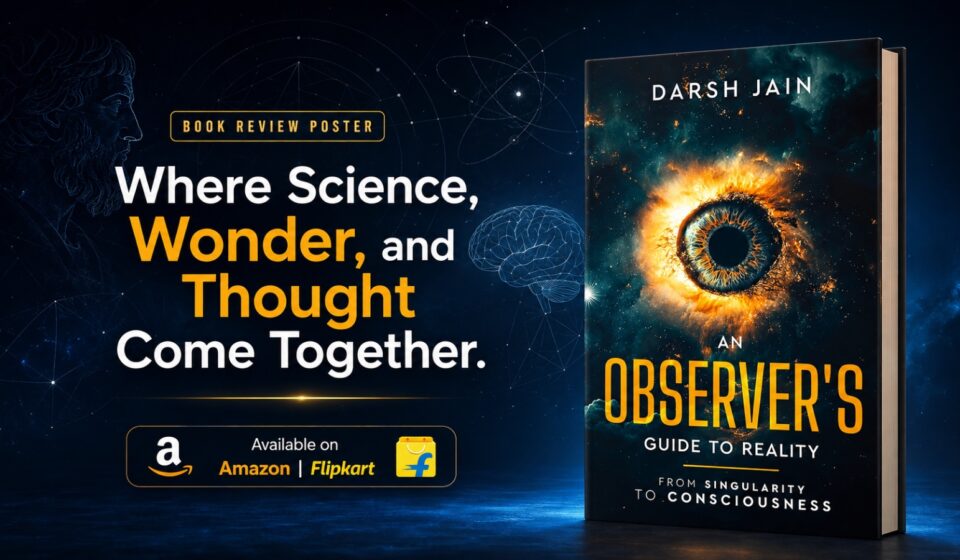

The importance of An Observer’s Guide to Reality can be understood through a simple problem: many people are curious about science, but they do not feel that science belongs to them. They remember difficult formulas, unfamiliar terminology, stressful examinations, and the feeling that one wrong answer meant they were “bad at science.” Darsh Jain writes against that experience. His book is built on the idea that science should begin with wonder, not fear. Instead of asking readers to prove that they are intelligent enough for cosmology, evolution, or neuroscience, he invites them to look at ordinary things—a chair, a ray of sunlight, a tree, a feeling of anger—and ask what is actually happening underneath the surface. This makes the book valuable not only for science enthusiasts but for people who once loved asking questions and later stopped because learning became too formal.
The opening section on the universe shows this method clearly. The Big Bang is introduced through common misunderstandings. Is it an explosion in empty space? What does a singularity mean? How can matter emerge from extreme early conditions? The author uses the questions a non-specialist might naturally ask and then builds from them. He moves into atoms, subatomic particles, energy, forces, and thermodynamics without pretending the ideas are simple. What he does instead is make the path into those ideas simple. Readers are given comparisons with daily life, moving objects, heat, light, chemical reactions, and visible consequences of invisible processes. The result is a style that says, in effect, “You do not have to master the mathematics before you are allowed to understand the story.” That is a powerful educational choice.
Another reason the book works is that it keeps asking why a fact matters. School science often tells us that atoms contain protons, neutrons, and electrons, but the deeper wonder can disappear. Jain repeatedly returns to the strange fact that everything we touch, see, and even think depends on particles and energy interactions. A human feeling does not float outside nature. A thought requires a living brain. A living brain requires cells. Cells require molecules. Molecules require atoms. Atoms came from the early universe and from stellar processes. By following those connections, the book gives scientific knowledge an emotional dimension. Facts stop being isolated points and become steps in a long chain that leads to the reader.
The chapters on Earth and evolution continue this approach. The reader is taken through changing climates, geological time, the rise and extinction of species, and the gradual development of more complex forms of life. Dinosaurs are not included merely because they are dramatic; their dominance and extinction help show how evolution responds to opportunity and environmental pressure. Small mammals surviving in the shadows become important because their descendants eventually lead toward primates. Primates matter because traits such as vision, grasping hands, social behaviour, and expanding brains prepare the path toward hominins. Human origins then become easier to understand because the book has already shown that every new stage is built from older biological structures.
This gradual storytelling is one of the book’s greatest strengths for beginners. The author does not treat Homo sapiens as if we appeared suddenly. He presents humanity as the current expression of a very old process. Upright walking, changing jaws, tool use, control of fire, social learning, language, empathy, culture, and imagination emerge across time. This makes evolution feel less like a chapter to be memorized and more like a family history written in bones, genes, and behaviour. Readers may finish these chapters with a different relationship to the word “human.” Instead of seeing humanity as separate from nature, they are encouraged to see us as deeply continuous with it, even when our cultural world feels completely different from the lives of other animals.
The book then makes a bold educational move: it treats society as something that can also be studied through science and evolution. Why do humans cooperate? Why do we form groups? Why do we copy customs? Why can words, flags, money, rituals, or laws affect us so deeply? These questions are explained through the development of language and collective imagination. The idea of imagined orders becomes especially useful because it gives readers a tool for analysing everyday life. A banknote has little value as paper; its economic power comes from trust. A border cannot be seen by a bird, but it can decide where a person may live. A title has no physical mass, yet it can change how people behave around someone. Once readers understand this, they begin to see society as a network of shared meanings layered over physical reality.
This does not mean the author is asking us to throw away social systems. In fact, the book makes clear that shared imagination is one of the reasons large-scale cooperation became possible. Human beings can work with strangers because both parties may trust the same currency, law, institution, story, or identity. The interesting question is not whether imagined orders are “real” or “fake” in an everyday sense. The important question is what kind of reality they have. They are not mountains or molecules, but they are real in their consequences. That simple distinction can improve critical thinking because it teaches readers to ask what a system is made of, who believes in it, how it began, and why it continues.
The same beginner-friendly style carries into the neuroscience sections. Instead of treating the brain as a mysterious organ that somehow produces a separate mind, the author explores memory, emotion, the limbic system, the prefrontal cortex, language, and the sense of self. The question of free will is approached through biological causes rather than abstract debate alone. We are shown that behaviour can be influenced by genes, development, hormones, neural pathways, social conditioning, memory, and environment. The book invites the reader to consider whether a decision can still feel free even if many of its ingredients were not chosen. This is a difficult philosophical problem, but the book keeps it connected to ordinary experience: anger, fear, self-control, habit, and the inner voice.
For students and young adults, this is especially useful because it models a better way to learn. The author’s own story, shared near the end, supports the message. He writes about preparing for the civil services examination and accumulating information across many subjects, then realising after not clearing the exam that knowledge and understanding are not the same thing. Knowing more facts can fill the mind, but understanding can change how a person sees other people and themselves. This personal reflection gives the book credibility as an educational project. It was not written from the position of someone who always enjoyed formal science education. It grew from dissatisfaction with memorisation and a desire to rebuild learning around curiosity.
That is why this book can be important even for readers who do not agree with all of its philosophical conclusions. Its deeper lesson is methodological. Ask questions. Look for evidence. Separate what is observed from what is interpreted. Be willing to update an idea. Notice how language shapes thought. Notice how emotion changes perception. Understand where a belief came from before defending it. These habits are useful far beyond science. They can improve how people respond to social media, political arguments, religious claims, health information, and even conflicts inside families. A scientific temperament is not only about laboratories; it is a willingness to remain curious when certainty would be easier.
Readers should pick up An Observer’s Guide to Reality if they want a large scientific story told in a conversational way. It is ideal for someone who asks big questions but does not want a book filled with equations. It is also a good bridge for readers moving from popular science into philosophy or from philosophy into neuroscience. The book’s length means it is better treated as a journey than a race. Read a chapter, pause, look up at the sky, notice your own reactions, and continue. The reward is not simply that you learn more about the universe. The reward is that science begins to feel personal again. The stars, cells, genes, and neurons stop being distant topics and become parts of the same story that is happening in you right now.
Why readers should consider this book
- It makes science accessible without treating the reader as unintelligent.
- It replaces memorisation with curiosity, examples, and connected understanding.
- It is a strong bridge between popular science, evolution, neuroscience, and philosophy.
Book link: https://www.amazon.in/dp/934747276X