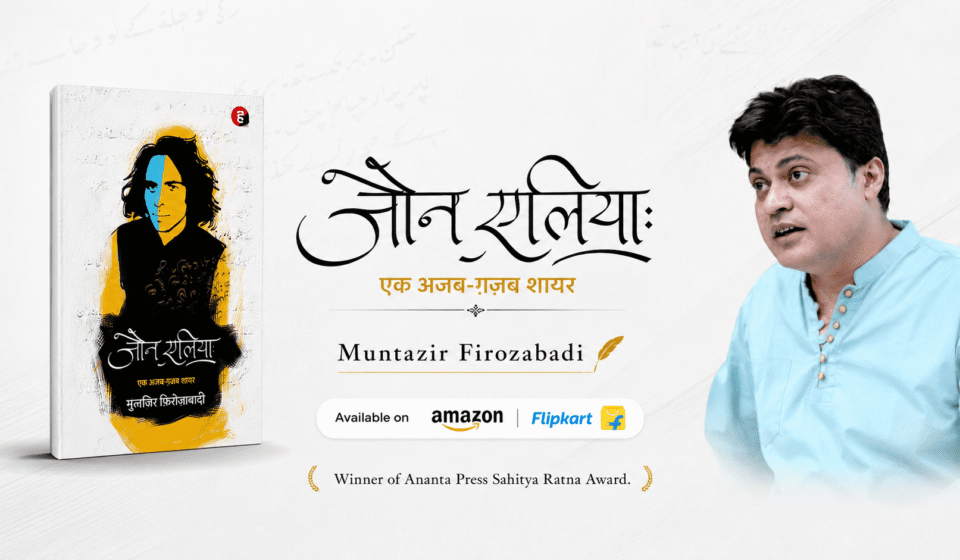

Book: Jaun Elia: Ek Ajab Ghazab Shayar | Author: Muntazir Firozabadi (Anant Bhardwaj) | Category: Poetry
The most remarkable fact about Jaun Elia today may be that he does not feel like a poet safely contained in the past. Decades after his death, young readers continue to discover him with the intensity usually associated with contemporary voices. His lines circulate through reels, captions, spoken-word clips, college conversations, and late-night reading sessions. Yet popularity can be deceptive: the more frequently a poet is quoted, the easier it becomes to mistake familiarity for understanding. Muntazir Firozabadi’s Jaun Elia: Ek Ajab Ghazab Shayar responds to this problem by offering readers a broader, more textured encounter with the poet behind the phenomenon.
The book’s strongest contemporary relevance lies in its understanding of Jaun’s emotional intelligence—or, more precisely, his emotional contradiction. Modern readers live in a culture that constantly asks them to name, explain, and optimize their feelings. Jaun often does the opposite. He reveals that feelings can be inconsistent, self-defeating, theatrical, intelligent, irrational, and unresolved all at once. Love can coexist with contempt; loneliness with pride; longing with refusal. This messiness feels surprisingly modern because it resists the simplified language through which emotional life is often packaged today.
Firozabadi’s selection of ghazals, nazms, qata’at, and ‘Jauniyat’ material provides multiple entry points into this unsettled mind. A reader attracted by one famous sher can discover longer poetic movements. A reader interested in personality can move toward the work. A poetry enthusiast can study tonal variation, while a casual admirer can enjoy the stories and characteristics that made Jaun such a distinctive public figure. The book’s structure therefore matches the way contemporary audiences actually discover writers: not always linearly, but through a network of curiosity.
The notion that repeated reading produces a kind of ‘Jaun virus’ or addiction is playful, but it describes something real about literary attachment. Jaun frequently gives readers the shock of recognition. He articulates thoughts that are socially inconvenient: resentment, boredom with convention, distrust of moral posturing, the desire to escape oneself, and the exhaustion of thinking too much. Such recognition can be intoxicating, especially for younger readers learning that poetry need not be polite or emotionally tidy.
However, the book’s deeper value lies in moving beyond identification. Jaun should not be read merely because he sounds relatable. He becomes far more interesting when readers notice his craft, intellectual background, rhetorical strategies, and philosophical restlessness. His lines often stage arguments rather than simply report emotions. A statement can undermine itself; an apparent confession can become an accusation; a romantic pose can suddenly turn into self-satire. This complexity rewards the slower reading that a dedicated book encourages.
Firozabadi’s emphasis on Jaun’s rebellious personality is particularly relevant in an age that celebrates rebellion as branding. Jaun’s defiance was rarely comfortable. It could be abrasive, excessive, and self-destructive. That is precisely why it should not be romanticized too simply. The book’s portrait allows readers to encounter rebellion as temperament rather than slogan. Jaun’s refusal of established rules—social, poetic, emotional—had consequences, and the resulting friction gives his work much of its distinctive energy.
The theatrical quality of Jaun’s style also helps explain his digital afterlife. He was, in many ways, extraordinarily compatible with the age of clips without having lived to see it. His voice could turn a couplet into a scene. His expressions, pauses, irritation, and delivery created memorable moments that travel well through recordings. Yet when a performance fragment goes viral, it can detach the line from the larger literary context. Ek Ajab Ghazab Shayar works as a corrective by leading the audience back from the clip to the poet’s wider world.
Another reason the book matters to younger readers is that it situates Jaun within a lineage. The mention of Mir, Momin, Ghalib, Faiz, Khumar and others reminds us that literary originality is not isolation. Jaun’s distinctiveness becomes clearer when seen against the conventions and inheritances he absorbed, challenged, and transformed. Contemporary readers often encounter poets algorithmically, one by one, without a sense of historical conversation. This book can encourage them to read backward as well as forward.
The author is well placed to make this connection because his own literary activities span old and new modes of engagement. Muntazir Firozabadi writes poetry, participates in mushairas and literary festivals, appears in podcasts and YouTube discussions, has worked in radio, and is represented on Rekhta. He therefore understands the transition of poetry across mediums. His interest in making a film on Jaun’s life is a natural extension of the same mission: translating literary memory into forms that can reach audiences beyond conventional book readership.
His work on future books about Sahir Ludhianvi and biographies of Parveen Shakir and Shiv Kumar Batalvi further demonstrates that he sees literary personalities as gateways into broader cultural history. This is valuable for young readers because a charismatic figure can often become the first step toward a much richer literary education. Someone who begins with Jaun may move toward classical ghazal, progressive poetry, Partition-era literature, modernist thought, or comparative South Asian poetics. A well-made introductory volume can spark that journey.
Jaun’s geographical biography also speaks to contemporary questions of identity. Born in Amroha and buried in Karachi, he belongs to a literary world that crosses national borders. Young readers increasingly consume art transnationally, and Jaun’s reception demonstrates that cultural affinity can survive political separation. Hindi and Urdu readers, Roman-script audiences, and global South Asian communities all participate in his afterlife. Firozabadi’s book becomes part of that circulation, helping readers approach the poet through an accessible frame.
The concept of ‘Jauniyat’ is especially effective for contemporary audiences because it names something more expansive than biography. It refers to a recognizable attitude: intellectual impatience, emotional extremity, irony, rebelliousness, philosophical unease, and a certain dramatic self-consciousness. Readers may initially be drawn to this attitude as style, but the book gives them an opportunity to ask what lies beneath it. That shift from aesthetic fascination to interpretive curiosity is one of the volume’s most important achievements.
Crucially, the book does not need to turn Jaun into a role model in order to establish his importance. Great literature often comes from difficult, contradictory personalities. The task of reading is not to imitate the writer but to understand the consciousness presented through language. Jaun’s sharpness, despair, ego, vulnerability, humor, and skepticism can all be studied without being simplified into lifestyle advice. A volume that preserves these contradictions respects both the poet and the reader.
For poetry lovers, therefore, Jaun Elia: Ek Ajab Ghazab Shayar is more than a collection attached to a famous name. It is an invitation to move from fandom toward literary engagement. It acknowledges the reasons Jaun is irresistible to contemporary readers while also opening doors to his range, history, personality, and artistic complexity. The book’s uniqueness lies in meeting the modern reader where curiosity begins and then encouraging that curiosity to deepen.
Jaun continues to speak because he gives language to states of mind that are not easily disciplined. Muntazir Firozabadi’s book understands this and builds an accessible literary portrait around it. Whether one arrives through a viral couplet, a mushaira recording, an interest in Urdu literature, or simple curiosity about the man behind the legend, the volume offers enough variety to turn recognition into exploration. That makes it especially valuable now: at a time when poetry is everywhere in fragments, it invites readers back into the richer experience of staying with a poet.
Amazon purchase link: https://amzn.in/d/09j2BZ3r