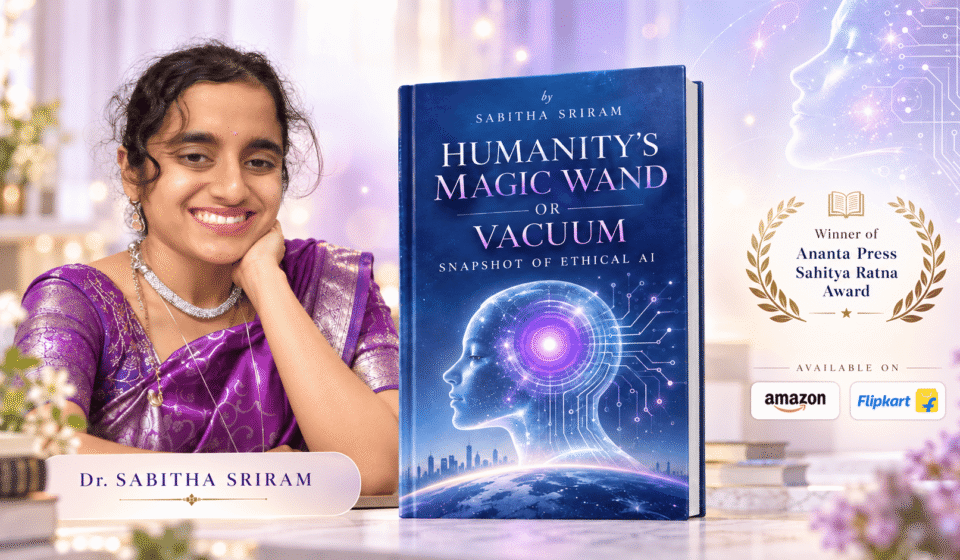

BOOK Humanity’s Magic Wand or Vacuum: Snapshot of Ethical AI AUTHOR Dr. Sabitha Sriram
Every major technological shift produces a debate about what the future will permit. Artificial intelligence adds a more unsettling variation: who will be allowed to define the future’s terms? The question is not confined to computer science. It concerns ethics, political economy, organizational accountability, security, and the ordinary experience of being assessed by systems that can appear authoritative. Dr. Sabitha Sriram’s Humanity’s Magic Wand or Vacuum: Snapshot of Ethical AI enters that discussion from an explicitly human-centered position. The book’s advertised themes place compassion, managed risk, regulation, and equitable growth alongside the promise of AI. This combination makes it a valuable starting point for readers who want to examine the assumptions beneath technological optimism.
The title works almost like a thought experiment. Imagine AI as a magic wand and one begins to list what it could enable: improved access to knowledge, assistance with difficult work, and new ways of addressing social needs. Imagine AI as a vacuum and the list changes: concentrated authority, unexamined dependence, poor decisions delivered at scale, and the possibility that human voices are pushed aside. Both interpretations are deliberately broader than one technical application. They draw attention to the conditions under which a technology acquires meaning. A device is not inherently a social triumph because it is ingenious. Its value must be assessed within institutions, relationships, and uneven distributions of power.
What distinguishes the book’s central premise from a narrow technical discussion is the priority it assigns to humanity. Human-centered AI should mean more than improving the attractiveness of an interface or making a system convenient. At its strongest, the idea asks who defines the objectives of a system, whose values influence its evaluation, and whether people retain meaningful ways to question its effects. This is an ambitious standard. It suggests that responsibility starts before data collection and continues beyond deployment. A development team may optimize a model beautifully while optimizing for a goal that was never adequately justified. Human-centered inquiry refuses to let the chosen metric close that discussion.
The concern about hallucinations is philosophically interesting because it exposes a confusion between expression and knowledge. Language that sounds coherent can tempt a listener to assume the presence of reliable understanding. When an AI system produces an invented or distorted claim, it reminds us that presentation and truth are different things. This issue has practical consequences in research, education, administration, and business. It also raises a question about human responsibility: what epistemic standards should institutions require before acting upon machine-generated content? The answer will vary by setting, but it cannot simply be that the output looks plausible or saves time.
Bias prompts another kind of examination. Public conversations sometimes treat fairness as a condition that can be certified once and for all, yet different people may reasonably disagree about what a fair outcome requires. Historical patterns can become embedded in data, and apparently neutral procedures can place unequal burdens on groups who already face obstacles. To evaluate those problems, readers must consider context, participation, and the consequences of mistakes. A thoughtful ethical framework should welcome difficult questions rather than promise that one model adjustment will solve every social conflict. The subject matter presented in Sriram’s synopsis makes this complexity central to any serious reading.
The author’s cybersecurity background opens an additional analytical dimension. Security questions ask who may gain unauthorized access, what vulnerabilities exist, and how systems respond when protections fail. Ethical questions ask whether authorized uses can themselves be unjust, misleading, intrusive, or harmful. These two forms of inquiry complement each other, but they cannot replace one another. A perfectly protected system could still make deeply problematic decisions; a socially beneficial service could still be dangerously exposed. Students examining the relationship between computer security and AI ethics can use the book’s framing to see why responsible technology requires both operational discipline and public justification.
The book also points toward a political question about corporate power. Large technology companies can influence available tools, business models, research priorities, and access to infrastructure. Their contributions may be substantial, but the public interest cannot be inferred from their success. If humanity is to take precedence, organizations affected by AI must have ways to articulate competing needs and demand accountability. The issue is not whether all companies behave badly or whether markets have no useful role. It is whether concentrated technical capability should also confer unchallenged authority over social outcomes. This is a question of governance, not merely consumer preference.
Regulation is therefore best understood as a public conversation about boundaries. Rules can prohibit certain conduct, establish duties, and provide ways to correct harm. They can also fail if written too vaguely, applied inconsistently, or disconnected from technical reality. A nuanced interpretation of the book’s position would neither idealize every regulation nor dismiss oversight as an obstacle. It would ask what forms of accountability are appropriate to particular risks and who should participate in setting them. The aim is not to freeze innovation but to prevent speed from becoming an excuse for avoiding responsibility. Such a view is particularly useful for academic debate because it leaves space for evidence, disagreement, and revision.
The appeal to compassion adds a different register to this institutional discussion. Laws and audit procedures are necessary, but they do not capture the full human experience of an automated mistake. Someone may feel anxious, excluded, confused, or powerless when confronted with an unexplained output. A compassionate design process anticipates these experiences and recognizes the importance of understandable information and human assistance. Compassion need not mean substituting sentiment for rigorous evidence. It means considering forms of harm that narrow performance measures may miss. The book’s humanitarian orientation allows readers to relate moral philosophy to the texture of everyday encounters with technology.
At the same time, academic integrity requires a boundary between the book’s stated aims and what can be established about its execution. The supplied description identifies its core themes but does not provide a full chapter breakdown, methodology, or research apparatus. It would be inappropriate to claim that the volume proves particular propositions through named studies or follows a specific argument chapter by chapter without inspecting that material. As presented, its contribution is an ethical orientation and an invitation to interdisciplinary inquiry. Readers evaluating its research depth should consult the complete text and its references. A responsible review can appreciate the questions a work raises while remaining transparent about the evidence available.
That qualification also helps clarify the value of the subtitle Snapshot of Ethical AI. A snapshot captures a landscape at a moment, but responsible thinking remains unfinished. Technical capabilities evolve, institutions adapt, and familiar principles acquire new complications. The most useful educational contribution may be teaching readers how to interrogate the next development rather than trying to predict every one. Who is responsible for error? What evidence supports the claimed benefit? Which communities were considered? What happens when a user disagrees with the output? Can society reverse a harmful decision? These questions travel well across changing systems and changing headlines.
Ultimately, Humanity’s Magic Wand or Vacuum offers a compelling framework for treating AI as a shared human challenge rather than a contest between dazzling machines and frightened observers. Dr. Sabitha Sriram’s emphasis on ethical governance, social welfare, and inclusivity pushes discussion toward obligations that cannot be delegated to technology itself. The book is distinctive for the tension embodied in its title and the insistence that compassion belongs in conversations about advanced systems. The challenge it leaves with the reader is not to decide whether AI is simply good or bad. It is to decide what institutions, safeguards, and habits of judgment are needed so that its power remains answerable to the people living with its consequences.
AMAZON PURCHASE LINK https://www.amazon.in/dp/9362880296