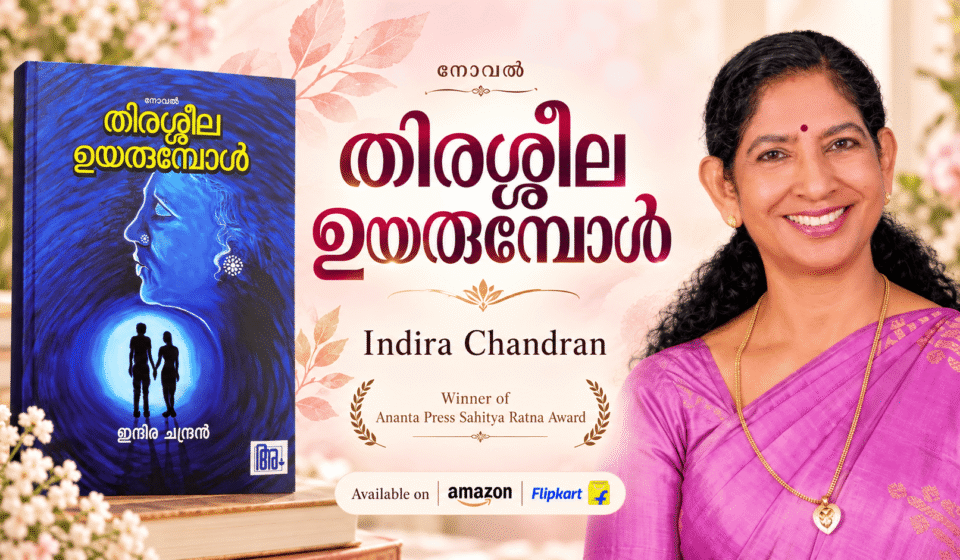

Book: Thirasseela Uyarumbol (തിരശ്ശീല ഉയരുമ്പോൾ) Author: Indira Chandran
A title can invite a reader into a novel before the first page has been turned. Thirasseela Uyarumbol, the Malayalam title of Indira Chandran’s novel, evokes the moment when a curtain rises and a hidden world becomes visible. That image is particularly apt for the story described by the author: an early twentieth-century North Kerala household in which a woman’s competence, a marriage’s quiet support, a joint family’s shared responsibilities and a son’s public ambitions gradually come into focus. The title’s metaphor, understood as an interpretation rather than a confirmed statement of the author’s intention, suggests a work interested in revealing the significance of experiences that rarely occupy the center of official history.
Historical storytelling is often strongest when it offers not an inventory of facts but a plausible sense of how people understood the possibilities before them. Here the entry point is Lakshmikkutty, a young woman from a Hindu Nair family who marries early, has limited formal education and nevertheless manages complicated family situations with dignity. The historical distance matters, yet the emotional premise is immediately accessible. A reader does not need to have lived in early twentieth-century Kerala to understand the desire for a respectful marriage, a stable home or children who can make their way in the world. The novel’s regional specificity and human familiarity reinforce each other.
The decision to place a woman like Lakshmikkutty at the center is a meaningful literary one. Public records tend to preserve the names of officeholders, property owners and prominent reformers. The people who sustained households, reconciled relatives and made daily life possible are less easily recovered. Fiction has the freedom to direct attention toward such figures and ask what society would look like if their achievements were taken seriously. The novel’s premise therefore participates in a valuable tradition of literary remembrance. It does not require Lakshmikkutty to become famous in order to make her worthy of sustained attention.
There is an attractive balance between stillness and movement in the story’s elements. Lakshmikkutty’s family embodies continuity through its attention to shared living and relationships. Her husband works in the Railway Department, an occupation associated with movement and the wider world. Their son later helps establish a school in a remote village and becomes a district collector, placing the family’s next generation in educational and administrative spheres. These details imply a widening social horizon, from household to community to district. That progression is one of the most distinctive features of the described plot, allowing the novel to connect personal memory with the language of public change.
Regional fiction has the capacity to protect differences from being flattened into a generic story of progress. North Kerala is a specific cultural setting, and identifying Lakshmikkutty’s Nair background makes clear that the narrative grows from a particular family world. Readers should resist the temptation to treat one fictional household as a complete portrait of all families in a region or community. The benefit of such a story is more precise: through one family, it can awaken curiosity about local history, inherited obligations and changing ambitions. Its value lies in particularity rather than in a claim to speak for everyone.
The joint-family dimension adds a distinctive texture to that world. Modern storytelling often follows a protagonist who must escape home in order to become fully realized. Chandran’s described narrative asks a different question: what if the labor of sustaining a home were itself a significant life achievement? Keeping peace among relatives, supporting a spouse and maintaining neighborhood relationships require attention to other people’s inner worlds. Those concerns offer drama of a quieter kind. The stakes are emotional and social rather than spectacular, but their effects can last across generations. A reader interested in character and human behavior can find a great deal to consider in such material.
The school founded by Lakshmikkutty’s son introduces another narrative possibility: a single new institution can change the meaning of a place. The author describes the effort as difficult and locates it in a remote village. That is enough to establish the importance of initiative without inventing particular obstacles or scenes. A school represents the choice to invest in people not yet old enough to shape their own futures. Within a multigenerational novel, it also forms a poignant response to Lakshmikkutty’s limited educational opportunities. The story seems to position one generation’s constraints beside another generation’s determination to widen opportunity.
His later appointment as district collector brings the narrative still further into public life. The distance between an early marriage in a traditional household and a major administrative position in the next generation is narratively striking. It encourages reflection on changing expectations, the relationship between education and social mobility, and the moral responsibilities that accompany authority. The available synopsis does not tell us the circumstances of his career or provide an account of his work in office. Nevertheless, the outline itself creates an expansive family arc, the sort that invites readers to connect personal choices with the longer history of a community.
The visual design of the supplied book cover is also worth considering as a part of the book’s presentation. A large blue-toned female profile dominates the composition, while two smaller figures appear together against a luminous circular background. That image can be read as a visual conversation between individual experience and relationship, memory and continuity. This interpretation concerns the cover art, not an unverified event from the story. The design offers a strong invitation to read the novel as one in which a woman’s presence frames a wider narrative of attachment and shared destiny. Its deep blue and violet tones contribute a reflective atmosphere rather than the urgency of sensational adventure.
Author Indira Chandran’s life story gives the project added interest. Originally from Kannur and now based in Bangalore, she served for many years in Kerala’s education system, beginning as a teacher and advancing into senior administrative positions. She received awards for educational work and participated in a government-supported teachers’ visit to Japan in 2012. Her writing began early, paused during a demanding professional career and resumed after retirement. Those details are striking because they illuminate a long relationship with both storytelling and service. They suggest the persistence needed to return to creative work after years spent fulfilling public responsibilities.
Her published works extend beyond this novel. The author lists Nizhalum Nilavum and Kanyakumariyil Oru Sandhya as short-story collections, and Ormacheppile Nakshatra Pookkal as a collection of poems. She also reports recognition in Malayalam literary groups and a golden badge on Pratilipi. This broader writing practice situates Thirasseela Uyarumbol within an ongoing creative life rather than as an isolated undertaking. Poetry, short fiction and the novel each invite different kinds of attention; a writer working across them may be drawn to both the concentrated emotional moment and the expansive patterns visible across a family history.
What can readers reasonably expect from the book on the basis of the material available? Not a documented promise of particular stylistic techniques, plot twists or chapter structures, because no full manuscript has been supplied for this appraisal. What they can expect from the premise is a general-fiction work concerned with family bonds, a capable female protagonist, the social meaning of education and the passage of values from one generation to the next. That is already a coherent and appealing set of interests. Readers who value novels for their attention to ordinary people may find the subject especially inviting.
The distinction between an inspiring story and an oversimplified one rests on the space it leaves for complexity. A young marriage raises questions about freedom; family harmony raises questions about compromise; educational achievement raises questions about unequal opportunity; and public success raises questions about duty. These themes deserve admiration and examination together. A rich reading of Chandran’s novel can celebrate Lakshmikkutty’s dignity without romanticizing every condition she lives under. It can appreciate kinship without idealizing every shared household, and it can admire an administrator’s rise without reducing the meaning of a life to professional status. That interpretive openness is part of the premise’s attraction.
Ultimately, Thirasseela Uyarumbol offers a reason to approach regional family fiction with renewed attention. Its story joins domestic endurance with social aspiration and gives a woman with limited formal advantages a central place in the telling. The journey from home to school to public office allows readers to think about the connections between memory, education and progress. Indira Chandran’s novel appears especially suited to those who enjoy reflective Malayalam narratives, historical settings and intergenerational questions that do not disappear when a story ends. When the figurative curtain rises, what comes into view is not merely a family from another era but a set of choices about how people care for each other, create opportunity and leave a meaningful inheritance.