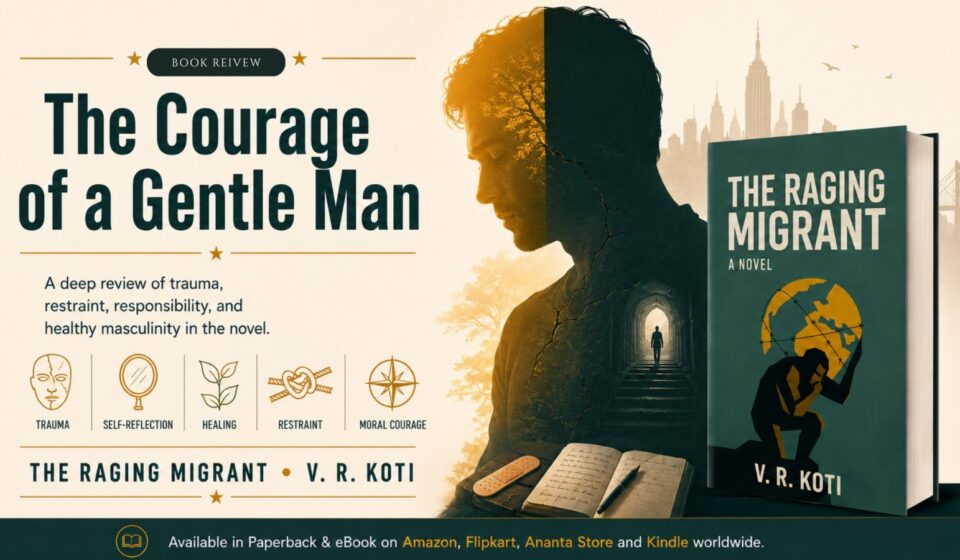

In The Raging Migrant, romance is not only about two people falling in love; it is about whether love can survive family pressure, distance, secrecy, and fear.
The Raging Migrant can be read as a migration novel, a family novel, and a psychological novel, but one of its most emotionally engaging layers is the love story between KK and Mira. V. R. Koti does not write romance as a soft escape from the difficulties of life. Instead, he writes love as one of the most difficult spaces in which a person must confront himself. KK’s love for Mira is tender, sincere, and life-changing, but it is also full of pressure. Their relationship asks a hard question: when love becomes tied to approval, ambition, secrecy, and distance, can it remain love in its purest form?
KK meets Mira in a moment of crisis. His friend Piyush has been attacked, and KK is desperately searching for a first aid kit. In the middle of blood, fear, shame, and urgency, Mira enters his life with grace and curiosity. The scene works because it is not conventionally romantic. KK is not looking polished or heroic. He is covered in the evidence of distress. Yet Mira sees something in him. This beginning matters because it tells us that the relationship is not built on superficial charm. Mira meets KK when he is vulnerable, helpful, and emotionally exposed.
The early interactions between KK and Mira have a freshness that readers will enjoy. There is awkwardness, admiration, humour, and the thrill of being seen. Mira’s elegance affects KK deeply. Her laughter, confidence, and warmth pull him out of the heaviness of his life. For a young man who has grown up with family tension, bullying, and uncertainty, Mira’s attention feels like light. The reader can understand why he becomes emotionally attached so quickly. She is not just a romantic interest; she represents the possibility that life can be beautiful, surprising, and chosen.
Yet Koti is careful not to make love too easy. Mira has a twin sister, Bianca, also called Bina, whose presence complicates the relationship. Bina’s expectations introduce the theme of conditional love. KK is told, directly or indirectly, that he must become more educated and physically better suited if the relationship is to be accepted or formalised. This moment is painful because it touches one of KK’s deepest wounds: the fear that he is not enough as he is. He has already been measured by money, class, family crisis, education, and social standing. Now love also becomes a space where he feels evaluated.
This is why the love story is important. It is not simply about whether KK and Mira will stay together. It is about what KK is willing to do to become worthy of the relationship. He begins to exercise, consider higher studies, and imagine a future that could match the expectations placed before him. Some readers may see this as motivation; others may see it as emotional pressure. The novel allows both interpretations. Love can inspire growth, but it can also make a person negotiate with his own self-worth. The tension between these two possibilities gives the romance depth.
Mira herself is not written as a one-dimensional figure. She loves KK, but she is also shaped by family, class, fear, and her own emotional needs. Her bond with Bina is strong. Her family’s expectations matter. She is capable of tenderness and sudden boldness, but also of hesitation. This makes her human. The novel does not turn her into either a perfect lover or a simple obstacle. She is someone trying to love within the limits of her world. That is why the relationship feels real. In real life, love rarely exists outside family structures, social pressure, and future planning.
The Vaishno Devi sequence and the sudden marriage proposal give the love story a dramatic emotional turn. Mira asks KK to marry her quickly, before he leaves for America. The moment has intensity, beauty, panic, faith, and uncertainty all at once. It is romantic on the surface, but emotionally complicated underneath. KK is not fully prepared. Mira is searching for security. The temple setting gives the decision spiritual weight, but the rush creates future consequences. This is one of the novel’s strongest choices: it shows how an act that feels like devotion in one moment can become a burden in another when it is not supported by clarity, family involvement, and emotional safety.
The wedding photograph becomes a powerful symbol. It is evidence of commitment, but also evidence of incompleteness. The photograph carries the weight of a decision made under pressure. Later, when KK is in America, the photograph becomes one of the few physical links to Mira and to the secret they share. It is a reminder that distance does not erase promises. In fact, distance often makes promises heavier. The reader understands the emotional loneliness of holding a relationship in silence while trying to survive in a new country.
The novel is especially relevant for today’s readers because many modern relationships are long-distance, cross-cultural, or shaped by career migration. People fall in love in one city and build futures in another. They promise to wait, grow, and remain loyal, but time and distance test those promises. The Raging Migrant does not treat long-distance love as a simple obstacle. It shows that distance magnifies existing doubts. If two people have not fully spoken about fear, family approval, expectations, and personal needs, distance makes those unspoken things louder.
Mira and KK’s relationship also raises the question of emotional safety. At one point, the idea appears that women value emotional safety, and that KK must understand what Mira needs if he hopes to save the relationship. This is a crucial insight. KK is loving, loyal, and willing to fight for Mira, but emotional safety is not only loyalty. It is also steadiness, communication, maturity, and the ability to create trust without forcing the other person into fear. KK has courage, but he must learn tenderness in a more mature form. He has passion, but he must learn patience. This growth makes the romantic arc meaningful.
The title Conditional Love is one of the most important chapter titles because it applies not only to romance but also to family. KK has seen conditional and unconditional love at home. His mother’s love often appears unconditional, while his father’s love is complicated by weakness and failure. Bina’s conditions for Mira’s partner echo social expectations. Mira’s fear creates conditions of its own. KK also carries conditions inside himself: if he becomes educated enough, fit enough, successful enough, perhaps he will be chosen fully. The novel asks whether love can remain healthy when it is built on improvement as proof of worth.
This is a strong theme because many readers will recognise it. People often enter relationships believing they must earn love by becoming more successful, attractive, educated, rich, or socially acceptable. Growth is good when it comes from self-respect. It becomes dangerous when it comes from fear of rejection. KK’s journey sits right at this border. His desire to study in America is connected to career ambition, but also to love. He wants to become someone Mira’s family can accept. This makes his success emotionally complex. If he wins, is he fulfilling himself, or proving himself to others? The novel does not answer too quickly.
The love story also reveals KK’s habit of over-responsibility. He wants to protect Mira, fix problems, and carry emotional weight. At Sarojini Nagar market, when Mira is harassed, KK reacts with protective instinct. The scene demonstrates courage, but it also leads to injury and raises questions about impulse and consequence. Mira’s reaction is important: she does not simply celebrate his bravery; she also worries about the danger. This moment shows that love is not only about heroic action. Sometimes love requires judgment, restraint, and the humility to let systems handle what anger wants to handle immediately.
In America, the relationship becomes even more psychologically charged. KK is trying to survive graduate school, cultural adjustment, financial pressure, and traumatic events. At the same time, his marriage to Mira remains unresolved and largely hidden. The annulment notice deepens the emotional wound. The idea that their marriage may be invalidated because it was rushed, secret, and not fully lived becomes painful not only legally but spiritually. KK has to confront the possibility that what he considered sacred may be reduced to paperwork. This is where Koti’s writing becomes most affecting: he shows how institutions can translate emotion into procedure, but the heart does not process loss so neatly.
The romance in The Raging Migrant matters because it is not separate from the book’s larger themes. It connects migration, family, masculinity, self-worth, trauma, and silence. KK’s love for Mira pushes him forward, but it also exposes what is unresolved inside him. Mira becomes the person for whom he wants to grow, but also the person through whom he must learn that love cannot be sustained only by sacrifice. It must be sustained by communication, mutual courage, and emotional clarity.
From a reader’s point of view, the book is engaging because the love story is unpredictable in an emotionally believable way. The reader may want KK and Mira to succeed, but the novel does not offer easy comfort. It understands that love can be real and still not be simple. It also understands that two people can love each other and still hurt each other when they are not ready, not supported, or not honest enough about what they fear.
The writing style helps the romance feel sincere. Koti uses small moments: a smile, a conversation, a shared meal, a question, a photograph, a phone call, a silence. These details create intimacy. The novel’s emotional force comes not from grand declarations alone but from the spaces between them. The reader feels how much is unsaid. That unsaid space is exactly where the relationship lives.
Why is this book important for readers today? Because it challenges the popular idea that love conquers all by itself. The Raging Migrant suggests that love needs more than feeling. It needs maturity, truth, timing, courage, and the ability to stand against unhealthy pressure without becoming destructive. It asks young readers to think about whether they are growing for themselves or performing worthiness for someone else. It asks families to consider how their expectations can turn love into a test. It asks migrants to think about what promises they carry when they leave home.
As a book review, this is one of the novel’s greatest strengths: it makes romance meaningful without making it shallow. KK and Mira’s relationship is not there only to add emotion. It is central to the question of who KK becomes. Through love, he learns the limits of ambition, the danger of secrecy, the need for emotional safety, and the painful truth that distance can stretch a bond but cannot replace honesty.
The Raging Migrant is available in paperback and e-book formats, with availability shared through Amazon, Flipkart, Ananta Store, and international channels across 150 plus countries. Readers who enjoy emotional literary fiction, complicated love stories, and novels that explore the pressure between family expectations and personal desire will find this book worth reading. It is not a simple romance. It is a story about love as a mirror. And what KK sees in that mirror is not only Mira, but his own hunger to be chosen, respected, and finally enough.