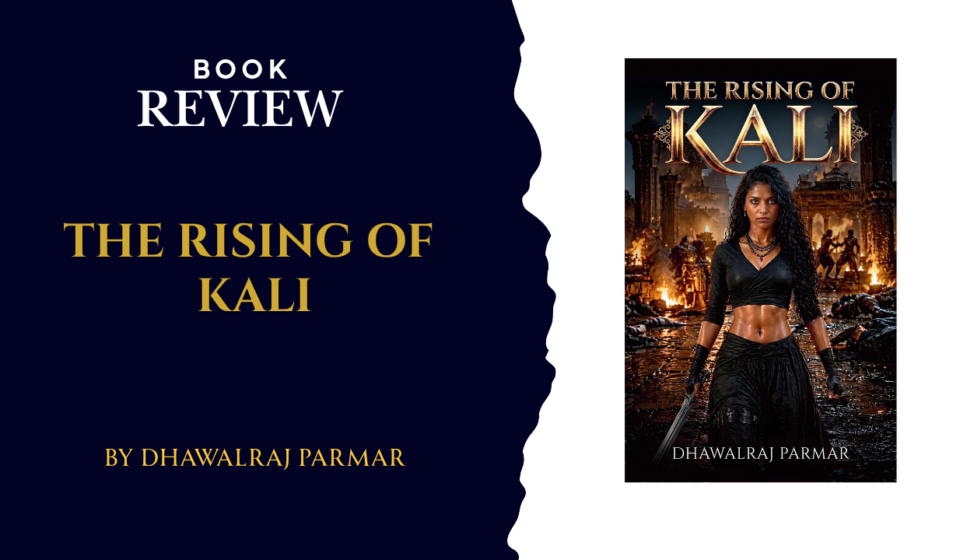

Dhawalraj Parmar’s The Rising of Kali is an ambitious mythological action thriller that works most effectively when read not merely as an adventure narrative, but as a story about identity under pressure. Beneath its martial-arts contests, secret organisations, sacred weapons and large-scale confrontations lies a more intimate question: what happens to a person when survival demands that she become someone she was never taught to be?
Saumya provides the novel with its emotional and philosophical centre. Raised in a Gurukul where discipline, meditation and control are inseparable from physical strength, she begins with an understanding of power founded upon stillness. Her sister Adhira offers an important counterpoint. Where Saumya gravitates toward inward discipline, Adhira is fiery, extraordinarily gifted and increasingly consumed by the desire to prove herself worthy of the divine sword. Their contrast establishes one of the novel’s strongest thematic oppositions: power as possession versus power as self-mastery.
Adhira’s disappearance gives the narrative its emotional engine. Saumya’s search is therefore never simply investigative. She is pursuing a missing part of her own emotional history. The Factory then becomes the novel’s most significant transformative space. Its name is symbolically appropriate: it attempts to reduce individual human beings to manufactured instruments of violence. The brutal trials, psychological pressure and enforced isolation progressively dismantle Saumya’s earlier assumptions about combat. Her emergence as “Kali” consequently carries more meaning than the acquisition of a fearsome identity. Kali represents the self produced by trauma, rage and necessity.
The novel’s use of mythology is particularly interesting because mythological elements are not restricted to decorative references. The divine sword, prophecy, ancient Gurus, sacred vaults, Rakshini Sena and later mythic weapons create a bridge between inherited cultural memory and contemporary thriller conventions. The sword itself operates as a symbol of worthiness. Physical ability alone cannot determine who deserves it; ethical and emotional discipline become equally important.
Structurally, the novel continually expands its scale. What begins as an intimate family conflict develops into a mystery, then a survival narrative, an international conspiracy and finally a mythological battle. This widening scope gives the book considerable cinematic energy. At times, however, the rapid accumulation of organisations, characters, revelations and combat situations can reduce the space available for psychological reflection. Some secondary figures could have benefited from greater interior development, while certain expository passages explain information more directly than necessary.
The prose is accessible and strongly visual. Parmar favours direct dialogue, quick scene transitions and clearly choreographed action rather than elaborate literary ornamentation. This makes the novel highly readable, though greater variation in sentence rhythm and more reliance on implication rather than explicit emotional explanation could have added further subtlety.
The ending gives the title its deepest significance. Saumya’s decisive achievement comes not through becoming more completely Kali, but through rediscovering Saumya. Faced with an opponent empowered by aggression, she must return to the calmness taught by her father. Most importantly, when given the opportunity to kill, she chooses restraint.
Thus, The Rising of Kali ultimately complicates its own title. The true “rising” is not simply the birth of a warrior driven by fury. It is the emergence of a woman capable of possessing extraordinary violence without allowing violence to possess her. In that reconciliation between Kali’s fire and Saumya’s stillness, Parmar finds the novel’s most convincing literary idea.
Title: The Rising of Kali
Author: Dhawalraj Parmar
Publisher: Evincepub Publishing