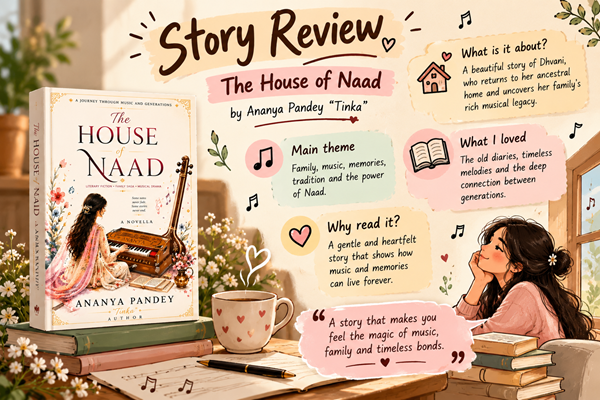

By Ananya Pandey “Tinka”
The House of Naad is a beautiful and emotional story about family, music, memories, and tradition. The story follows a young woman named Dhvani, who returns to her ancestral home. She thinks she is coming back to an old house, but soon she finds that the house is holding many forgotten stories of her family.
As Dhvani walks through the old rooms, she discovers diaries, memories, and melodies from the past. These things slowly tell her about the people who lived there before her. She learns that music was once a very important part of her family. Her family had a deep love for Hindustani classical music. For them, music was not just entertainment. It was a way of life. They gave their time, atience, and heart to it. This discovery changes the way Dhvani looks at her family. One of the most touching parts of the story is the old diaries. They are like small doors to the past. Through them, Dhvani begins to understand the dreams, feelings, and struggles of earlier generations. The old house also feels special. It is not just made of walls and rooms. It feels as if the house has kept every song and every memory safe for years. The idea of Naad makes the story even more meaningful. Here, Naad feels like a sound that never truly disappears. One generation may leave, but its music can continue through the next generation.
I really liked the way the story talks about inheritance. Usually, when we think about inheritance, we think about money, property, or jewellery. But Dhvani receives something very different. She receives her family’s music. She receives their memories. She receives their traditions. And she receives the responsibility of remembering them. The story also shows that learning music needs discipline. Talent is important, but regular practice, patience, and love for the art are equally important. As Dhvani understands her family’s musical journey, she also begins to understand herself better. Her journey into the past slowly becomes a journey towards her own roots. That is what makes the story emotional. It also made me think about my own family. Sometimes we are so busy with the present that we forget to ask about the past. Our grandparents and older family members may have many beautiful stories that we have never heard.
The House of Naad reminds us that these memories are also valuable. Overall, this is a gentle and heart-touching fictional story. It is especially suitable for readers who enjoy music, family stories, Indian traditions, old memories, and emotional journeys. For me, the message of the story is very simple: Our greatest inheritance is not always money or property. Sometimes it is the love, memories, values, and traditions our family leaves inside us.
People may leave, houses may grow old, and time may move forward. But a beautiful melody can continue to echo for generations. And that is the real beauty of The House of Naad.