
Passion, karma, ethical choice, and the collapse of imagined freedom
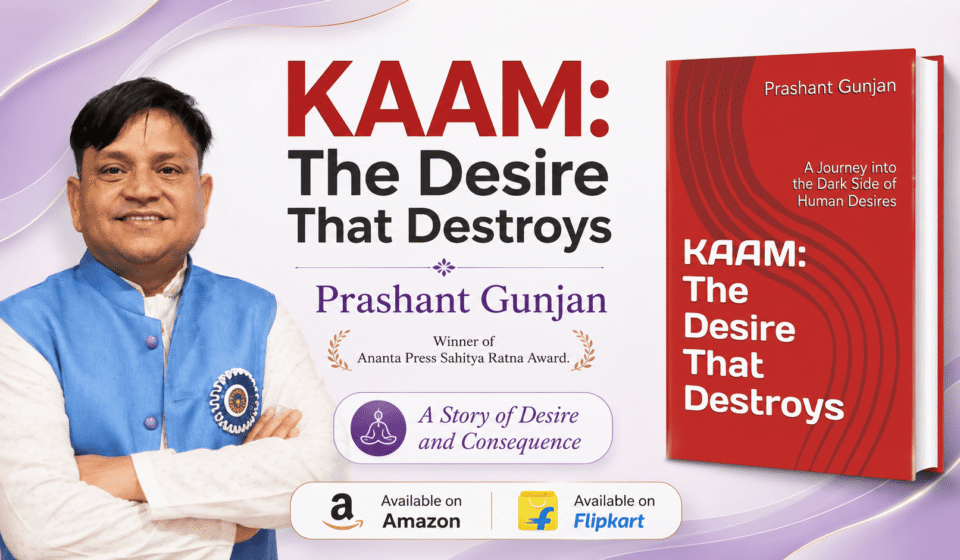
Book: KAAM: The Desire That Destroys | Author: Prashant Gunjan |
The title KAAM: The Desire That Destroys invites a philosophical reading even before the plot begins. “Kaam” can signify desire, pleasure, longing, or sensual appetite, but the subtitle immediately directs attention toward excess. This is not desire integrated into a balanced life. It is desire separated from restraint, responsibility, and compassion. Prashant Gunjan uses a thriller/mystery framework to explore an ancient human problem: when does longing stop enriching life and begin consuming it?
The story of Suraj and Sonam has the shape of modern tragedy. They begin as lovers divided by forces larger than themselves. Caste, family honour, and rigid tradition deny their relationship. This creates the first tragic condition: a genuine emotional bond is prevented from developing honestly. Yet tragedy does not end with injustice. It deepens when the characters respond to injury in ways that create new injury. Years later, the lovers meet again, but the reunion does not restore innocence. It brings the past into a present already occupied by marriage, reputation, loneliness, and resentment.
Sonam is trapped in a loveless marriage with Ajay. Suraj is consumed by obsession and isolation. Their renewed contact appears to offer freedom from lives they did not choose, but that freedom is deceptive. Secret conversations may feel like acts of emotional truth, yet secrecy also requires division—between public and private selves, duty and desire, memory and reality. The characters imagine they are recovering something authentic, but they may actually be surrendering to an idealised version of the past.
This is where the novel’s tragic intelligence becomes visible. Human beings often believe the object of desire will resolve the condition of desire. We think possession will end longing. In reality, unexamined desire frequently produces more desire: more reassurance, more secrecy, more control, more risk. Suraj does not merely want to speak with Sonam; he seeks what he believes was stolen. Sonam does not merely remember Suraj; she seeks relief from emotional confinement. Their expectations expand until the relationship must carry the weight of years, identity, regret, and imagined redemption.
No relationship can safely function as a complete answer to such burdens. When another person becomes the solution to one’s entire dissatisfaction, love begins to resemble dependency. The beloved is no longer encountered as a complex individual but as a doorway out of suffering. The tragedy of KAAM is that the doorway leads into a darker prison. Betrayal creates fear. Discovery creates rage. Murder creates guilt. Police investigation creates external danger. The pursuit of freedom ends in increasing forms of captivity.
Ajay’s role is equally important to the philosophical design. He is associated with status and reputation, qualities that can become forms of attachment. If Suraj and Sonam are attached to a lost love, Ajay may be attached to a public identity. When he discovers the truth, rage erupts into murder. His response shows another face of uncontrolled desire: the desire to preserve honour, possession, and power at any cost. The novel therefore does not limit “kaam” to sexuality. It reveals how destructive appetite can appear as jealousy, pride, domination, or refusal to accept loss.
The murder is the tragic climax because it converts emotional conflict into irreversible moral fact. Before violence, each character may justify actions through pain. Suraj can remember social injustice. Sonam can point to a loveless marriage. Ajay can point to betrayal. After murder, justification becomes harder. A human life has been taken, and suffering has multiplied. The story’s moral force comes from this transition. Pain explains behaviour, but it does not erase responsibility.
The statement that burying a body cannot bury guilt introduces a concept close to karma, not necessarily as supernatural punishment but as consequence embedded in action. Every decision changes the person who makes it. The crime creates fear of police discovery, but it also creates an inner witness that cannot easily be silenced. Guilt becomes the psychological continuation of the act. Even if external evidence were hidden, the characters would still live inside the result.
This theme aligns strongly with Prashant Gunjan’s wider intellectual interests. The supplied author profile describes his engagement with ethics, spirituality, psychology, consciousness, karma, human behaviour, and personal transformation. It also presents him as an engineering professional with more than thirteen years of experience in quality assurance, inspection, and project coordination. These fields may seem distant from fiction, yet they meet in the idea of consequence. Engineering examines how systems behave under stress and how failures propagate. Ethics examines how choices affect people and character. KAAM combines both perspectives in a narrative chain of cause and effect.
Gunjan’s multidisciplinary identity is one reason the book feels distinctive. He is presented not only as a novelist but as a researcher, quality professional, martial artist, and performer. According to the details supplied for this project, he has also received literary recognition and is known for achievements that combine discipline with creativity. That combination suits a novel concerned with what happens when discipline disappears. A person trained in controlled movement and rigorous systems turns his attention toward uncontrolled impulse.
These questions give KAAM value beyond entertainment. A reader may begin for suspense but continue thinking about emotional self-regulation, social pressure, and the stories people use to excuse harmful choices. The novel’s warning is not puritanical. It does not suggest that desire should be eliminated or that social obedience is morally superior. After all, rigid social obedience is what first destroys Suraj and Sonam’s chance at an honest relationship. Instead, the book points toward balance: desire without freedom becomes repression, but desire without responsibility becomes destruction.
This balance prevents the novel from offering an easy moral. Tradition is not automatically virtuous. Rebellion is not automatically liberating. Marriage is not automatically loving. Passion is not automatically authentic. Status is not automatically strength. Each idea must be judged by the human consequences it produces. That ethical complexity is the hallmark of serious tragedy.
The thriller framework makes these ideas emotionally immediate. Philosophy alone can remain abstract, but a crime story places concepts inside fear, blood, concealment, and investigation. The police closing in represent the return of reality. Suraj and Sonam may have built a private world around memory and desire, but the consequences belong to the public world. Law, evidence, and death refuse the fantasy that their choices affected only themselves.
KAAM: The Desire That Destroys stands out because it treats a sensational plot as an ethical investigation. Its forbidden love gives the story emotional sympathy; its affair introduces moral conflict; its murder creates irreversible consequence; and its investigation forces hidden truth toward exposure. The novel can be read as psychological suspense, social critique, crime fiction, or modern tragedy. In every reading, the same insight remains: desire becomes destructive when it demands that reality, morality, and other human beings submit to it.
For readers who appreciate dark fiction with reflective depth, KAAM offers a premise that is both gripping and cautionary. It suggests that the most dangerous prisons are sometimes built from the freedoms we pursue without wisdom. Suraj, Sonam, and Ajay are not destroyed by one emotion alone. They are destroyed by the failure to examine that emotion before acting upon it. In this sense, the book’s final subject is not lust but consciousness—the moment at which a person either becomes aware of desire or becomes governed by it.
Purchase on Amazon