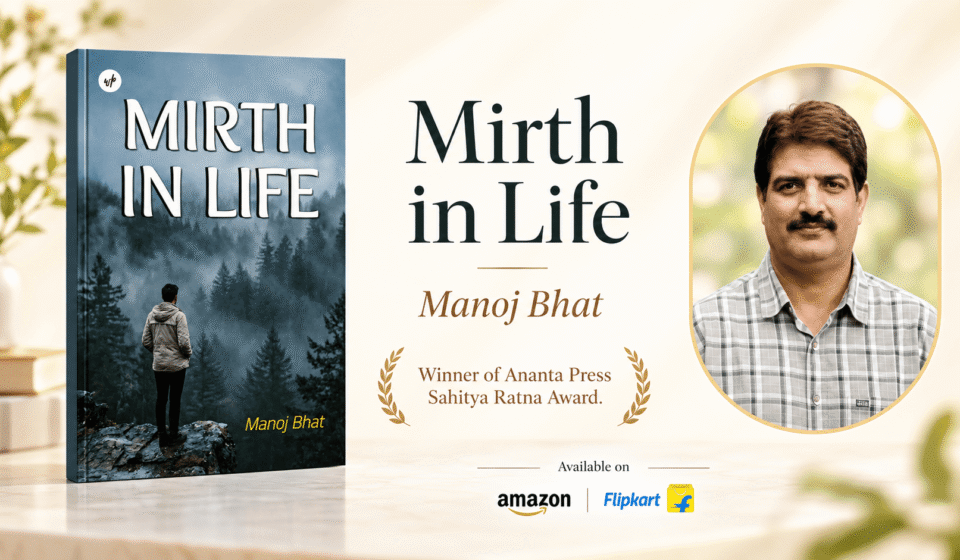

The most compelling idea in Manoj Bhat’s Mirth in Life is the movement from intelligence to wisdom. Its protagonist, Rohan, possesses a sharp mind and a strong desire to shape his life deliberately. He is surrounded by close friends—Gurdeep, Akriti, Irfan, and Tapas—who share in the effort to rise above negativity and create a more meaningful existence. Yet the story gradually reveals that intelligence, planning, and even financial independence can carry a person only so far. Beyond them lies a different challenge: learning how to live with oneself, with others, and with the unpredictability of life.
This makes the novel fundamentally human. Many stories celebrate the acquisition of power, wealth, knowledge, or status. Mirth in Life begins closer to the point at which such stories might end. Rohan has the mental capacity to plan effectively and the ambition to pursue uncommon goals. He is capable of understanding consequences and imagining multiple outcomes. But his eventual dissatisfaction exposes a gap between achievement and fulfillment. The book is interested in what happens inside that gap.
The concept of “grey matter” is therefore almost symbolic. Rohan’s intellectual strength is valuable, but it also becomes something against which the limits of rational control are measured. Life refuses to behave like a problem set. Relationships change, emotions resist logic, time moves faster than expected, and destiny introduces events no plan has anticipated. Rohan must discover that a brilliant mind may still need humility before uncertainty.
The group of friends deepens this discovery. Gurdeep, Akriti, Irfan, and Tapas give the novel a social heart. Their collective journey suggests that wisdom is rarely developed in isolation. Friends become witnesses to one another’s transformations. They remember earlier versions of us, challenge our assumptions, and help us distinguish temporary disappointment from lasting truth. Even the description of the group as “stoic” carries meaning: these are people trying to endure life with composure, yet endurance alone does not satisfy them. They want to discover mirth.
That distinction between endurance and joy is one of the book’s strongest themes. Human beings can become remarkably good at surviving routines, responsibilities, disappointments, and emotional strain. A person may appear strong because they continue functioning. But functioning is not the same as flourishing. Mirth in Life asks whether Rohan and his friends can move beyond the disciplined management of hardship toward genuine inner ease.
The novel’s use of financial freedom is also well judged. Rohan learns that money can reduce dependence and expand choices, but it cannot automatically produce emotional fulfillment. This is not an argument against financial security. Rather, it is an argument against confusing one form of freedom with every form of freedom. Economic independence is external; peace of mind is internal. The two can support each other, but they do not operate by the same rules.
The reference to Robert Frost’s “The Road Not Taken” introduces a literary metaphor for the choices shaping Rohan’s life. Roads represent more than opportunities; they also represent irreversibility. Once a person has travelled far enough in one direction, the other path becomes partly imaginary. This creates both meaning and regret. The novel seems aware that people often construct their identities from the choices they have made while simultaneously wondering about the lives they did not live.
This is where destiny enters the story. Rohan asks, in effect, how the wind will move and why circumstances sometimes fall apart. The question is ancient because it lies at the meeting point between human agency and forces beyond control. Mirth in Life does not need to solve that philosophical problem completely to make good use of it. The uncertainty itself becomes part of the characters’ education. They learn that a meaningful life may require both decisive action and acceptance of what cannot be directed.
The role of scriptures and meaningful messages adds a deeper dimension to this process. When rational planning reaches its limits, the characters turn toward sources of accumulated wisdom. This indicates that their search is not simply for emotional comfort but for a framework of meaning. Spiritual ideas can help people place suffering within a larger context, reconsider attachment, and distinguish between desire and contentment. Within the novel, these ideas function as part of the characters’ attempt to understand rather than merely escape their struggles.
Manoj Bhat’s academic background in English Literature is relevant here because the novel is clearly interested in ideas as well as events. The allusion to Frost, the attention to symbolism, and the reflective tone all suggest a writer who sees fiction as a space for philosophical exploration. At the same time, Bhat’s long professional experience gives the subject practical weight. After working in a multinational company, receiving recognition as a Star Performer, and then serving in government for twenty-eight years, he brings to the theme of achievement a perspective shaped by different kinds of institutional life.
That biography also makes the novel’s critique of success more nuanced. It does not come from someone dismissing work, discipline, or ambition. On the contrary, Bhat’s own record suggests sustained commitment. The book’s deeper point is therefore not that achievement is meaningless, but that its meaning depends on the larger life into which it is placed. A career can be honorable and productive while still leaving existential questions unanswered.
The emotional material of the novel—regret, woes, miseries, skepticism, and melancholy—prevents its philosophy from becoming abstract. These are experiences readers recognize. Everyone reaches moments when careful plans fail, when a decision appears uncertain in retrospect, or when expected happiness does not arrive. Rohan’s situation invites empathy precisely because it is not extraordinary. The book’s universal quality comes from taking ordinary dissatisfaction seriously.
The question of whether the group’s “final assault” on negativity will succeed gives the narrative forward motion, but it also opens an interesting interpretation. Perhaps the deepest victory is not the elimination of every negative experience. No life can guarantee that. The more durable achievement may be the development of a way of thinking and living that prevents difficulty from becoming the whole story. In this sense, wisdom means learning how to hold pain without allowing pain to define the entire meaning of life.
For readers, this makes Mirth in Life more than a story about one young man. Rohan becomes a representative figure for anyone who has ever believed, “Once I achieve this, I will finally be happy,” only to discover another layer of longing beyond the achievement. The novel gives that realization room to unfold without trivializing it. It asks readers to consider whether happiness is a destination, a discipline, a relationship, a perspective, or perhaps some combination of all four.
The book’s uniqueness lies in its willingness to keep these questions open while still offering hope. Rohan and his friends continue their search. Their determination does not disappear when their original assumptions are challenged. Instead, the challenge becomes an opportunity to grow. That is one of the novel’s most constructive ideas: disappointment can become a beginning rather than an ending if it leads to a wiser understanding of what matters.
Mirth in Life is therefore well suited to readers who appreciate fiction with a reflective and spiritual dimension. It combines friendship, ambition, literary allusion, personal struggle, and the search for purpose. Its underlying message is both simple and demanding: a meaningful life cannot be built from intelligence and achievement alone. It also requires values, emotional awareness, resilience, relationships, and the courage to revise one’s beliefs.
By tracing Rohan’s journey from confidence in planning toward a broader search for understanding, Manoj Bhat creates a novel about one of life’s most important transitions. The movement from knowing how to succeed to knowing how to live is rarely straightforward. Mirth in Life gives that transition a narrative shape and asks readers to examine the roads they themselves are travelling. In doing so, it offers not a formula for happiness, but something more valuable: a thoughtful reason to question the formulas we have already accepted.
Amazon Purchase Link: https://amzn.in/d/0aKhgiLE