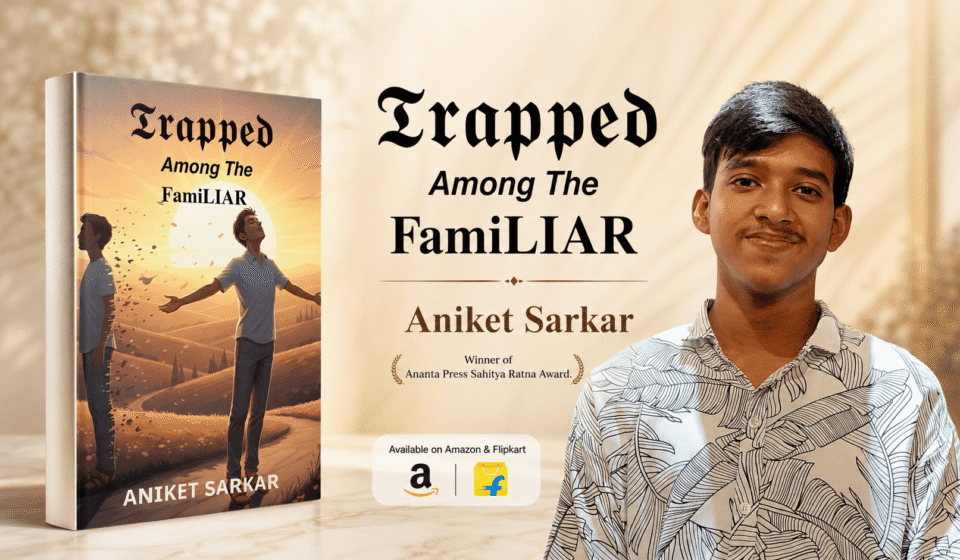

Book: Trapped Among The FamiLIAR | Author: Aniket Sarkar | Category: Psychological Self-Help
——————————————————————————————————————————————————————————————
Some books begin with a problem that is easy to define. Trapped Among The FamiLIAR begins with something much more difficult: confusion. The confusion of caring about someone yet feeling drained after every interaction. The confusion of trusting a person while repeatedly questioning your own judgment around them. The confusion of receiving advice that sounds protective but somehow leaves you less confident. Aniket Sarkar’s psychological self-help book explores this uncertain territory and offers readers a pathway from emotional confusion toward awareness, stronger boundaries, intuition, and personal growth.
That starting point is important because emotional manipulation is rarely experienced as a neat, identifiable event. If it were obvious, it would be easier to resist. More often, unhealthy influence develops gradually. A familiar person learns what makes us feel guilty, what we are afraid to lose, what kind of approval matters to us, and where our insecurities are. Sometimes this knowledge is used consciously; sometimes people repeat controlling behaviours without fully understanding them. Either way, the person on the receiving end may slowly lose confidence in their own perspective.
Trapped Among The FamiLIAR is valuable because it encourages readers to rebuild that perspective. The book’s central message is not simply “do not trust people.” That would be both unrealistic and emotionally damaging. Instead, it argues for a more mature form of trust—one that includes observation, boundaries, self-respect, and the ability to notice when something repeatedly feels wrong. This distinction gives the book a constructive rather than cynical tone.
The title captures this tension beautifully. “Familiar” suggests comfort, history, recognition, and belonging. By highlighting “LIAR” within the word, the title introduces the possibility that appearances and intentions can diverge. It is memorable marketing, but it is also a psychological metaphor. We often see people through the role they occupy in our life: parent, friend, partner, mentor, relative, classmate. Those roles create expectations. The book asks us to look beyond the role and examine the behaviour.
One of the book’s strongest themes is self-awareness. When people think about manipulation, they naturally focus on the manipulator. But self-help becomes more powerful when the reader also asks, “What makes me vulnerable to this pattern?” Perhaps it is fear of abandonment. Perhaps it is the need to be liked. Perhaps it is a habit of avoiding conflict. Perhaps it is the belief that setting boundaries is rude. Perhaps it is simply inexperience. Understanding these vulnerabilities is not self-blame; it is a way of gaining choice. We cannot control another person’s motives, but we can become more aware of the emotional buttons that influence our responses.
This is where personal growth enters the book. Growth is often described as becoming more ambitious, disciplined, or successful. Sarkar’s subject suggests another form of growth: becoming harder to manipulate because you understand yourself better. A person who knows their values can evaluate advice more clearly. A person who recognises guilt can pause before reacting to it. A person who accepts that disagreement is normal does not need to surrender every boundary to preserve a relationship. These changes may not look dramatic from the outside, but they can transform the quality of a person’s life.
The book’s interest in emotional intelligence is equally important. Emotional intelligence includes awareness of other people, but it also includes the ability to recognise one’s own internal state. If every conversation with someone creates anxiety, confusion, or pressure, those emotions are information. They may not prove wrongdoing, but they deserve examination. The book helps legitimise this process of noticing. Too many people are taught to dismiss discomfort if they cannot immediately justify it.
The discussion of intuition supports that idea. Intuition can be understood as an early warning system based on patterns we may not yet have consciously organised. Readers are encouraged to sharpen that intuition, which is most useful when paired with evidence and reflection. Rather than immediately assuming the worst, a person can watch for consistency. Does the same feeling arise repeatedly? Does the person respect a clearly stated limit? Do their actions match their promises? Do they become supportive only when we behave as expected? This careful approach can turn emotional instinct into practical wisdom.
Another major strength is the book’s broad relevance. Almost everyone has experienced a relationship that felt difficult to interpret. It might be a friend who competes while pretending to encourage, a family member who uses obligation as leverage, a partner who dismisses concerns as overreaction, or a colleague who presents control as guidance. The exact situation varies, but the underlying question remains the same: how do we recognise when influence has become unhealthy?
The answer suggested by Trapped Among The FamiLIAR is awareness before action. That is a sensible sequence. People often move between two extremes: tolerating too much or abruptly cutting someone off. Awareness creates more options. A reader can first identify the pattern, then decide whether the situation requires communication, a boundary, distance, support, or simply a change in personal response. This makes the book useful as a reflective tool rather than a collection of dramatic instructions.
Aniket Sarkar’s youth adds freshness to the book. At eighteen, he is writing from a point in life where identity is still actively being shaped. This matters because young adults are especially exposed to social comparison, peer approval, and the pressure to belong. They are also forming habits that may influence relationships for decades. Learning early that closeness should not require self-erasure is a valuable lesson.
His study of Education also aligns with the book’s deeper purpose. Education is ultimately about developing the ability to think. In that sense, a book that encourages critical thinking about relationships belongs naturally within an educational mindset. Readers are not merely told what to believe; they are encouraged to notice behaviour, examine motives, and understand themselves more clearly.
The book also has a quiet social importance. Healthy communities depend on individuals who can recognise coercion without becoming cynical, who can communicate boundaries without unnecessary aggression, and who can distinguish care from control. Emotional intelligence is therefore not only a private skill. It affects friendships, families, workplaces, and institutions. A reader who becomes more self-aware can also become more respectful of other people’s boundaries.
There is, however, an important caution. Psychological self-help works best when readers resist the temptation to turn every concept into a label. Not everyone who behaves badly is intentionally manipulative, and not every familiar relationship hides deception. Human beings make mistakes. People can be insensitive, insecure, or emotionally immature without having a calculated plan. The book’s ideas should therefore be used to identify patterns and protect wellbeing, not to create a permanent atmosphere of suspicion.
For readers facing serious emotional abuse, coercion, or mental-health distress, a self-help book should also be seen as one resource among many, not a substitute for professional assistance. But for everyday awareness, reflection, and personal development, Trapped Among The FamiLIAR provides an accessible framework. It can help readers begin conversations with themselves that they may have avoided for years.
What ultimately makes the book stand out is the way it connects interpersonal awareness with inner freedom. The “trap” in the title is not only another person’s behaviour. It can also be our own habit of ignoring evidence, seeking approval, or believing familiarity guarantees safety. Freedom therefore begins internally. When readers learn to recognise their own patterns, they become less dependent on the emotional rules set by others.
Trapped Among The FamiLIAR is a promising work from a young author whose interests in psychology, creativity, education, and personal growth come together around a timely subject. It asks readers to become more observant without becoming fearful, more self-protective without becoming closed, and more intuitive without abandoning reason. Most importantly, it encourages a form of emotional maturity that many people spend years trying to develop: the ability to remain connected to others while still remaining connected to oneself.