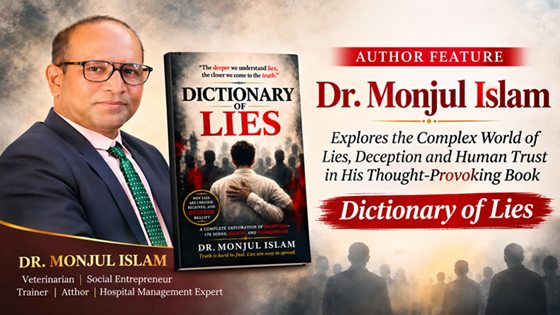
Dr. Monjul Islam Explores the Complex World of Lies, Deception and Human Trust in His Thought-Provoking Book Dictionary of Lies

Hindustan Central | Author Feature | November 2026
India, November 2026: Truth and deception have always played significant roles in shaping human relationships, influencing decisions and determining the course of societies. While honesty is considered a fundamental human value, lies often find their way into personal interactions, professional environments and social institutions. Exploring these complexities, Dr. Monjul Islam, a veterinarian, social entrepreneur, author and hospital management expert from Assam, presents his thought-provoking book, Dictionary of Lies.
Drawing inspiration from personal experiences and more than two decades of professional involvement in organizational management, Dr. Islam examines why people lie, why others believe falsehoods and how deception can gradually influence perceptions of reality.His book offers an insightful exploration of human behaviour, trust, misinformation and the importance of protecting truth without developing unnecessary suspicion toward others.
Dr. Monjul Islam: A Journey of Experience, Leadership and Human Understanding
Dr. Monjul Islam’s professional journey reflects his dedication to healthcare, entrepreneurship, organizational leadership and understanding human behaviour.
A veterinarian by education, he has worked with various national and international organizations, gaining valuable experience across diverse professional environments. He is also a trainer, author and hospital management expert, serving as the founder-director of two private hospitals in Nagaon, Assam, India.
With 24 years of management experience, Dr. Islam has developed a keen interest in the psychological and emotional factors that influence human relationships, leadership decisions and organizational dynamics.
Throughout his career, he has observed how communication, trust, personal beliefs and interpersonal relationships affect the functioning of institutions and individuals.His professional experiences have also encouraged him to examine the influence of misinformation, manipulation and deception in everyday interactions.
Beyond his professional observations, personal encounters involving trust, betrayal and changing relationships have significantly shaped his understanding of the complicated relationship between truth and falsehood.These experiences eventually inspired him to explore deception as a broader human phenomenon, leading to the creation of Dictionary of Lies.
Dictionary of Lies: Understanding the Hidden Nature of Deception
Dictionary of Lies is an exploration of lies, deceit and deception and their impact on individuals, relationships, organizations and societies.
The book is built around an important idea: being truthful does not automatically protect individuals from becoming victims of dishonesty.As the author emphasizes, “Truthfulness alone may not protect us from lies; we must also learn how to protect the truth.”
Through this perspective, Dr. Islam encourages readers to understand how deception develops, why misleading information becomes believable and how falsehoods can gradually influence human judgment.
The book raises several questions that remain relevant across different cultures and generations.
Why do human beings lie? Why do people believe lies? How does deception gain influence? Why can dishonesty destroy trust? And how can individuals protect themselves without becoming suspicious of everyone around them?Rather than offering a message of distrust, the book encourages awareness, responsible questioning and critical thinking.Its central purpose is to help readers recognize deception while preserving the honesty and confidence necessary for healthy human relationships.
The Fragile Relationship Between Trust and Lies
Trust is one of the most essential foundations of human relationships. Whether within families, friendships, workplaces or institutions, trust allows individuals to communicate, cooperate and develop meaningful connections.
However, deception can weaken this foundation.
A single lie may create misunderstanding, while repeated dishonesty can gradually damage emotional security and confidence.
In Dictionary of Lies, Dr. Islam explores how deception can influence relationships and alter people’s understanding of reality.The book considers the consequences of misleading information not only at an individual level but also within organizations and wider society.In professional environments, misinformation can influence decision-making, leadership and workplace relationships. In personal life, dishonesty may lead to emotional distress, conflict and broken connections.
Dr. Islam’s approach highlights the importance of balancing trust with awareness.
He encourages readers to recognize that questioning information responsibly does not necessarily mean distrusting the people around them.Instead, careful observation and thoughtful verification can help individuals build stronger and more dependable relationships.
From Personal Experiences to a Universal Message
One of the distinctive aspects of Dictionary of Lies is its connection to the author’s personal experiences.
Dr. Islam acknowledges that the book was inspired by personal pain and trauma, particularly experiences involving trust, betrayal and changing relationships.However, his intention extends beyond sharing individual experiences.
He seeks to transform those reflections into a meaningful exploration of deception that readers from different backgrounds can understand.
His years of involvement in organizational management have provided additional perspectives on human motivations, communication and interpersonal behaviour.By connecting these observations with broader questions about honesty and manipulation, the book examines deception as a recurring challenge in human interactions.Importantly, Dr. Islam does not present suspicion as the solution to dishonesty.
Instead, he encourages readers to develop the ability to distinguish between genuine trust and unquestioning belief.This approach gives the book a constructive message: understanding lies should strengthen one’s ability to protect truth rather than weaken faith in human relationships.
Why Dictionary of Lies Matters in Today’s World
In today’s rapidly evolving information environment, the distinction between truth and misinformation has become increasingly important.
Digital communication, social media and instant information sharing have made it easier for ideas and claims to spread across communities.However, the widespread availability of information does not always guarantee its accuracy.
Misleading narratives and unverified claims can influence public opinion, personal decisions and professional relationships.Against this backdrop, Dictionary of Lies explores questions that extend beyond ordinary dishonesty.The book encourages readers to examine how beliefs are formed, how deception becomes accepted and why critical thinking remains essential.
Its themes may appeal to readers interested in human psychology, personal development, relationships, leadership, organizational behaviour and social issues.By examining deception from multiple perspectives, Dr. Islam invites readers to become more thoughtful about the information they encounter and the conclusions they draw.
Protecting Truth Without Losing Trust
At its heart, Dictionary of Lies carries a message about awareness, honesty and the preservation of meaningful relationships.
Dr. Islam believes that understanding deception should not make people fearful or suspicious. Instead, it should encourage responsible judgment and greater appreciation for truthfulness.
The book invites readers to question wisely, verify information carefully and recognize the influence of misinformation on human behaviour.It also emphasizes that trust and critical thinking can coexist.
Through his writing, Dr. Islam seeks to encourage a more informed approach to relationships and communication, where honesty is valued and deception is better understood.His professional background and personal reflections contribute to a work that examines an issue affecting individuals across different walks of life.
A Thought-Provoking Contribution to Contemporary Non-Fiction
With Dictionary of Lies, Dr. Monjul Islam brings together his professional experiences, personal observations and enduring interest in human relationships to explore the complicated nature of deception.
The book is not simply about identifying lies. It is about understanding why they emerge, how they influence beliefs and what individuals can do to preserve honesty.
From interpersonal relationships to organizational environments and broader social structures, its subject matter addresses challenges that remain relevant in modern society.Ultimately, Dictionary of Lies invites readers to reflect on an essential question: How can people protect truth while continuing to trust one another?
Through this exploration, Dr. Islam presents a meaningful message about critical thinking, responsible awareness and the importance of protecting the human relationships that depend on honesty.
About the Author: Dr. Monjul Islam is a veterinarian by education, social entrepreneur, trainer, author and hospital management expert based in Nagaon, Assam. He is the founder-director of two private hospitals and has 24 years of management experience across diverse organizations. His interests include human behaviour, trust, leadership, relationships and organizational dynamics.
Book Details
Title: Dictionary of Lies
Subtitle: How Lies Are Created, Believed to Destroy Reality
Author: Dr. Monjul Islam
Category: Non-Fiction | Human Behaviour | Truth and Deception
Amazon Link: https://www.amazon.in/Dictionary-Lies-Dr-Monjul-Islam/dp/9373359266