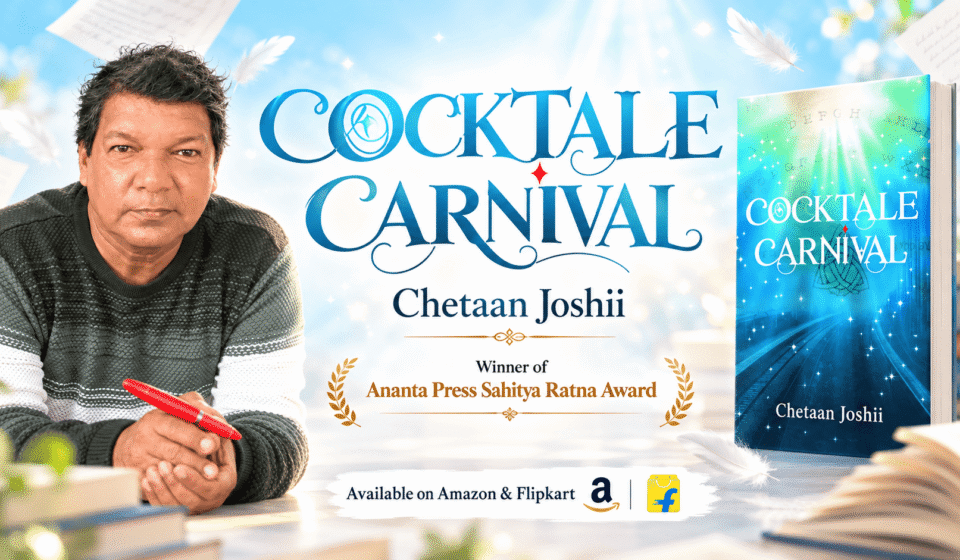

CockTale Carnival is not just a compelling short story collection; it is also a meaningful reflection of Chetaan Joshii’s broader storytelling vision. To read this book is to encounter a writer who has spent decades exploring the possibilities of narrative without surrendering to convention. His body of work—ranging from short story collections and graphic books to tribal novels and genre-bending creations—reveals a restless creative energy, and CockTale Carnival emerges as a vibrant expression of that energy. It is a book that reflects experience, confidence, imagination, and above all, an unwavering commitment to originality.
What becomes clear very quickly from the conception of this collection is that Joshii does not approach literature narrowly. He does not treat genre as a boundary; he treats it as a resource. Fantasy, horror, humour, surrealism, science fiction, realism, satire, and fable all find room in the book, and they appear to do so not awkwardly but organically. This suggests a writer who listens to the demand of each idea rather than forcing every idea into a preselected mould. That creative openness is one of the defining strengths of the collection. It helps explain why the stories feel fresh and why the book as a whole appears so dynamic.
CockTale Carnival can also be appreciated as the work of a writer who understands the relationship between literary experimentation and reader engagement. Joshii’s ideas are undeniably inventive. A composer making a music note vanish, a writer entering his own story, a detective looking for a stolen heart, a medium weaponizing planchette, a man dealing with the curse of O. Henry—these are eccentric, even flamboyantly imaginative ideas. Yet they do not seem designed merely to impress with oddity. Instead, they are reader invitations. They create the anticipation that something unusual, meaningful, or emotionally rich is about to happen. This is a sign of an experienced storyteller. He knows that imagination becomes most effective when it opens the door to connection.
The author’s background makes this achievement even more significant. Chetaan Joshii is not only an accomplished writer across multiple formats, but also a creative writing mentor certified by the British Council, a workshop facilitator, and the founder of LiTreasure Creative Writing Academy. His long engagement with literature as both practitioner and mentor suggests a deep understanding of how stories function. However, the real beauty of CockTale Carnival is that this knowledge does not result in stiffness. The stories appear to remain agile, playful, and alive. They are informed by experience, but not weighed down by it.
A particularly appealing aspect of Joshii’s storytelling vision is his faith in imagination itself. His statement that the only chance humans have to gain the upper hand during the AI invasion is the strength of HI—Human Imagination—is both memorable and revealing. It captures something essential about CockTale Carnival. The collection is not simply a display of narrative skill; it is also a demonstration of imagination as a human power. The stories ask readers to enter improbable situations, to see ordinary emotions through extraordinary metaphors, and to allow wonder, absurdity, and invention to reshape perception. In doing so, the book quietly celebrates one of literature’s oldest and most vital functions: enlarging the boundaries of thought.
At the same time, the collection does not seem detached from human experience. This is important because originality without humanity can feel hollow. The themes hinted at through the story concepts suggest a deeper emotional undercurrent. Ambition, creativity, desire, longing, ego, love, illusion, and self-discovery all appear to move beneath the eccentric surfaces. This is what turns the book from a clever idea collection into a meaningful literary experience. Readers are likely to enjoy the novelty, but they are also likely to find something more durable: emotional suggestion, symbolic richness, or a new angle on familiar truths.
The place of humour in Joshii’s storytelling deserves special mention. Humour is often underestimated in literary discussion, yet it is one of the most demanding and revealing modes of writing. It requires not only wit, but precision, timing, and psychological insight. The fact that Joshii’s literary journey began with humorous essays and expanded into broad genre storytelling helps explain the lively tone associated with CockTale Carnival. Humour here likely functions not as ornament, but as a mode of thinking. It permits inversion, exaggeration, surprise, and critical observation. It opens up the field of storytelling and makes even serious or emotional material more approachable.
The inclusion of animal-centered fables also demonstrates Joshii’s range and vision. Fables require clarity and symbolic economy. Through them, writers can express truths about pride, insecurity, foolishness, identity, or social behaviour in ways that are both simple and resonant. By including such stories alongside surreal, satirical, or speculative ones, the author reveals a capacious sense of storytelling. He recognizes that literature does not need to remain in one register to be powerful. Instead, power can come from contrast and interplay.
Chetaan Joshii’s achievements outside this volume also enrich the reader’s sense of the book. His works have been shortlisted, celebrated at major literary events, translated into Marathi, and linked with diverse creative collaborations. His recent recognition among influential authors and the awards won by his books underscore his active and respected place in contemporary literary culture. Yet CockTale Carnival does not rely on those accolades to justify itself. It stands on its own as a compelling collection. The external achievements matter not because they replace reading, but because they confirm what the work itself suggests: that Joshii is a writer committed to innovation and sustained literary exploration.
This collection is especially valuable because it models artistic courage. Many writers eventually find one successful formula and repeat it. Joshii chooses the harder path. He continues to explore. He writes across forms, genres, and tones. CockTale Carnival reflects that courage through every sign of variety and unpredictability in its design. For readers, this is refreshing. For emerging writers, it is instructive. It shows that originality need not be a slogan; it can be a lifelong discipline.
The book’s title line—“Stories that will shake and stir”—feels increasingly apt in light of the author’s wider vision. To shake is to disrupt fixed patterns. To stir is to awaken feeling, thought, or appetite. CockTale Carnival appears to do both. It shakes up generic expectations and stirs the reader’s imagination. It offers entertainment, but it also awakens admiration for the possibilities of storytelling itself. That is a rare and valuable effect.
In the end, CockTale Carnival is a strong achievement precisely because it unites the personal signature of its author with the expansive pleasures of fiction. It is unmistakably the work of a writer who values originality, enjoys experimentation, and remains deeply invested in the reader’s experience. Chetaan Joshii has created a collection that is lively, varied, emotionally responsive, and conceptually fresh. It celebrates not only stories, but the spirit in which stories are born.
For readers who want more than routine fiction, this book offers a rewarding encounter. It invites them into a world where ideas are bold, genres are fluid, and imagination is taken seriously as a human gift. That makes CockTale Carnival a distinctive and memorable collection—and an excellent example of what happens when a writer follows the principle that only the impossible is worth the effort. Amazon Link:
https://www.amazon.in/dp/9382035176