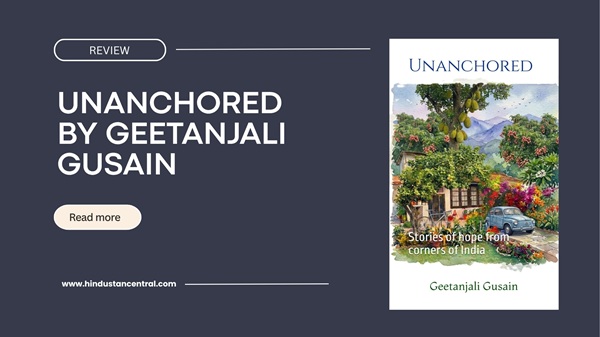
Book Review: Unanchored by Geetanjali Gusain, A Beautiful Journey Through India’s Landscapes of Hope

Some books entertain us for a few hours, while others awaken memories, stir emotions, and leave us looking at ordinary life a little differently. Unanchored: Stories of Hope from Corners of India, by Geetanjali Gusain, belongs to the latter category. Part of the Landscapes of Hope: Indian Short Stories series, this collection of fourteen narratives offers a thoughtful exploration of human vulnerability, nostalgia, resilience, and the enduring search for belonging. With evocative storytelling and an eye for the smallest details, she brings readers closer to the lives of people whose experiences feel remarkably familiar.
What makes Unanchored such an engaging read is its ability to transform everyday observations into meaningful literary experiences. The stories capture the extraordinary within the ordinary, reminding us that behind every familiar face lies a world of memories, unspoken emotions, private struggles, and quiet hopes. As readers move from one narrative to the next, there is a natural desire to continue, to discover another character, another place, and another moment of unexpected recognition.
One of the collection’s greatest strengths is its vivid sense of place. The stories take readers across India’s diverse landscapes, beginning with the spiritual atmosphere of the Golden Temple in Amritsar and moving towards the dry expanses of Rajasthan. Pigeons fly over Udaipur’s Lake Pichola, traditional naukas travel across Odisha’s Chilika Lake, and Kerala’s lush backwaters offer a different rhythm of life. The journey continues through Daman’s colonial architecture, Indore’s urban landscape, the emerald surroundings of Bhimtal, and the bustling streets of Mussoorie, extending into India’s modern metropolitan spaces.
These locations do more than establish a geographical setting. They create an atmosphere in which the characters’ emotions and personal journeys unfold. Each place carries its own associations, inviting readers to revisit familiar memories or imagine landscapes they have yet to experience. The descriptions are particularly appealing because they encourage the imagination to participate in the storytelling. Small details become vivid images, and the written word creates scenes that seem to exist beyond the page.
Yet the true heart of Unanchored lies in its exploration of human experiences. Across the fourteen stories, the protagonists confront moments of uncertainty, change, and self-discovery. One narrative follows a man attempting to rebuild his identity after a life-altering stroke, an experience that challenges his sense of self and forces him to reconsider his place in the world. Another explores the burden of familial expectations through the struggles of a young man caught between personal aspirations and the demands placed upon him.
These experiences give the collection emotional depth. Rather than treating resilience as an uncomplicated victory over adversity, Geetanjali Gusain explores the quieter process of learning to live with change. Her characters occupy that uncertain space between who they have been and who they might become. Their journeys reflect the complicated nature of identity, where personal desires, relationships, memories, and social expectations often pull in different directions.
The author’s writing style is warm, observant, and emotionally engaging. She pays attention to details that might otherwise escape notice, allowing seemingly insignificant moments to reveal something larger about the human condition. This sensitivity makes the characters relatable and gives the stories an intimate quality. Readers may recognise elements of their own families, friendships, neighbourhoods, and experiences within these narratives.
There is also a strong sense of nostalgia throughout the collection. Certain places and encounters have the power to transport us to earlier stages of life, bringing back memories we may not have revisited for years. Unanchored captures this feeling without relying solely on the past. Instead, it explores the relationship between memory and the present, showing how our experiences continue to influence the people we become.
Geetanjali Gusain’s professional background adds an interesting dimension to her perspective as a writer. With more than twenty-two years of experience as a strategist across sectors ranging from heritage conservation to high-tech Agritech, she brings a keen interest in observing people and understanding the environments that shape their lives. Recognised as one of India’s Most Impactful Women Leaders of 2025, she combines analytical observation with an empathetic approach to storytelling. This attention to the hidden layers of everyday life is evident in a collection that looks beyond outward appearances to explore the emotional worlds within.
Ultimately, the most memorable quality of Unanchored is its quiet celebration of hope. The book does not suggest that life’s difficulties can always be resolved easily. Instead, it reminds readers that moments of connection, acts of courage, and the willingness to begin again can help us find meaning amid uncertainty. Belonging, the collection suggests, is not necessarily tied to a particular place. It can emerge through understanding, acceptance, shared memories, and the people who make us feel seen.
Unanchored: Stories of Hope from Corners of India is a rewarding choice for readers who appreciate contemporary Indian fiction, character-driven narratives, and stories that combine emotional depth with vivid settings. It is a collection to savour slowly, allowing each story to unfold and its quieter observations to linger. Whether it evokes a cherished memory, brings a smile, or encourages reflection, the book offers something meaningful to take away.
Final verdict: A beautifully observed and heartwarming collection that celebrates ordinary lives, extraordinary emotions, and the resilience of the human spirit. Highly recommended for readers seeking a thoughtful escape into stories that restore a sense of connection and leave them feeling a little more hopeful.