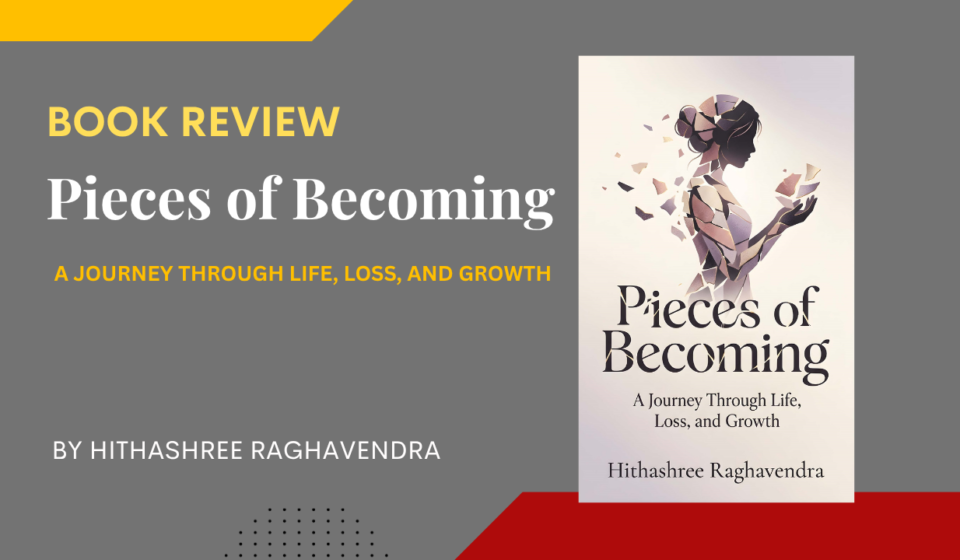
Book Review: Pieces of Becoming – A Gentle and Relatable Reflection on Life, Love, Fear, and Hope

Some books try to impress you. Others try to teach you. Pieces of Becoming by Hithashree Raghavendra does something quieter: it sits beside you and starts asking questions you may have been avoiding.
I did not read this book as a guide to “fix” life. The author makes it clear early that she is not offering a perfect formula or a final answer. That approach suits subjects such as purpose, fear, friendship, love, misunderstandings, expectations, regret, letting go, and hope. These are not topics with one correct answer. They are experiences, and the book is built around them.
The early chapters took me back to the strange transition between childhood and adulthood. “We Grew Up” captures something many of us feel but rarely say: growing older does not mean the child inside us disappears. We become more capable, but also more conscious of failure, comparison, responsibility, and other people’s expectations. The writing here is simple, and that simplicity gives the memories room to work.
The chapter on fear is relatable because fear is not presented as some dramatic villain. It appears in ordinary ways. A previous failure can make us overthink a simple task. A bad experience can make us suspicious of a new opportunity. A difficult relationship can make us afraid of getting close to someone else. The point is not that courageous people never feel afraid. It is that fear becomes dangerous when it starts making every decision for us.
My favourite stretch begins with “Chemistry of Connections.” Raghavendra uses chemistry to explain friendships and human bonds, comparing relationships with different chemical structures and reactions. On paper, this could have felt forced, but it gives the chapter personality. The most interesting idea is that some people are like catalysts: they enter our lives, change something in us, and then leave. Their absence does not cancel their importance.
From there, the book moves into the messier territory of modern emotions. “Was It Love?” questions our need to label every close connection. Friendship, comfort, attraction, admiration, gratitude, attachment, and love can overlap. The author mentions the vocabulary of modern dating, but her concern is much older than any new label: how do we know what we feel, and what happens when we are too afraid to say it?
That question becomes stronger in “Misunderstanding” and “The Unsaid Things.” These chapters understand how relationships often end in real life—not with dramatic fights, but with delayed replies, assumptions, silence, and two people waiting for each other to speak first. I found this part painfully believable. The book keeps returning to a basic but important idea: people cannot read the conversations happening inside our heads. We may think someone “should know,” but often they simply do not.
The chapters on judgment and expectations widen the focus. Now the issue is not only what happens between two people but also the way family, society, social media, and our own ambitions shape us. The discussion of expectations works because it does not say all expectations are bad. Wanting honesty, respect, effort, or care is reasonable. Trouble begins when we expect others to understand needs we never express, or when we expect ourselves to be excellent at everything.
What I appreciated most is how the second half creates a natural emotional sequence. Expectations can lead to disappointment; disappointment can become regret; regret asks for acceptance; acceptance makes letting go possible; letting go slowly becomes moving on; and moving on makes space for hope. That progression gives the book more shape than a random collection of motivational essays.
The author’s treatment of letting go stayed with me. It is not about pretending something never mattered. It is about carrying it differently. That feels more realistic than the usual advice to simply “move on.” The book also describes moving on as a process of small choices rather than one magical morning when the pain disappears.
The final chapter on hope avoids the easy promise that everything will be fine. Hope here is smaller and more believable. It means continuing even when there is no guarantee and accepting that the life we planned may not happen as imagined. The image of a painting changing after a mistake works well: the unexpected mark can become part of something new instead of proof that the whole picture has failed.
The book is not flawless. Some ideas repeat across chapters, and readers looking for academic psychology or complex philosophical argument may want more depth. But that is not what Pieces of Becoming seems interested in doing. Its strength is emotional familiarity. It uses everyday examples and direct language to make readers reflect without making reflection feel heavy.
Near the end, the book turns that reflection back on the reader through questions about forgiveness, expectations, important connections, hidden parts of oneself, and what a meaningful life actually means. There is also space for personal reflections. It is a small but effective choice because the book does not simply finish; it asks the reader to continue the conversation privately. The manuscript explicitly closes with reflective questions before the author’s final note, reinforcing this participatory approach.
Pieces of Becoming will speak most strongly to students, young adults, and anyone standing between an old version of life and a new one. It does not promise transformation in ten steps. It offers something more modest: a chance to notice what has already transformed you. Sometimes that is where becoming begins.
Title: Pieces Of Becoming
Author: Hithashree Raghavendra
Publisher: Evincepub Publishing|
Buy This Book on Amazon