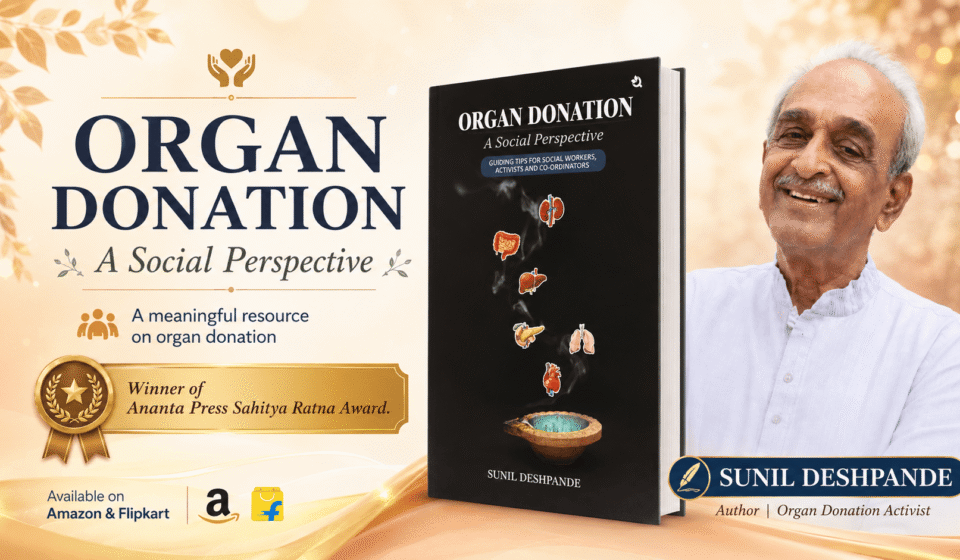

What makes an organ-donation system work? The first answers are obvious: skilled surgeons, functioning hospitals, legal safeguards, transplant coordinators, matching systems, and timely medical decisions. But there is another answer that receives less attention: society itself. If people do not understand organ donation, if families are afraid to discuss it, if myths remain stronger than facts, and if communities do not trust the process, even the most advanced medical system faces limitations. Organ Donation – A Social Perspective by Sunil Ranganath Deshpande is built around this often-overlooked truth. The book turns attention toward the social architecture that must exist around transplantation and, in particular, toward the workers and activists who help build it.
That perspective immediately gives the book a distinct place within nonfiction on healthcare. It is not presented as a surgical manual or a policy document. It is a guide for social workers, activists, and coordinators. This means its central concern is translation: how to translate a complex medical-social issue into meaningful public understanding. Translation here does not simply mean changing one language into another. It means translating expert knowledge into everyday language, turning abstract social responsibility into personal relevance, and converting awareness into informed action.
This is a difficult task. Organ donation touches some of the most sensitive areas of human life: death, grief, the body, family consent, morality, hope, and trust. Any public communicator working in this field must therefore combine accuracy with empathy. Too much technical language can create distance. Too much emotional language can create pressure. Oversimplification can produce misinformation. Silence can allow myths to grow. A good awareness worker must constantly balance these risks. The value of Deshpande’s book lies in taking this role seriously.
The author is particularly well suited to write from this angle because he has spent a large part of his public life doing exactly this work. His roles in the Mrutyunjay Organ Foundation, the Federation of Organ and Body Donation, Rotary, and a Maharashtra government authorization committee demonstrate involvement across voluntary, civic, and institutional settings. More importantly, his record of direct public campaigning gives the book an experiential foundation. Through four Avayavdaan Vaari padayatras from 2016 to 2020, he covered about 4,000 kilometres across Maharashtra and participated in more than 500 awareness programs. The majority of these programs were reportedly held in rural areas. This is not incidental background; it explains the logic of the book.
When an activist spends years meeting people in villages and towns, they begin to understand that awareness is not a single message. It is a relationship. One audience may be concerned about religious beliefs. Another may confuse organ donation with body donation. Some may worry about medical misuse. Others may simply have never considered the subject. A responsible communicator has to listen before speaking. They need to know the social context in which a question arises. In this sense, the book’s social perspective is less about theory and more about responsiveness.
One of the most interesting implications of the book is that organ-donation awareness should be treated as a professional skill. Volunteers often enter social causes with goodwill, which is essential, but goodwill alone cannot guarantee good communication. Training matters. Consistency matters. Ethical boundaries matter. Knowledge of systems matters. If a volunteer gives incorrect information, trust can be damaged. If an activist uses pressure, the cause can be harmed. If a coordinator cannot distinguish a social question from a medical one, they may overstep their role. A guiding text can help create a more disciplined culture of advocacy.
The book’s potential value is therefore organizational as well as individual. NGOs and civic groups can use such a resource when orienting new members. Colleges can use it in social-work or public-health awareness discussions. Rotary and service organizations can draw on it while planning campaigns. Volunteer teams can use it to establish a shared understanding before entering communities. When everyone involved in awareness begins from a clearer framework, the public receives a more coherent message.
Deshpande’s work on the Marathi organ-donation pratidnya, which was approved by the Government of Maharashtra as an official pledge, further highlights the importance of shared language. A public pledge is a social tool. It gives individuals a way to express intention and gives campaigns a memorable form. The fact that the author has also worked through Marathi and Hindi publications, English writing, and even music suggests that he understands awareness as multi-format communication. This is an important lesson for contemporary activists. People learn differently, and social campaigns become stronger when they use several forms of engagement rather than relying on one lecture or one poster.
The book also carries a wider lesson about public health. Many health challenges are not solved by medicine alone. Vaccination, blood donation, mental-health awareness, preventive care, and organ donation all depend on public understanding. Information must circulate through families and communities. Trust must be created before action is required. Social workers often perform this connecting function, yet their role can remain invisible compared with that of formal professionals. Organ Donation – A Social Perspective makes that invisible work visible.
Another reason the book stands out is the age and experience of its author. At seventy-six, Deshpande represents sustained activism rather than a short campaign. His continued writing and advocacy suggest that the book is part of a larger life project. That gives the text a sense of continuity. Readers are not simply receiving information from someone who studied the subject; they are receiving the accumulated perspective of someone who has repeatedly tested messages in real communities.
His literary background adds another dimension. He has published several Marathi books and contributed to works in other languages, while his book Manasi Samvad received recognition from the Maharashtra Sahitya Parishad in 2026. Writing skill is particularly important in public awareness because clarity is not cosmetic. A confusing sentence can become a confusing idea. A well-structured explanation can reduce fear. A memorable phrase can stay with a person long after an event. The author’s experience as both campaigner and writer gives this book a useful intersection of knowledge and communication.
The reader value of Organ Donation – A Social Perspective lies in how it reframes responsibility. A person does not need to be a surgeon to contribute to the organ-donation movement. They may contribute by organizing a discussion, correcting a misconception, sharing accurate information, supporting a family with appropriate resources, or helping a community understand the concept before an emergency arises. The book validates these roles while implicitly reminding readers that they should be performed responsibly.
Its social approach also protects the subject from becoming purely transactional. Organ donation should never be reduced to the idea of acquiring organs for recipients. It must remain connected to dignity, voluntary consent, human relationships, and respect for families. The more activists understand this, the stronger and more ethical the movement becomes. A social perspective keeps the human being at the centre.
For general readers, the book can broaden understanding. For professionals and volunteers, it can offer orientation. For organizations, it can serve as a discussion resource. For the organ-donation movement itself, it represents an effort to document and transfer field experience. That last function may be the most important. Social movements grow when one generation of workers passes its learning to the next. Without that transfer, every new activist is forced to begin from zero.
Organ Donation – A Social Perspective therefore deserves to be read not only as a book on donation, but as a book on how societies become ready for donation. It reminds us that awareness has structure, communication has ethics, and public trust must be earned. Medical science can make transplantation possible, but social understanding helps make donation imaginable. By focusing on the people who create that understanding, Sunil Ranganath Deshpande has chosen a subject that is both specific and far-reaching. The book’s greatest strength is this recognition: before an organ can become a gift of life, the idea of donation must first find a place in the public mind.