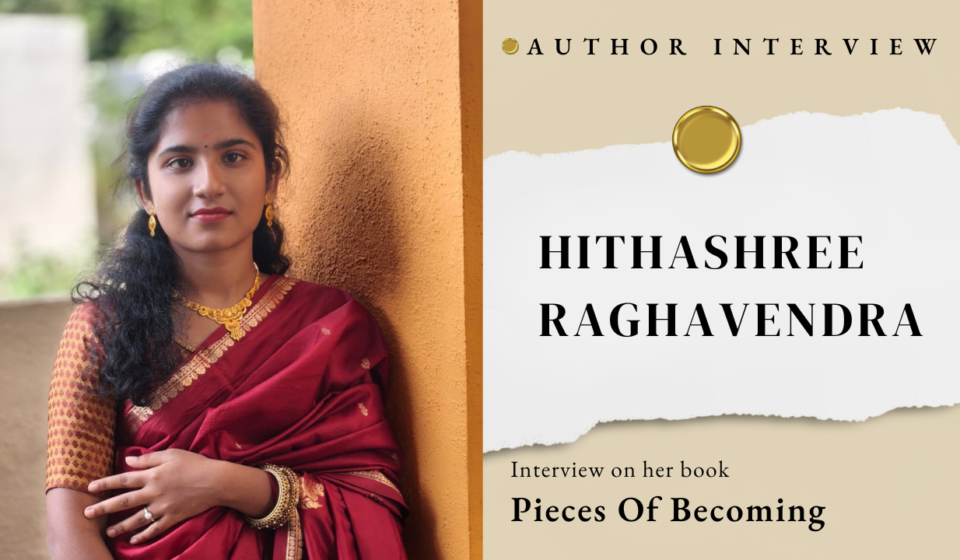
Beyond Labels and Expectations: Hithashree Raghavendra on Purpose, Identity and the Journey of Becoming

About The Book:
Pieces of Becoming is a reflective journey through the emotions, experiences, relationships, fears, regrets, acceptance, and hopes that shape us as we grow. It explores the quiet thoughts we often carry within ourselves and the lessons hidden in ordinary moments. Through its pages, the book invites readers to pause, reflect, and understand that becoming who we are is not a straight path, but a collection of little pieces gathered along the way.
About The Author:
Hithashree Raghavendra is a young writer and poet who finds inspiration in everyday experiences, emotions, and the quiet thoughts of life. She enjoys putting feelings into words and exploring the little things that often go unnoticed. Pieces of Becoming is her debut book, born from her reflections on life, growth, connections, and the journey of becoming.
Interview questions
1. Your book begins by questioning the purpose of life. Why did you choose such a large question as the starting point?
Hithashree Raghavendra: I think purpose is something almost everyone thinks about at some point, especially when life doesn’t go the way we expected. I didn’t choose it because I had an answer to it. I chose it because I was questioning it too. I felt that was a good place to begin because the rest of the book is, in a way, about understanding ourselves while we are still figuring life out
2. Do you believe purpose is discovered, created, or continuously rewritten?
Hithashree Raghavendra: I think it’s continuously rewritten. Maybe we discover certain things about ourselves along the way, but what we want from life can change too. Something that feels important to us at one stage might not mean the same thing later. I don’t think we need to have one fixed purpose for our entire life.
3. How has your own definition of a meaningful life changed over time?
Hithashree Raghavendra: Earlier, I think I associated a meaningful life more with achieving things and having something to show for it. Now I feel it’s much simpler than that. It’s about being able to look at your life and feel that you were actually present for it—that you cared about people, experienced things, did things that mattered to you and became someone you can be at peace with.
4. Why do people often connect identity so strongly with profession, achievement, marks, and social approval?
Hithashree Raghavendra: Because those are the things we are constantly taught to measure ourselves by. From a young age, we are asked about our marks, what we want to become, what we achieved and how others see us. After hearing that for so long, it becomes easy to mistake those things for who we actually are. But they are only parts of us, not the whole person.
5. What remains of a person when all external labels are removed?
Hithashree Raghavendra: I think what remains is the person underneath all of it—their thoughts, values, the way they treat people, what they care about and how they see the world. If you remove the titles and achievements, you’re still left with someone who has feelings, fears, hopes and a way of experiencing life. I think that part is much more important than the labels.
6. Can someone have several purposes at different stages of life without contradicting themselves?
Hithashree Raghavendra: Of course. I don’t think changing your purpose means you were wrong about what you wanted before. We change, our circumstances change and sometimes our priorities change too. What mattered to you at one stage may not be what matters to you later, and I think there’s nothing wrong with that.
7. Do you think the pressure to “find your purpose” can itself become unhealthy?
Hithashree Raghavendra: Yes, definitely. Sometimes we put so much pressure on ourselves to find one big purpose that we forget to actually live. Not every phase of life needs to have a grand meaning. Sometimes you’re simply learning, trying things, making mistakes and figuring yourself out. I think that is also a part of becoming.
8. How can a person distinguish between what they genuinely want and what society has taught them to want?
Hithashree Raghavendra: I think it takes a lot of honesty with yourself. Sometimes you have to ask, “If nobody knew about this, would I still want it?” or “Would I still choose this if there was no appreciation attached to it?” The answers may not always be immediate, but questions like these can help you understand whether something is truly yours or something you learnt to want.
9. Is becoming more about adding new qualities or removing false identities?
Hithashree Raghavendra: I think it’s both. We keep learning new things and becoming better versions of ourselves, but at the same time, we also have to let go of things that no longer feel like us. Sometimes becoming isn’t about adding something new at all. It’s about removing what we were only carrying because we thought we were supposed to.
10. What question should people ask themselves more often than “What am I going to become?”
Hithashree Raghavendra: Maybe, “Who am I becoming while I’m trying to become something?” We spend so much time thinking about where we want to reach that we sometimes forget to notice who we are turning into along the way. I think the journey matters just as much as whatever destination we have in mind.