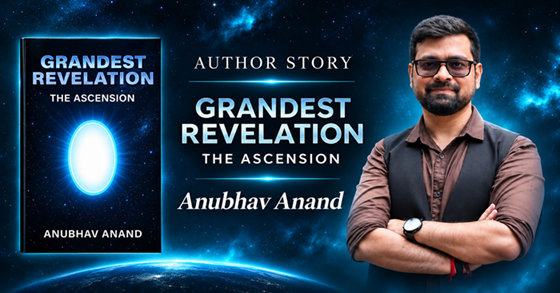

Author feature on Grandest Revelation The Ascension
Anubhav Anand’s account of his writing begins with two ordinary resources: observation and imagination. From a town in India, he has developed a fantasy-science fiction world in which stars, their descendants and human lives are entangled in a struggle for the universe. Grandest Revelation: The Ascension extends that world. For The Rise Insight, the most revealing aspect of this author story is the relationship between the scale of his invention and the personal questions that give it direction.
Anand self-published Grandest Revelation: The Exordium in June 2021. The Ascension follows that earlier work rather than presenting a wholly unrelated fictional setting. This matters when considering his development as a storyteller. A continuing story requires the writer to carry forward its history while creating new situations that change the significance of what readers already know. In The Ascension, the loss of Arthur Kane Davis destabilises the group he assembled and forces the narrative away from the reassurance of a guiding mentor.
The book’s note to readers identifies survival as its central concern. Anand does not limit the idea to avoiding physical destruction. He links it with retaining memories, maintaining conscience and asserting identity. This is an illuminating statement of the work’s priorities. The universe may be under threat, but the language of survival also raises questions about what deserves to be preserved within an individual. Continuing to live is inseparable from deciding what a life remains connected to.
The opening scenes give those questions a concrete setting. Davis’s campus has become Káymargue, a place named for home, and Mark Jones is responsible for its care. Training continues after loss, and conversations about relationships unfold alongside preparations for danger. Home is therefore not just a backdrop. It is something the characters attempt to maintain through routine and shared presence, even when the person who established it can no longer offer security. The story’s later separation of the group makes this early sense of belonging more consequential.
Anand’s world-building depends on lineage, but it does not treat knowing one’s origins as a simple solution. Demistars inherit celestial powers, while prophecies suggest that a particular descendant could alter the balance of the conflict. These ideas give ancestry immense importance without removing uncertainty. Characters have to interpret what they learn and decide whom to trust. A discovery about family can create a responsibility as readily as it provides an answer. Identity, in this setting, is something negotiated under pressure.
The author’s interest in abstract subjects also appears in his stated practice of occasional blogging. The novel gives such questions a dramatic form rather than presenting them as an essay. Its Ministry of Heavenly Body, rival factions and ancient divinations create situations in which authority and knowledge can be contested. The existence of an institution does not automatically guarantee safety, and the presence of a prophecy does not mean its meaning is equally available to everyone. Readers encounter ideas through the difficulties they cause for the characters.
There is a practical side to this imaginative work. The Ascension includes a recap of the earlier story, character introductions and a glossary. These elements recognise the reader’s task of learning a specialised vocabulary and following a large cast. They are also a reminder that creating a fictional universe involves more than inventing names. The writer must decide how to communicate its rules, how to preserve continuity and when to release information. Anand makes those demands visible through the supporting structure of the book.
His movement between familiar places and invented worlds provides another point of entry. The narrative can place a disoriented character on a recognisable Australian beach, then return to locations shaped by celestial conflict. Such shifts keep the fantastic world in contact with everyday experience. They also allow different kinds of response: confusion, humour, fear and resourcefulness. The result is a story that does not depend exclusively on distance from ordinary life. Familiar reactions help readers navigate unfamiliar circumstances.
Anand’s wish to extend his readership belongs alongside this attention to how a reader enters the story. The ambition is not simply to introduce a new title, but to bring more people into a fictional world whose history is already taking shape. The earlier book provides a foundation rather than a closed chapter. What can be seen in The Ascension is the work of continuation itself: expanding a mythology, redistributing the narrative among several characters and returning to questions of loyalty and endurance from different directions.
That sustained engagement is the clearest thread in Anand’s author story. Grandest Revelation began with The Exordium and continues here with a world whose dangers exceed any single character’s understanding. The Ascension invites readers who enjoy expansive speculative fiction to follow that uncertainty. Beneath the stars and the ancient struggle is a more accessible concern: how people preserve a sense of purpose when certainty disappears. Anand’s fiction gives that concern a universe in which to unfold.