
A review of Sandeep Narpala’s novel about the Kohinoor, identity and the weight of inherited history
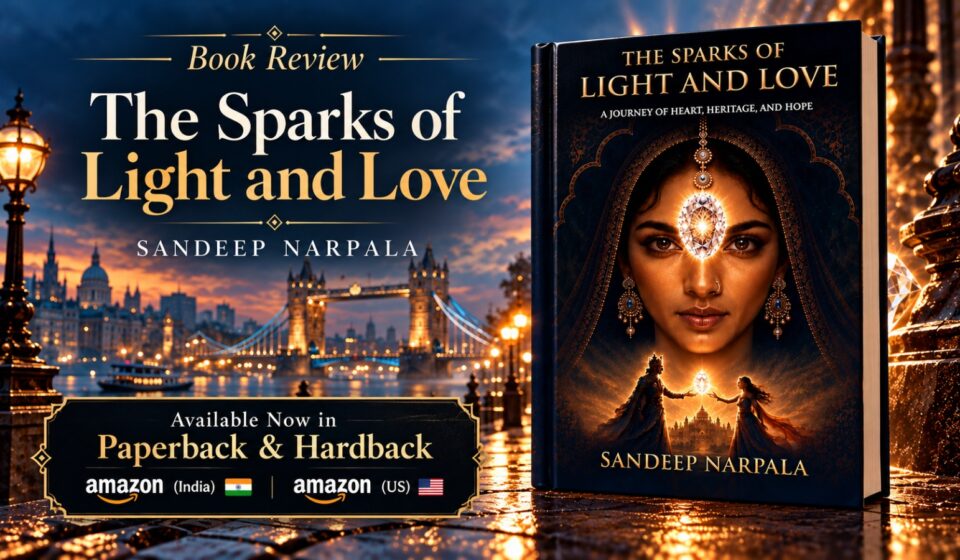
Some objects carry histories far larger than themselves. The Kohinoor is one of them. For centuries, the diamond has moved through royal hands, political upheavals and imperial power, gathering layers of meaning along the way. In Sandeep Narpala’s The Sparks of Light and Love, it becomes more than the centrepiece of a heist. It becomes a question: what does it mean to belong to a history that you did not create, but cannot escape?
The novel opens with the theft of the Kohinoor from London, immediately setting a thriller in motion. But beneath the chase lies a more complicated story about identity, heritage and the unfinished business of the past. Sandeep is interested not simply in where the Kohinoor is, but in what it has come to represent and who gets to decide what its history means. The result is a work of popular historical fiction that brings together suspense, romance and a question that has remained unresolved across generations.
A Character Caught Between Two Histories
At the centre of the novel is Prince Suryanarayana, an Indian-British gemologist whose professional expertise gives him an unusual relationship with the Kohinoor, while his dual identity places him between two competing versions of its history. He belongs, in different ways, to both sides of the historical divide. He lives within the country that currently possesses the diamond, while carrying an inherited connection to the country that continues to remember its loss.
That predicament gives Prince much of the novel’s emotional and intellectual weight. He is neither a detached observer nor a straightforward nationalist hero. He cannot simply stand on one side and judge the other from a comfortable distance. Every decision threatens some part of the life he has built, while every refusal to act risks feeling like an acceptance of an injustice that predates him.
Sandeep consequently uses Prince to explore the complicated nature of belonging. Is identity determined by the passport one carries, the place one lives, the work one does, or the stories one inherits? What happens when those different definitions point in opposite directions? The novel does not give Prince a neat answer. Instead, it places him in the uncomfortable space where several loyalties can exist at once, without necessarily being compatible.
As the book reaches readers, its themes of heritage, identity and belonging are also central to the wider conversation around it.
When the Past Refuses to Stay in the Past
Sandeep’s inspiration for the novel came from a 2016 news report about renewed requests for the Kohinoor’s return and Britain’s refusal. The idea remained with him, particularly the implication that returning contested objects could potentially empty British museums. That starting point helps explain why the novel is driven by more than a fascination with a famous jewel. Beneath the thriller is an engagement with a wound in public memory.
Rather than approaching the question through a purely historical or political narrative, Sandeep turns it into fiction. That allows him to explore what official statements and diplomatic exchanges often leave unresolved. Governments can make claims, museums can discuss provenance and historians can reconstruct the movement of an object through time. Fiction, however, can ask what those histories feel like when they become part of an individual life.
That is where The Sparks of Light and Love finds much of its emotional territory. The past is not presented as something safely contained within history books. It continues to shape the identities, choices and relationships of people living in the present.
Vajra and the Physical Weight of Memory
Vajra, the gifted student Prince loves, embodies that inheritance in an intimate and almost supernatural way. Her mysterious connection to the Kohinoor leaves her experiencing visions of the diamond’s violent past, and those visions begin to affect her health.
It is an intriguing narrative device because it removes the comfortable distance that often surrounds historical objects. A museum visitor can stand before a diamond, read its history and walk away. Vajra cannot. For her, the past refuses to remain behind glass. It enters her present and begins to threaten her future.
Through Vajra, Sandeep gives emotional and physical form to the idea of historical memory. The violence associated with the diamond is no longer something that happened centuries ago to people whose names have become part of history. It becomes a force that continues to act upon those living now.
The idea is central to the novel’s larger argument: history may be over chronologically, but it is not necessarily finished emotionally.
When Love Complicates Justice
Prince’s relationship with Vajra further complicates the politics of reclamation. He is not acting solely because he believes the Kohinoor belongs elsewhere. He believes recovering it may save someone he loves.
That distinction matters. A political argument can be debated from a distance. Love rarely allows such distance. Prince’s personal desperation pushes him towards decisions that his professional training and public responsibilities might otherwise prevent him from making.
The novel therefore avoids giving him a single, uncomplicated motivation. He is simultaneously a gemologist, a citizen, a man caught between competing histories and someone trying to protect another human being. Those identities do not always agree.
His desire to do what he believes is right can lead him towards actions that are ethically difficult. The moral tension of the story emerges precisely from that contradiction. A noble purpose does not automatically make every method noble.
The romance, therefore, is not simply an emotional subplot added to a historical thriller. It is one of the forces that moves the story forward and complicates its central question.
The Diamond Between Two Worlds
The Kohinoor becomes a fitting symbol for Prince himself. It exists physically in one place while carrying a history that reaches far beyond it. Prince’s dual citizenship creates a similar condition. He exists between worlds rather than neatly inside one.
His professional life is shaped by contemporary British institutions, while his understanding of the diamond is inseparable from Indian history and memory. This gives the novel an interesting perspective on identity. It does not present belonging as a simple choice between two countries. Instead, Prince embodies the complications that arise when histories overlap.
He can participate fully in the present while still being confronted by the consequences of the past.
London consequently becomes more than a setting. It represents both the modern world Prince inhabits and the imperial history that continues to shape the meaning of the diamond. The Kohinoor may physically sit in Britain, but within the novel it remains historically and imaginatively present in India.
The diamond does not need to move for its meaning to travel.
When Expertise Becomes a Moral Dilemma
Prince’s profession as a gemologist adds another layer to his divided identity. He understands the language of stones, provenance, authenticity and value. His expertise gives him access to the very systems that determine how objects such as the Kohinoor are identified and protected.
But that same knowledge becomes dangerous when his personal motivations begin to conflict with his professional responsibilities.
He is no longer simply using his expertise to understand a historical object. He is putting his career, credibility and reputation at risk because of what that object represents. In that sense, the question of reclaiming heritage becomes inseparable from the question of what Prince is willing to sacrifice in order to act on his beliefs.
His professional identity, citizenship, personal relationships and understanding of heritage all begin pulling in different directions.
The diamond becomes a test of conscience.
Who Gets to Tell the Story?
One of the more interesting ideas running through The Sparks of Light and Love is that ownership is not only about possession.
Who owns an object? The person who currently possesses it? The institution that legally holds it? The kingdom from which it was taken? The people who inherited the cultural memory of its loss?
And perhaps the more difficult question: who gets to tell its story?
Sandeep does not attempt to settle these questions through a single historical argument. Instead, he places different characters around the same object, each carrying a different understanding of legitimacy.
Detective Scott approaches the diamond through the framework of present-day law. Prince sees it through professional knowledge, personal identity and historical memory. Amarkesh Vitrodi brings another set of motives into the equation. Their competing perspectives prevent the narrative from becoming a straightforward contest between heroes and villains.
The Kohinoor becomes the point around which different ideas of ownership, duty, legitimacy and justice collide.
The Mountain of Light
The meaning of the Kohinoor itself gives the novel an evocative central motif. Koh-i-Noor translates to “Mountain of Light”, and the idea of light runs naturally through the story.
Light can represent beauty and value, but it can also expose what has been hidden. The diamond’s brilliance is inseparable from the darker history surrounding it. Its beauty draws attention, while its history complicates the possibility of simply admiring it.
For Vajra, the diamond becomes a source of suffering. For Prince, it represents heritage and hope, but also temptation and danger. For those pursuing it, it represents possession, legitimacy or power.
The same object means something different to each person who approaches it.
That may be the novel’s most effective metaphor. The Kohinoor does not have one meaning because history itself does not have one meaning. What appears to be an object of beauty from one perspective can become a symbol of loss from another.
A Thriller Carrying a Larger Question
For all its historical and political concerns, The Sparks of Light and Love remains a work of popular fiction. The heist creates momentum, the pursuit creates suspense and the relationship between Prince and Vajra provides the emotional centre.
This accessibility is important to Sandeep’s larger purpose. He has spoken about wanting the book to reach readers who may not ordinarily choose historical fiction. Rather than asking readers to approach the Kohinoor through an academic discussion, he gives them characters to care about and a mystery to follow.
The result is a story that allows historical questions to arrive through entertainment.
Readers do not need specialist knowledge of colonial history to understand the central dilemma. They simply need to recognise the human impulses driving the characters: love, loyalty, belonging, fear and the desire to correct something perceived as unjust.
The author’s scientific background also creates an interesting relationship between fact and imagination. Sandeep researched the historical record, but fiction allows him to move beyond what can be documented and explore what history might mean to the people living in its shadow.
The novel then asks a different question: what do those facts mean when people have to live and act within them?
An Unfinished History
The Sparks of Light and Love is at its most interesting when it treats return as more than the movement of a diamond from one display case to another. Reclamation can involve dignity, identity and the right to tell one’s own history. At the same time, the story recognises that historical symbols place real people under pressure.
Prince and Vajra are not observers of history. They are caught inside its pressure.
That is what makes the novel more than a straightforward tale of a stolen treasure. The Kohinoor is not simply the object everyone is chasing. It is the force that exposes who these people are, what they believe they owe to the past and what they are willing to risk in the present.
The novel’s most interesting question is therefore not simply whether the Kohinoor should be returned. It is what returning it would actually mean.
Would it restore cultural dignity? Would it repair a historical wrong? Would it change the lives of people who have inherited the memory of its loss? Or would the diamond simply move from one display case to another while the deeper questions remained unresolved?
Sandeep leaves room for these possibilities.
Reclamation, in the world of The Sparks of Light and Love, is not merely about recovering an object. It can mean recovering identity, dignity and the authority to tell one’s own history. But the novel also recognises that such symbols demand sacrifices from real people.
The Final Question
Ultimately, The Sparks of Light and Love is a novel about a diamond, but it is also a novel about the people who find themselves standing beneath its enormous historical shadow.
Prince’s divided identity gives the story its central conflict. Vajra’s connection to the diamond gives history a human and physical dimension. The heist provides the suspense, while the question of ownership gives the story its larger purpose.
For readers, the novel leaves behind a question that is more difficult than simply asking who should possess the Kohinoor.
Who gets to decide what the past means?
That is where The Sparks of Light and Love finds its lasting relevance. It takes an object that has been debated for generations and places it inside the lives of fictional characters, allowing history to become personal, intimate and immediate.
The diamond may be centuries old. The question surrounding it is not.
And perhaps that is the most fitting place for the story to leave us: not with a final answer, but with the recognition that some histories remain unfinished because every generation finds itself deciding what to do with what it has inherited.
About the Book
A story of suspense, romance and cultural heritage, the novel brings together a stolen diamond, a divided identity and a history that refuses to remain in the past.
Read and purchase:
- Goodreads: The Sparks of Light and Love on Goodreads
- Amazon India: Buy on Amazon India
- Amazon.com: Buy on Amazon.com
- Ziffy Bees: Buy on Ziffy Bees
About the Author
Sandeep Narpala is a dynamic storyteller who blends heart-pounding suspense, epic romance and rich cultural heritage into unforgettable page-turners. With a keen eye for history’s hidden truths and humanity’s deepest emotions, he crafts gripping tales of love, destiny, sacrifice and defiance that keep readers engaged until the final page.
Drawing from his South Asian roots and a lifelong passion for uncovering extraordinary stories, Sandeep creates high-stakes narratives filled with vivid characters and sweeping adventure. The Sparks of Light and Love is his debut novel.
When he is not writing, Sandeep is involved in scientific research, building new ventures and pursuing entrepreneurial ideas that bridge technology and human potential. He lives in Maryland, USA.