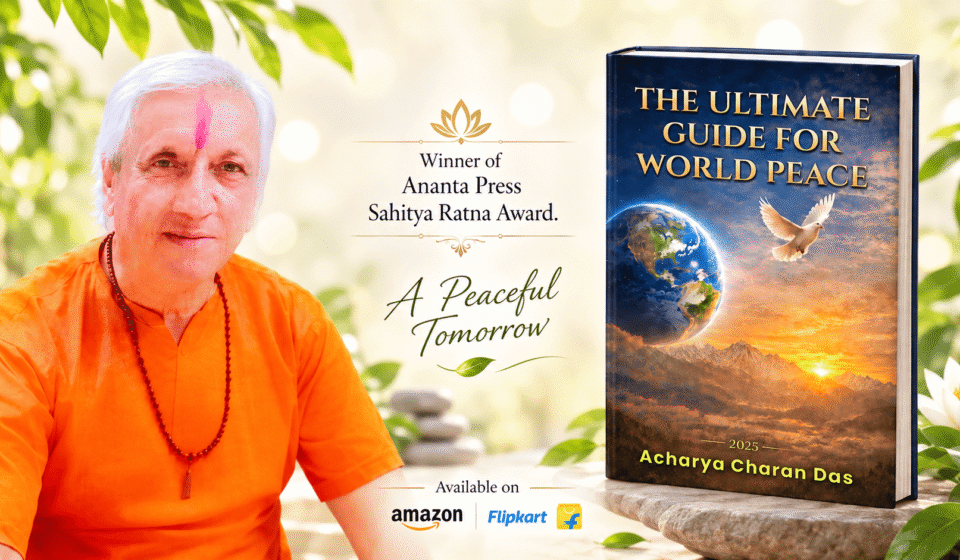

The most persuasive idea in The Ultimate Guide for World Peace may also be its simplest: people learn peace not only from what they are told, but from what they repeatedly see others do. Acharya Charandas returns to the importance of example throughout the book, and this theme gives his vast manuscript an immediately practical dimension. Parents, teachers, spiritual leaders, governments, public figures, and ordinary citizens are all participants in moral education. If their conduct contradicts their words, the contradiction does not remain private. It becomes culture.
This focus allows the book to speak directly to daily life even while discussing global problems. World peace can sound impossibly large. Most individuals do not negotiate treaties or command armies. Charandas reduces the scale without reducing the seriousness. What do we consume? How do we respond to anger? What do we teach our children through conduct? Are we honest when nobody is watching? Do we treat other living beings as objects or as creatures capable of suffering? Do we perform our duties responsibly? Are our beliefs chosen through examination or merely inherited? In the author’s framework, answers to these questions are part of the architecture of peace.
The preface offers a revealing example of his reasoning. Charandas argues that advice has little value when the adviser models the opposite behavior. His broader principle is that examples shape consciousness. This may be one of the book’s most accessible ideas because it applies regardless of the reader’s religion. A child notices hypocrisy before understanding theology. A citizen notices whether leaders obey the standards they impose on others. A community notices whether public messages about compassion are reflected in actual treatment of vulnerable people and animals. The book insists that moral credibility is behavioral.
From this principle, Charandas develops a demanding conception of responsibility. He does not allow the reader to blame social systems while ignoring personal participation in them. Institutions matter, but institutions are made and sustained by people. Markets respond to desires. Political cultures reflect collective habits. Religious institutions acquire power because individuals trust and support them. Environmental damage grows through repeated choices. Violence becomes normalized through repeated examples. The author therefore brings responsibility back to the individual mind, which he describes as capable of becoming either a friend or an enemy depending on how it is trained.
The spiritual foundation for this argument is self-realization. Drawing on the Bhagavad Gita, the author describes the self as distinct from the temporary body and emphasizes the need to control the senses rather than allowing them to dominate consciousness. This is not presented as an abstract mystical achievement. It is connected with freedom from compulsive desire, pride, anger, and ego. The person who is governed by endless craving cannot easily contribute to a peaceful society because every relationship risks becoming a competition for possession, recognition, control, or pleasure.
The book’s treatment of work and renunciation is especially useful here. It pushes back against the idea that spiritual life means escaping obligations. The author discusses duty as active service and argues that a person should work responsibly while loosening attachment to selfish reward. This gives his spirituality a social dimension. Peace requires people who do their work, support families and communities, and direct talent toward something larger than personal accumulation. It is a vision of discipline rather than passivity.
Compassion is the second major pillar. Charandas extends moral concern beyond human beings and repeatedly argues that animals are sentient and spiritually significant. His critique of slaughter and meat consumption is intense, and the book includes graphic material intended to force confrontation with suffering that may otherwise remain invisible. Readers may agree or disagree with all the theological and causal claims attached to this subject, but the ethical question is difficult to avoid: can a culture become more peaceful without examining the forms of suffering it normalizes for convenience, appetite, or profit?
The author also connects responsibility with intellectual honesty. The book is openly suspicious of inherited belief when it prevents examination. It asks readers to compare teachings, observe outcomes, and distinguish what the author calls eternal truth from social habit. This is one of the reasons the manuscript spends so much time criticizing religious texts and institutions. The criticism is often severe, sometimes sweeping, and clearly written from a Vedic standpoint. Some claims about history, science, religion, and social groups should be independently verified rather than accepted solely on the authority of the text. A thoughtful reading therefore requires two kinds of openness at once: openness to the author’s moral challenge and openness to questioning the author’s evidence.
That tension can actually make the book more engaging. A bland peace book might offer agreeable statements that no one contests. The Ultimate Guide for World Peace rarely settles for agreeable generalities. It wants the reader to take positions, test assumptions, and confront inconsistency. Its tone can be polarizing, but it is never indifferent. The author writes as someone who believes civilization is facing consequences that cannot be corrected by public relations or symbolic gestures.
The book’s long development gives this urgency weight. Charandas traces the project back to a manuscript prepared around 1990 in connection with a competition focused on the survival and prosperity of life on Earth. The present work therefore carries the feeling of a sustained vocation. Its 15-chapter structure, extensive visual material, quotations, comparative arguments, environmental discussions, and final sections of summary and suggested reading suggest a writer who has accumulated evidence and reflections over many years. Whether the reader views this as exhaustive or overwhelming will depend on taste, but the commitment behind it is unmistakable.
The title The Ultimate Guide for World Peace is intentionally ambitious. No single book can settle every religious, historical, environmental, political, and moral debate gathered here. The more productive way to read the title is as an expression of the author’s aspiration: to identify foundational principles that he believes can guide human life toward peace. Those principles are remarkably consistent across the manuscript – self-knowledge, sense control, compassion, duty, truthfulness, responsibility, respect for life, and the recognition of a spiritual unity deeper than social labels.
This is why the book can be meaningful even for readers who do not share every theological conclusion. Its deepest challenge is behavioral. What happens when we demand peace from governments but do not cultivate patience at home? What happens when we condemn violence but remain indifferent to suffering that benefits us? What happens when spiritual language becomes a substitute for disciplined conduct? What happens when we inherit beliefs without testing whether they produce humility and compassion? These questions give the book its continuing relevance.
The Ultimate Guide for World Peace is a demanding read because it demands something from the reader. It asks for examination, restraint, responsibility, and a willingness to connect private conduct with public consequences. Its voice is intense, its scope enormous, and its arguments sometimes controversial, but beneath all of that is a direct ethical proposition: peace must be practiced before it can be institutionalized. For readers willing to engage critically and patiently, that proposition makes the book memorable. It is not content merely to describe a peaceful world. It asks what kind of person would be capable of building one.
Amazon Link: https://www.amazon.in/ULTIMATE-GUIDE-WORLD-PEACE-ebook/dp/B0H27JGP8W/