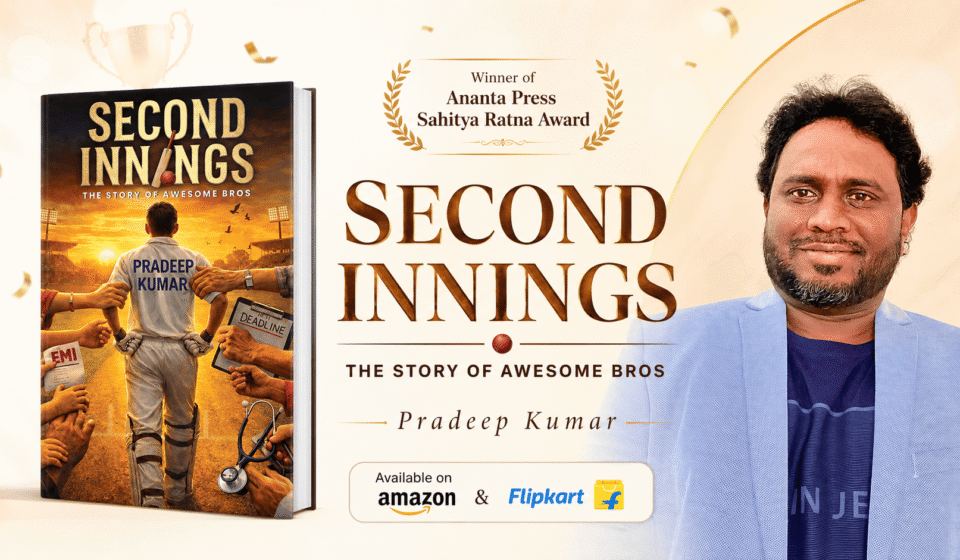

A debut book often carries a special kind of energy. It represents not only the beginning of an author’s public journey but also the moment when private experience becomes something that can be shared, examined, and preserved. Second Innings: The Story of Awesome Bros is especially notable in this regard because Pradeep Kumar did not approach writing as a long-established literary ambition. He describes himself as neither a habitual reader nor a habitual writer. The story of Awesome Bros, however, became important enough to move him from experience to reflection and from reflection to authorship.
That origin is one of the book’s greatest strengths. Many nonfiction works begin with a thesis and search for examples to support it. Second Innings appears to begin with life itself: a group of strangers in a gated community starts playing weekend cricket, and over time the game becomes the foundation of a meaningful human collective. The author’s insights about leadership, recognition, resilience, and belonging emerge because he lived through this transformation. The book is therefore written not from theory but from accumulated moments.
This distinction matters. Readers can usually sense when a lesson has been imposed on a story and when it has been discovered within one. Pradeep Kumar’s reflections are grounded in close matches, missed catches, early mornings, debates, breakfasts, and experiences away from the field. These are concrete details, and they keep the book connected to reality. Leadership is not presented as a polished slogan. It is visible in the way people respond when pressure rises. Resilience is not a motivational command. It is visible when the team returns after losing. Belonging is not a sentimental claim. It is visible when strangers begin treating one another like family.
The book’s uniqueness also comes from the scale of its subject. Professional sport is already widely documented. Readers have access to biographies of celebrated players, accounts of international tournaments, tactical analyses, and stories of elite achievement. Far fewer books give serious attention to community-level sport, even though this is where countless people experience the game personally. Awesome Bros represents the cricket of ordinary adults who play because the game gives structure, joy, and connection to their lives. By focusing on them, the book honours a large but often invisible sporting culture.
The cover’s idea of competing responsibilities is reflected in the premise. A player walks toward the field while surrounded by the claims of work, family, health, and finance. This is a compelling visual metaphor for the book’s central tension. The second innings is not played in the absence of responsibility. It is played while responsibility remains present. The participants do not escape adulthood; they negotiate with it. Every Saturday appearance therefore carries a small story of prioritisation.
This makes the book relevant to a broad readership. Cricket lovers will recognise the emotional intensity of close matches, the pain of dropped chances, and the endless conversations that follow play. Corporate professionals will recognise the challenges of building trust across different personalities. Community leaders will recognise the effort required to keep voluntary groups alive. Readers interested in personal growth will recognise the importance of consistency and second chances. Even those with little interest in sport can understand the desire to belong to something that exists beyond work and obligation.
Pradeep Kumar’s corporate experience gives the reflections additional depth. With more than two decades in the IT and corporate world, he has led teams across varied functions. He believes that people come before performance. In Second Innings, that belief is tested and illustrated outside the office, where people participate voluntarily and where formal power has limited force. A weekend team cannot rely indefinitely on authority. Members will keep returning only when they feel respected, included, and emotionally connected to the group.
The emphasis on leadership without titles is particularly timely. Society often celebrates visible leaders while overlooking the many people who stabilise a team informally. The person who checks availability, creates enthusiasm, encourages someone after failure, makes a fair suggestion, or prevents a disagreement from becoming personal may be leading in the most practical sense. The book broadens recognition by asking readers to notice such contributions. This is one reason it can remain useful beyond its immediate story.
The theme of recognition beyond results gives the work moral weight. Results are easy to celebrate because they are visible. Runs, wickets, victories, promotions, and awards can be counted. Yet human groups depend on many uncounted actions. A player may not dominate the scorecard but may be essential to the team’s confidence. A colleague may not receive public credit but may quietly enable others to succeed. A family member may hold routines together without applause. By valuing these contributions, the book encourages a more generous and accurate view of achievement.
The treatment of loss is equally important. A meaningful team must learn how to lose without losing itself. This requires perspective, humour, and trust. Close defeats can create frustration, and mistakes can tempt people toward blame. But they can also deepen a group’s maturity. When players continue to support one another, defeat becomes part of a shared history rather than a reason to separate. The book’s attention to resilience through losses prevents it from becoming a simple celebration of success.
The humour promised in the narrative is another sign of authenticity. Community sport is full of incidents that are funny precisely because the people involved care so much. A missed catch can become legendary, an argument can later seem absurd, and a serious plan can collapse in an unexpectedly comic way. Humour allows the book to remain warm while discussing meaningful ideas. It reflects the tone in which friends often remember their most important experiences: with affection, teasing, and gratitude.
The title Second Innings deserves praise for unifying the book’s many layers. It refers to cricket, but it also suggests renewal in personal identity, friendship, leadership, and creativity. The team gives its members another way to see themselves. The book gives Pradeep Kumar another way to express himself. Readers may also discover a second-innings question of their own. What interest has been postponed? What community has not yet been joined? What part of life could be revived through regular commitment?
The subtitle, The Story of Awesome Bros, keeps the work personal and specific. This is not presented as a universal formula with guaranteed steps. It is the story of one team and the meaning its members created together. That specificity is a virtue. The more honestly a book describes a real group, the more readers can compare it with their own experiences. Universal value emerges not from vagueness but from truthful detail.
As general nonfiction, the book’s literary and reader value lies in its capacity to preserve a living culture. Groups often generate stories that remain scattered across messages, photographs, jokes, and personal memories. Over time, details fade and participants move through different phases of life. Writing gathers those fragments and gives them continuity. Second Innings becomes not only a book for the public but also a record of how Awesome Bros came to matter.
The work also represents an act of recognition by the author. By writing about a collective rather than only himself, Pradeep Kumar acknowledges that the experience was created by many people. Team stories are inherently shared stories. Each player’s presence, temperament, effort, conflict, and support contributes to the whole. The book’s sense of gratitude is therefore likely to be one of its most attractive qualities.
For readers seeking highly technical cricket analysis, this may not be the primary purpose of the book. Its larger interest is human. Cricket is the arena through which it explores how people build trust, create traditions, recover from disappointment, and make room for joy. This clarity of purpose helps the book stand out. It knows that the emotional meaning of a match can be more lasting than the score.
Second Innings: The Story of Awesome Bros is a promising debut because it transforms a local, lived experience into a reflection with broad relevance. It celebrates ordinary people without pretending that their journey was effortless. It respects competition while looking beyond victory. It values leadership while freeing it from hierarchy. It acknowledges responsibility while defending the need for friendship and play. Most of all, it shows that extraordinary communities can begin with ordinary people who choose, consistently, to be present for one another.
The book’s final impression is one of warmth and possibility. A gated community becomes a neighbourhood. Strangers become teammates. Teammates become family. A working professional becomes an author. A Saturday game becomes a philosophy of life. That chain of transformations is exactly what makes the book unique. It reminds readers that a second innings does not need a stadium, a crowd, or a dramatic announcement. Sometimes it begins quietly, with a bat, a ball, a few willing people, and the decision to meet again next week.
| PURCHASE THE BOOK ON AMAZON https://amzn.in/d/0bT5H2eK |