A Contemporary Hindi Voice for the Unsaid: The Literary Promise of Lifafe Samvednaon Ke

Book: लिफ़ाफ़े संवेदनाओं के — किस्से, कविताएँ और ख़याल | Author: Sushmita Sammi
A literary collection need not be large in ambition to be serious in purpose. Sometimes a modest intention—to notice what is normally overlooked—creates the most direct relationship with readers. Sushmita Sammi’s लिफ़ाफ़े संवेदनाओं के: किस्से, कविताएँ और ख़याल is presented as a Hindi book gathering stories, poems, and reflections around the emotional lives of ordinary people. Its thematic concerns are familiar: love, silence, longing, memory, pain, spirituality, and hope. What gives the project a distinct identity is the decision to treat these not as isolated topics but as related expressions of samvedna, human sensitivity. The collection can thus be considered in the context of an enduring literary question: how does a writer give public form to feelings that most people experience in private?
Writing for the everyday interior life
Much contemporary communication rewards speed, confidence, and easy clarity. People are encouraged to state an opinion, reach a conclusion, or move on. Emotional experience rarely works that way. A memory may remain vivid despite having no obvious use. An affection may outlast its circumstances. A disappointment may return long after someone claims to have recovered. Literature has room for these unfinished realities because it is not obligated to end a conversation at the moment it becomes inconvenient. The imaginative world promised by Lifafe Samvednaon Ke values this slower, less conclusive attention. Its central image of an envelope suggests deliberate keeping: a feeling is placed somewhere safe, not because it has been resolved, but because it deserves not to be lost.
This concern with inward experience is especially fitting for a collection that moves among different literary modes. A narrative can show social pressures that shape an individual’s response. A poem can compress the emotional consequence of such pressure into an image. A reflective passage can ask the question that neither account fully answers. Used thoughtfully, the three forms can create a dialogue between public situation and private response. That is a meaningful literary possibility, not merely a marketing category. The book’s stated structure signals that the author is more interested in following human experience than in defending strict boundaries between storytelling, lyric expression, and personal thought.
Sensitivity as a literary perspective
The word samvedna is central to the collection’s identity. It suggests feeling, responsiveness, and a capacity to recognise another person’s emotional reality. That is broader than sentimentality. Sentimentality asks readers to feel a prescribed emotion; sensitivity makes room to understand why an emotion exists and how differently it may appear in different people. This distinction offers a useful standard for appreciating the book’s premise. The strongest writing in this tradition does not insist that every sorrow is profound or every love eternal. It pays close attention to the human circumstances through which such experiences acquire meaning. The supplied description positions Sammi’s work as sympathetic to what remains unspoken, and that orientation gives the project both warmth and a clear ethical direction.
A reader does not need to share the author’s experiences to enter this imaginative space. Feelings become communicable through recognisable situations, images, rhythms, and questions. The book’s emphasis on simple language is therefore significant. There is an important place in contemporary Hindi publishing for work that takes emotion seriously without making literary participation feel restricted to experts. A collection capable of welcoming people who read poetry only occasionally can widen the conversation around what literature is for. It can invite readers to take their private observations seriously and perhaps to discover forms of expression they had not previously considered.
The significance of a recognisable symbol
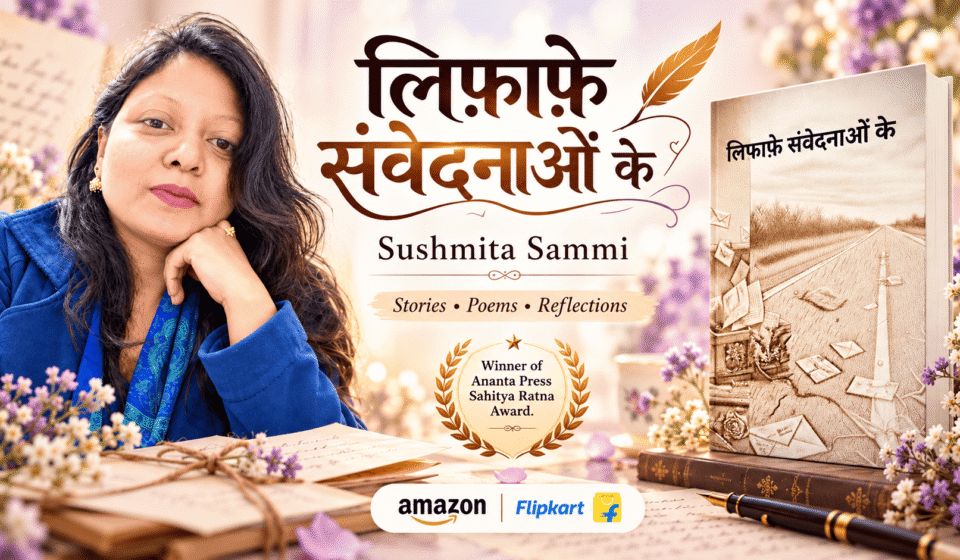
A strong title can function as a compact literary argument. Here, the envelope stands for the tension between privacy and communication. It can be sealed or opened, saved or sent, addressed to someone else or kept without an addressee. Its meaning changes according to the life it enters. This adaptability is what makes the chosen symbol effective. It does not force the book’s varied subjects into one narrow interpretation. Instead, it provides a common object through which grief, affection, regret, gratitude, and memory can all be imagined. The sepia-toned cover, with its imagery of correspondence and a pathway extending into the distance, supports that reflective atmosphere. Visually, the book situates itself in a world of recollection rather than urgency.
The cover design also helps clarify the reading expectation. It does not announce a sensational plot twist or position a single character as the subject of a novel. Its letters and subdued palette suggest fragments, time, and the traces people leave behind. That relationship between visual presentation and literary concept is a quiet strength. A book cover cannot demonstrate the quality of every page, but it can prepare the reader for the kind of attention a work asks for. In this case, the material presentation and thematic description point in the same direction: inwardness, memory, and a feeling of intimate correspondence.
An author working across creative disciplines
Sammi’s personal trajectory adds context without needing to become a substitute for judging the work itself. Her supplied profile describes her as a banker by profession and writer by choice. It also traces interests in poetry, reflective prose, spirituality, letters, storytelling, and film-related writing. Under the creative name Swarnima Sagar, she pursues screenwriting and visual storytelling as well. These details suggest a writer willing to move between practical structure and expressive freedom, between language on the page and the visual possibility of a scene. Her separate projects explore related themes of emotional struggle, transformation, and personal connection. Seen in that broader context, Lifafe Samvednaon Ke belongs to an identifiable ongoing curiosity about how inner experiences can be represented.
The author’s profile also describes recognition connected with literary and record-related initiatives. Such milestones may matter to her professional story, but the book’s most persuasive claim to readers does not depend on awards or records. A collection about emotion succeeds, ultimately, through the encounter between its language and someone else’s life. That is why the project should be considered primarily on its literary intentions and, when the full text is available, on how precisely it fulfils them. External recognition can draw attention to a writer; it cannot replace the independent work of reading. Keeping those two measures separate makes a review more useful, and it keeps the focus where this particular book asks it to remain: on feeling, expression, and human connection.
Where the collection may find its readers
The audience likely to be drawn to this collection is diverse but not undefined. It includes readers of accessible Hindi poetry, those who enjoy personal reflections, and people interested in the emotional residue of relationships. It may appeal to anyone who appreciates books that can be entered in short sittings, where a thought can remain in mind after the physical book is put aside. Readers seeking complicated plots or extensive factual argument may have different expectations and should understand that this is presented as an introspective literary collection. Its apparent strength lies in the opportunity to pause, rather than in the promise to astonish through event after event. Naming that distinction does not diminish the book; it helps identify its natural readership.
There is also a potentially meaningful social dimension to writing that validates interior life. People may hesitate to discuss loneliness or vulnerability because ordinary conversation expects them to remain composed. A book that gives these states language can encourage empathy, including empathy for experiences a reader has not personally shared. This possibility should not be inflated into a universal claim that every reader will feel healed. Literature affects people differently, and a respectful review should recognise that. Still, the impulse behind the collection—to turn private pain and memory into shareable words—offers a humane counterpoint to the pressure to appear untouched by difficulty.
A measured appreciation
A full critical verdict on craftsmanship would require the actual poems and stories: their imagery, narrative decisions, rhythm, tonal variation, and attention to detail. The available materials provide a cover, a synopsis, and an extensive author profile, so any assessment must be candid about that boundary. Within it, the book’s literary proposition is strong. It has a memorable symbol, a clear emotional centre, a flexible mix of forms, and an inviting relationship to Hindi-language readers. It appears designed to offer neither spectacle nor rigid instruction, but the possibility of recognition. लिफ़ाफ़े संवेदनाओं के deserves attention from readers who believe that the unsaid is a legitimate subject for literature. Its distinctive promise is to give the private world of feeling a visible address, and to remind us that what remains inside an envelope may still matter deeply.AMAZON PURCHASE LINK: https://www.amazon.in/dp/8199672064