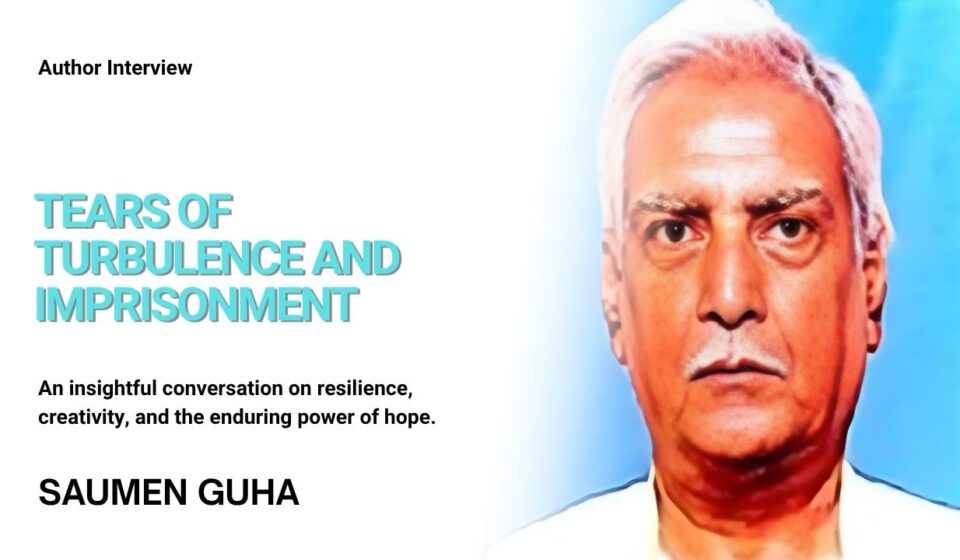

Title: Tears of Turbulence and Imprisonment
Author: Saumen Guha
ISBN: 9789373356594
Publisher: Evincepub Publishing
About the Book
The book consists of poems on various themes and feelings, and in addition English version of some older poems of the author with social, human and revolutionary context, and finally some poems written during imprisonment in 1970s.
About the Author
Saumen Guha was born in 1947 in East Pakistan (now Bangladesh), brought up as a poor refugee in West Bengal, and is now an Indian citizen.
Formally trained in science and engineering for his livelihood, he left his job as Engineering Overseer (Mechanical and Electrical) at the Calcutta Metropolitan Development Authority in 1970 to work with poor peasants in villages as a Communist revolutionary (called Naxalite).
Due to his involvement in militant Communist ideology, he and his family members, including his wife, were arrested and brutally tortured by the West Bengal and Calcutta police in 1974 and imprisoned for three years.
He is the architect of the internationally famous and historic ‘Archana Guha Case’ against torture in police custody, one of the world’s longest legal battles, and continues the crusade as counsel for the prosecution toward victory.
He is a devoted reader, writer, painter, and music lover. He has written and edited several books and authored many articles on human rights, music, films, literary biography, socio-economics, nuclear pollution, and related subjects.
Saumen is now busy preparing the English version of his memoir of imprisonment, Bright Darkness, and a compilation of documents related to the ‘Archana Guha Case’ against torture in police custody.
Deep in the Broken Words is the first book of English poems by Saumen Guha. Tears of Turbulence and Imprisonment is his second book of English poems.
Shivangi Mishra: You have worked for human rights for many years. How has this influenced your writing?
Saumen Guha: My poems focus on human rights-the rights of individuals-shaped by my personal experiences. I am dedicated to devoting my life to the cause of human rights. Consequently, themes of human rights and a heartfelt plea for them are woven into the imagery of my poetry, even if this is not explicitly reflected in the poem’s structure.
Shivangi Mishra: What motivated you to continue the fight against torture and injustice?
Saumen Guha: I have personally experienced police brutality three times; my only “offense” was advocating for the rights of the poor. Moreover, when the police forcibly took my wife, my older sister, and a young woman who was like a sister to me from our home and subjected them to unimaginable torture, I resolved to take a stand. I am determined to confront and fight against police brutality. Although I am not a lawyer by profession, I have acquired knowledge through extensive reading and studying of numerous law books. I have transformed into an invincible legal strategist; this is how I triumphed in the renowned Archana Guha case after a relentless 19-year struggle. The entire responsibility for that fight rested on the extensive preparations and expertise I brought to my legal battle.
Shivangi Mishra: How do literature and social responsibility connect in your view?
Saumen Guha: Poetry can have no enmity with society; on the contrary, it takes shape within the very womb of society. One thing must always be borne in mind: we should constantly cherish a resolve within our hearts to do something for society in our lives.
Shivangi Mishra: Besides poetry, you are also interested in painting and music. How do these arts influence your poems?
Saumen Guha: From early childhood, I have had an inclination towards music and painting, and I kept practicing them in my own way; in them, I found a realm of free expression. In 1980, I initiated the ‘Super-8 Film Movement’ as films of the people, by the people. I started the first S-8 film on the pavement dwellers of Kolkata in 1980. This movement continued for a couple of years. But I devoted my whole time to the legal battle against police torture.
Thus, these are not merely sudden thoughts or whims for me. They are an integral part of my very being.
Shivangi Mishra: What inspires you to keep writing even today?
Saumen Guha: It is not merely a matter of reminiscing; I have the material to write a great deal by consolidating my own studies and research. Yet, despite having written some, much remains unwritten- while neither time nor my body has stood still, and I find myself gradually losing the strength to continue.
Shivangi Mishra: How do you begin writing a new poem?
Saumen Guha: In my early youth, when a massive social movement stirred everyone, I retrieved my old poems one day and scattered them across the grass of an open field; then I began my journey into new poetry, for I had become a new person.
Shivangi Mishra: Are there any writers or poets who have influenced your work?
Saumen Guha: My poetry has taken shape through observing society and people; it was not molded by the influence of any specific poet or writer. Whatever I have gathered comes from nature and human society; I have never felt that a writer or poet was standing before me, illuminating my path.
Shivangi Mishra: What emotions do you feel when readers connect with your poems?
Saumen Guha: Every line and word of my poetry reflects the thoughts and sentiments deep within my mind; therefore, I hope readers will not view my poetry merely as a form of literature artificially embellished for dramatic effect, but rather as an extension of my own feelings, my mind, and my consciousness.
Shivangi Mishra: How important is honesty in poetry?
Saumen Guha: Every word of my poetry was born from the union of honesty and courage; there is never even the slightest trace of dishonesty, performative arrogance, or mere verbal trickery in it. I believe that honesty is the guide in every step of my life.
Question: What advice would you give to aspiring poets?
Saumen Guha: I cannot offer advice to poets; I can only share my own feelings. Poetry takes shape through one’s personal philosophy-forged by every life experience, emotion, and way of living-devoid of even the slightest helplessness or hypocrisy; it is rooted in honesty and the truths of life, both seen and unseen.
Shivangi Mishra: How do you decide whether an idea should become a poem, an article, or a book?
Saumen Guha: Decisions regarding exactly which poem or book to create are rarely made through deliberate planning; rather, a form or structure emerges spontaneously from the depths of the mind, shaping a work of art or literature-whether it be a poem, an essay, or a book.
Shivangi Mishra: Can readers expect more English poetry collections from you in the future?
Saumen Guha: My current book-its very poems-will reveal what can be expected of me; there is no need to state it separately, for the poetry of the future actually shapes its form within the womb of the poetry of the past.
Shivangi Mishra: What can you tell us about your upcoming memoir Bright Darkness?
Saumen Guha: First part of my memoir, ‘Bright Darkness’, has already been published in Bengali under the title ‘Ujjwal Andhakar’; it recounts the period when I-along with my wife, elder sister, and younger sister-was subjected to police brutality and forced to endure a time of three years of imprisonment. Efforts are underway to bring out an English edition of this Bengali memoir; simultaneously, a second volume is being written-chronicling the historic legal ‘Battle of Archana Guha Case- against police torture’-though it has not yet been published. However, a book in English titled ‘Battle of Archana Guha Case- Against Torture in Police Custody’, which critical documents including judgement of the trial Court of the case, was published in 1997. A vast amount of information and numerous reports have been compiled in this book, transforming it into a technical handbook that is now widely recognized internationally.
Shivangi Mishra: What projects are you currently working on?
Saumen Guha: I still have many unpublished poems, but I haven’t found the time to compile and publish them; I am currently preoccupied with the urgent tasks of writing the second volume of ‘Bright Darkness’ and compiling original documents and correspondence related to the ‘Archana Guha Case against torture in police custody’ and editing of Latika Guha’s memoir about imprisonment and torture.
Shivangi Mishra: After such a remarkable journey, what continues to give you hope and purpose every day?
Saumen Guha: I am old now; my strength and time have diminished, yet optimism has never left me. I still feel there is much work left to do, and I live with the goal of accomplishing it. Now I live with memories of my brilliant, powerful past and try to capture that experience through words.