
The question that opens the synopsis of Kaalchakra – The Cursed Prophecy sounds ancient, but its anxiety is unmistakably modern: are our lives governed by forces beyond us, or can we meaningfully change what comes next? In an era when people plan their futures through calendars, forecasts, algorithms, and careful professional choices, the idea of an inescapable destiny can feel both unsettling and strangely familiar. Nikhil Rawal builds his debut mythological fantasy around that tension. His protagonist, Vishwa, is a businessman whose private world is broken by loss before an ancient inheritance pulls him toward an extraordinary responsibility. The story then moves into Kaliyuga, prophecy, cosmic danger, and questions about whether creation itself can survive. It is a premise that turns the familiar worry about control into a sweeping speculative adventure, and that connection gives it potential resonance beyond the usual boundaries of fantasy readership.
A modern reader does not need to believe literally in a prophecy to understand the fear of being trapped by circumstances. A family history can seem to dictate a future; an unexpected loss can dismantle carefully made plans; social expectations can feel as immovable as cosmic laws. By giving Vishwa an ancient bloodline and a destiny he never requested, the novel transforms those ordinary experiences into the language of myth. That transformation is one of fantasy’s enduring gifts. It provides enough distance from everyday life to examine its pressures more clearly. In Rawal’s conceptual world, the wheel of time is not only a grand cosmological image. It can also be read as an enlarged version of the cycles people recognize in their own lives: inherited patterns, repeated mistakes, and the struggle to find freedom within obligations they did not choose.
Indian mythological storytelling provides a particularly fertile foundation for these concerns. Its broad traditions include questions of duty, moral decline, renewal, and the relationship between human action and larger orders of existence. Kaalchakra’s synopsis explicitly invokes Dharma and Kaliyuga, using a recognizable spiritual vocabulary to frame a new fictional adventure. This distinction matters. The book is presented as mythological fantasy, not as a scholarly account of scripture or a claim that all its imagined events belong to any one authoritative tradition. Readers can therefore approach its mythic references as material for creative storytelling while remaining attentive to their cultural resonance. The most interesting possibility is not that the novel reproduces the past, but that it uses inherited concepts to illuminate contemporary concerns about moral courage and personal responsibility.
The title itself carries a broad cultural and imaginative appeal. Kaalchakra evokes the turning of time, allowing the story to join two experiences that might otherwise seem separate. On one hand is the historical awareness that kingdoms, institutions, and even whole civilizations rise and fall. On the other is the everyday feeling that an individual’s decisions are urgent and unique. The companion poem supplied with the book speaks of worlds and empires passing through time, then narrows its attention to the choice facing one soul. That movement from vastness to individual action resembles the movement promised by the novel’s synopsis. Such a contrast can be emotionally compelling because it refuses to solve the question of significance by scale alone. A single decision may matter profoundly even when measured against ages that dwarf a human lifetime.
Another reason the premise stands out is its refusal to stay within one genre label. The author describes a blend of Indian mythology, fantasy, adventure, ancient mysteries, and science-fiction elements. Genre boundaries can be useful to bookstores, but readers often enjoy narratives that move between them with purpose. The combination suggests a story interested in both wonder and systems, both divine symbolism and speculative possibility. Its reader might be someone who normally reaches for epic fantasy because of immersive worlds, or someone who prefers science fiction because it tests assumptions about reality and time. There is no evidence in the supplied material of exactly which technological or scientific concepts appear, and those details should not be invented. Yet the announced hybrid form is itself a meaningful creative choice, signaling a desire to make mythological imagination converse with future-facing speculation.
The protagonist’s ordinary professional identity makes this hybrid world more approachable. Vishwa is not initially situated among gods or mythical warriors; he starts from the texture of contemporary life. This gives readers a point of recognition before the story expands into a hidden ancestry and a threatened cosmic balance. The contrast between workplace pragmatism and supernatural vocation also creates an appealing source of dramatic irony. A person once occupied with practical decisions may be forced to contemplate karma across generations. A life organized around manageable risks may become bound to an unimaginable one. Even without knowing the specifics of the novel’s scenes, that contrast reveals a coherent narrative strategy. The extraordinary world is likely to feel more significant because it interrupts the ordinary one, rather than simply existing in isolation from any recognizable human routine.
The figure of Vritra provides a dark counterweight to this journey. Within the supplied synopsis, Vritra is the embodiment of evil and a force threatening the balance of Dharma and existence. Contemporary storytelling sometimes avoids a clear contrast between good and evil for fear of appearing simplistic. Yet such a contrast can be productive when it serves as the beginning of moral exploration rather than its end. Readers may readily understand that creation must be defended, while still questioning why a good person should suffer, how much one individual ought to sacrifice, and whether noble ends can excuse troubling means. Those questions connect the mythological conflict to debates about power and responsibility in ordinary life. A gigantic adversary becomes relevant when confronting that adversary forces the protagonist to examine what kind of person he chooses to be.
The companion poem adds another layer of relevance by refusing to romanticize endless existence. It imagines immortality as a burden and allows a fallen guardian to believe that stopping creation could end its suffering. Those images resonate with an age preoccupied with optimization, permanence, and eliminating uncertainty. Human beings often want conditions in which no loss can occur and no decision can go wrong. But a world without risk might also be a world without growth, surprise, or freedom. Rawal’s poem suggests an interest in precisely this paradox. It should not be mistaken for a scene-by-scene summary of the novel, but as companion material it enriches the conceptual basis on which the book invites readers to reflect. It implies that the problem of a perfect, permanent solution may be more dangerous than imperfection itself.
Rawal’s biography gives the project an additional contemporary texture. Based in Udaipur and working as a business analyst in a software organization, he also brings experience in blogging and digital marketing. His stated interests extend across mythology, spirituality, history, travel, and the human experience. It is not unusual for a writer to draw on a professional life outside literature, but the combination is especially suggestive here because his fictional premise concerns large connected systems and the moral consequences of changes within them. More importantly, his debut reflects a willingness to engage Indian cultural ideas through a popular narrative form. That choice can make inherited concepts accessible to readers who encounter them first through fictional imagination and then decide to explore their broader intellectual backgrounds.
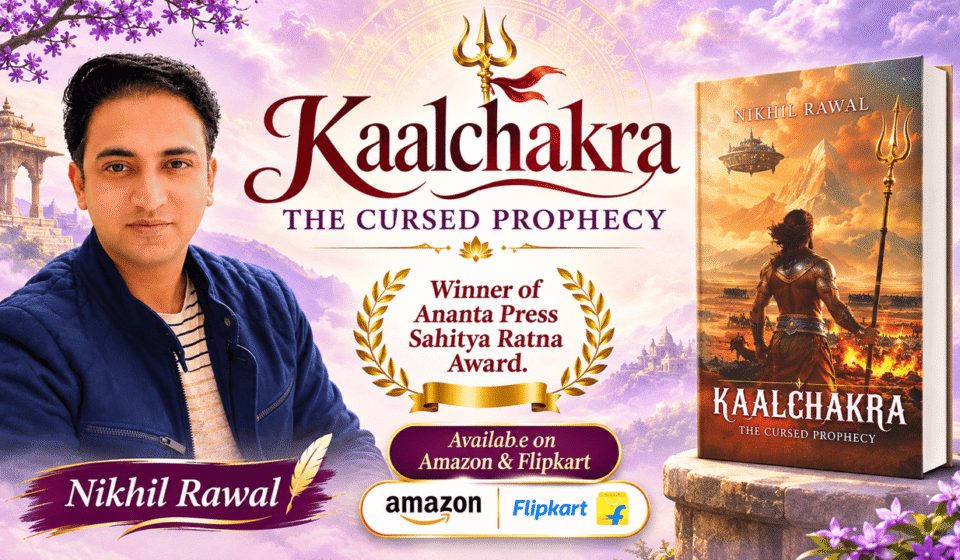
The book’s visual presentation makes its intended audience clear. Its supplied cover is expansive and dramatic, showing a lone armed figure confronting a vast landscape under a fiery sky. The imagery combines a mythic weapon with a speculative hovering form and a sense of approaching warfare. Such a cover invites someone browsing digital shelves to expect a cinematic adventure. It is a thoughtful match for the stated blend of mythology and science fiction, although cover imagery cannot verify any specific event in the story. The deeper value of the packaging is that it puts an ambitious Indian-rooted fantasy on the shelf with the visual confidence associated with large-scale speculative fiction. Readers are invited to approach it not as a minor curiosity but as a world worth entering.
There are, of course, several different ways audiences could respond to a book built around this many ideas. A reader who wants uncomplicated action may find the emphasis on grief, karma, and metaphysics more reflective than expected. Someone who enjoys philosophical fantasy may find precisely that emphasis attractive. The promise of multiple realms and ages may excite those who like complex narrative worlds, while readers seeking a tightly focused contemporary novel should recognize the deliberately expansive scale. These are matters of reading preference rather than faults demonstrated by the supplied materials. A full manuscript would be needed to evaluate the smoothness of the prose, accuracy of the internal logic, depth of secondary characters, and effectiveness of the conclusion. A synopsis can reveal an artistic direction; it cannot prove how completely that direction has been realized.
For a debut released in 2026 by NuVoice Publisher, Kaalchakra – The Cursed Prophecy announces a clear identity: an Indian-rooted speculative adventure in which individual suffering opens onto cosmic responsibility. Its potential readership includes enthusiasts of mythology, epic fantasy, spiritual inquiry, and concept-driven adventure, especially those who value stories that allow spectacular events to carry ethical meaning. What makes the project distinctive is the combination of a present-day protagonist, a mythic vision of recurring time, a threatening embodiment of disorder, and an insistence that choice still matters. These elements are not individually unprecedented, but their stated arrangement gives the story a recognizable voice and an appealing thematic direction. The result, on the evidence available, is a premise that speaks across cultural and genre boundaries without abandoning its Indian philosophical orientation.
The best invitation this novel offers is not simply to watch someone try to save the universe. It is to consider whether a universe worth saving must remain open to sorrow, struggle, and change. Vishwa’s journey begins with loss, and the larger story asks what he might do with the life that remains. In that sense, Kaalchakra turns a cosmic prophecy into a deeply human question about agency. Readers who seek imaginative fiction with both momentum and meaning will find a compelling reason to explore Rawal’s debut. The wheel may keep turning, and the future may resist prediction, but the story’s central proposition is reassuringly active: the choices made in the face of uncertainty are part of what gives a life its shape.
AMAZON / BOOKSTORE LINK