Beyond the Provider: Arv’s The Rolling Stone That Gathered Moss Reconsiders the Emotional Identity of Fathers

Book Review
What does society expect from a father? For generations, the answer has often been shaped by a familiar collection of qualities: responsibility, discipline, financial stability, protection, and strength. These attributes can be valuable, yet when they become the only acceptable expressions of fatherhood, something essential is lost. A father is not merely a person who performs duties. He is also an individual who experiences fear, affection, uncertainty, tenderness, hope, and the desire to be understood.
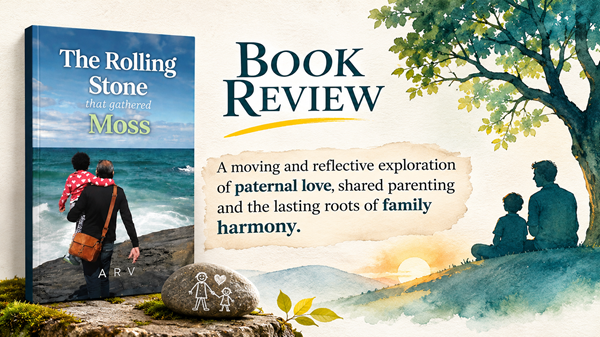
In The Rolling Stone That Gathered Moss, author Arv places this neglected emotional dimension at the center of a reflection on family life. Described as a voice for fathers, the book emphasizes the quiet but profound love that connects fathers to their children. It also recognizes the importance of mothers and fathers working together to create an enduring foundation for the next generation.
The result is a premise that invites both personal reflection and wider social discussion.
One reason the subject matters is that social expectations can make emotional expression difficult for men. From an early age, many boys receive messages encouraging toughness, independence, and emotional control. These lessons may help individuals develop resilience, but they can also discourage open communication when interpreted too narrowly.
As those boys become adults and eventually fathers, emotional restraint may feel less like a choice and more like an obligation.
A father may be willing to make enormous sacrifices for his family yet hesitate to discuss the anxiety accompanying those sacrifices. He may feel immense pride in his child’s accomplishments while struggling to express it directly. He may worry about making mistakes but believe that admitting uncertainty would weaken his authority.
These contradictions deserve thoughtful attention.
Arv’s subject challenges readers to distinguish between emotional silence and emotional absence. A father who does not frequently discuss his feelings may still experience them intensely. Nevertheless, silence alone should not be regarded as the highest form of love. Emotional connection becomes stronger when feelings can be communicated in ways that others recognize and understand.
This distinction gives the book’s message a valuable contemporary dimension.
The goal is not simply to praise fathers for remaining strong. It is to broaden the definition of strength itself.
Strength can include the ability to apologize after an argument, listen without immediately offering advice, acknowledge a personal limitation, or provide reassurance when a child is frightened. It can mean supporting a partner’s decisions, sharing responsibilities, and recognizing that care does not diminish dignity.
These qualities deserve a place beside the traditional expectations of provision and protection.
The book’s description also emphasizes the role of mothers and fathers as distinct but equally vital contributors to a child’s upbringing. Its imagery of two hands joining in prayer or a warm embrace communicates both unity and tenderness.
What makes this metaphor interesting is that it portrays parental partnership as a relationship between contributors rather than a hierarchy.
Healthy cooperation does not depend on determining which parent matters more. Instead, it requires acknowledging that a child’s emotional world develops through many forms of support.
A parent who provides practical guidance contributes to a child’s confidence. A parent who offers comfort helps create emotional security. A parent who sets reasonable boundaries teaches responsibility. A parent who demonstrates affection reinforces the experience of being valued.
These contributions need not follow gender-based divisions. Both mothers and fathers can participate in all of them.
The most productive interpretation of Arv’s idea is therefore one grounded in shared commitment and mutual respect.
This approach also addresses an important challenge in contemporary households. Work patterns, family structures, financial pressures, and expectations surrounding caregiving have changed considerably. Many fathers seek closer involvement in their children’s daily lives, while mothers increasingly challenge the assumption that emotional and domestic responsibilities belong primarily to them.
Within this context, partnership must be flexible.
A family cannot always divide every responsibility equally at every moment. Circumstances may require one parent to carry a greater share of particular tasks. Yet fairness can still be maintained through communication, appreciation, and a willingness to adapt.
The book’s central idea of staying rooted together offers a meaningful way to consider such changes.
Rootedness can be understood as emotional continuity rather than rigid adherence to tradition. It suggests that family members can grow, change roles, and develop new expectations while maintaining a shared sense of belonging.
The title, The Rolling Stone That Gathered Moss, reinforces this interpretation.
Traditionally, the image of a rolling stone implies motion without attachment. By presenting a rolling stone that nevertheless gathers moss, Arv creates a symbolic contradiction that invites reflection. The title suggests that movement need not eliminate connection and that personal evolution can coexist with lasting commitments.
For fathers, this idea is especially relevant.
Parenthood is not a fixed identity acquired once and then performed without change. It develops through experience. A new father learns to care for someone entirely dependent on him. A father of school-age children confronts questions of guidance and discipline. A parent of adolescents must negotiate independence, trust, and changing emotional needs.
Later, as children become adults, fatherhood may require a different kind of support: the willingness to remain available without attempting to control every decision.
Each stage offers opportunities for growth.
The metaphor of gathering moss can therefore represent the accumulation of patience, understanding, and emotional wisdom.
Another significant aspect of the book’s message concerns the relationship between fathers and their adult children. Family members do not always fully recognize one another’s experiences while living through them.
A child may remember restrictions more vividly than the concerns that motivated them. A father may remember the pressure of providing stability without realizing how his silence affected his child. Both may carry incomplete understandings of the same relationship.
Reflection can help create space for a more balanced perspective.
This does not mean that all parental actions should be interpreted as love or that good intentions eliminate the consequences of mistakes. Responsible reflection acknowledges both care and shortcomings.
The most meaningful family relationships are not necessarily those without conflict. They are relationships in which people remain willing to communicate, reconsider assumptions, and develop greater understanding.
Through its focus on paternal love, the book’s premise encourages precisely these conversations.
It also raises the question of how society can better recognize fathers beyond ceremonial appreciation. Public celebrations of fatherhood are meaningful, but everyday recognition matters more. Fathers benefit from being treated as emotionally capable caregivers rather than secondary participants in family life.
Children, too, benefit when they see that care and tenderness are compatible with strength.
A father who demonstrates compassion may influence a child’s understanding of masculinity. A father who respects his partner can provide a model of cooperation. A father who takes responsibility for mistakes can teach accountability more effectively than one who insists on appearing infallible.
Such influence is often gradual, developing through repeated observations rather than dramatic declarations.
This makes the subject of The Rolling Stone That Gathered Moss relevant not only to fathers but also to educators, partners, adult children, and anyone interested in changing family expectations.
The book’s greatest promise is the possibility of recognizing fathers as complete human beings rather than reducing them to their responsibilities.
Its focus on enduring love and shared parental commitment offers an accessible framework for discussing difficult emotional questions. How can fathers express affection more openly? How can families appreciate sacrifices without glorifying emotional suppression? How can parents support one another while continuing to grow as individuals?
These questions make the book’s central themes worth exploring.
Ultimately, Arv’s The Rolling Stone That Gathered Moss presents fatherhood as an experience shaped by emotional complexity, responsibility, and lasting attachment. Its message challenges the assumption that fathers must choose between strength and sensitivity.
The most meaningful form of paternal strength may lie in the ability to combine both.
By giving attention to fathers’ inner experiences and celebrating the cooperation that helps families flourish, the book invites readers to move beyond conventional stereotypes and reconsider what it truly means to be present.
Fatherhood, in this vision, is not simply about standing at the front of a family or carrying its burdens in silence. It is about participating in a relationship of mutual growth, enduring care, and shared humanity.
And perhaps that is the deepest meaning of the book’s striking title: even those who spend their lives moving forward can discover that love has quietly given them roots.
Amzon Link – https://www.amazon.in/Rolling-Stone-That-Gathered-Moss/dp/9379001541/