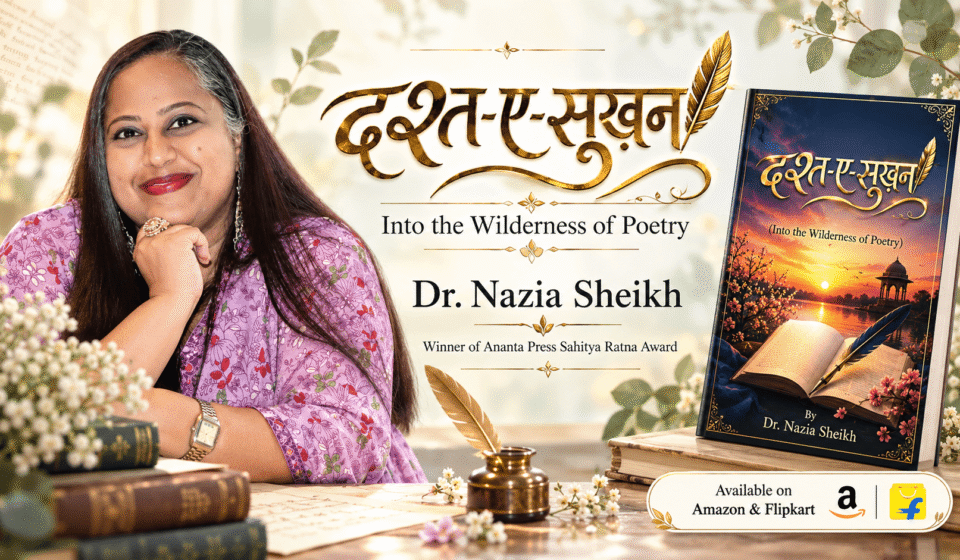

The contemporary relevance and lasting reader appeal of Dr. Nazia Sheikh’s दश्त-ए-सुख़न
In an age of fast-moving feeds, instant reactions and compressed messages, a collection of reflective poetry asks for a different kind of attention. It does not compete by delivering more information in less time. It offers the chance to feel a thought unfold, to notice a silence and to remain with an emotion after the page has ended. Dr. Nazia Sheikh’s दश्त-ए-सुख़न is introduced in precisely this spirit. Its central concerns are not headlines or fleeting fashions, but love, separation, longing, hope, resilience and the search for inner understanding. These subjects may seem timeless, yet the need to engage with them patiently is especially relevant to contemporary readers.
The book’s premise begins with a simple observation: people often approach poetry because they are looking for themselves. That does not mean readers expect to find a literal account of their own circumstances. They may instead recognize a feeling they have never clearly described, a contradiction they have hidden from others, or a memory that still determines how they respond to the present. Poetry’s unusual power comes from transforming a highly individual expression into an experience another person can enter. The description of दश्त-ए-सुख़न places that transformation at the heart of its artistic identity. It seeks emotional connection without pretending that every life is identical.
This is a useful distinction at a time when the language of emotion can become standardized. Popular culture supplies ready-made phrases for almost every kind of heartbreak, admiration or personal growth. Repetition can sometimes make genuine feeling sound rehearsed. A poet must face the harder task of discovering which words belong to a particular emotional truth. Dr. Sheikh’s collection is presented as valuing authenticity, evocative imagery and quiet intensity over ornament alone. That claim points toward a literary practice rooted in attention. The interesting question is not whether a poem contains a recognizable sentiment, but whether its expression encourages the reader to reconsider that sentiment with fresh sensitivity.
The title contributes strongly to this invitation. दश्त-ए-सुख़न can be understood as a wilderness of words or poetry, a suggestive image for the unpredictable terrain of the mind. A wilderness cannot be reduced to a numbered list of conclusions. There are open spaces, concealed paths, difficult crossings and unexpected moments of beauty. That metaphor suits a collection organized around the inner life. A reader may enter looking for comfort and encounter an unsettling recognition, or arrive carrying sadness and notice a possibility of hope. The title establishes poetry as a place of exploration rather than a tool for producing instant emotional answers.
What makes the project potentially distinctive is its emphasis on both literary texture and welcome. Hindi and Urdu provide an immensely expressive vocabulary for affection, yearning, introspection and endurance. Yet the author does not present that richness as something reserved for specialists. The supplied description speaks directly to experienced poetry enthusiasts and first-time readers alike. That matters in a literary culture where newcomers can feel unsure of their right to interpret. A poem is not an examination paper with only one acceptable response. Good literary writing may reward scholarship and attentive rereading, but it can also begin with the immediate recognition of a feeling.
The reading habits associated with poetry are also worth defending. Unlike a long narrative, a poem can sometimes be revisited between ordinary commitments, carried in memory or read aloud to another person. Its brevity, when present, should not be mistaken for superficiality. Compression requires the writer to decide what can remain implied. Pauses, images and verbal rhythm may contribute as much as explicit explanation. The account of दश्त-ए-सुख़न stresses the profound force of the unspoken, making this an especially relevant lens for considering its ambitions. It is a reminder that meaningful communication is not always the loudest or the most exhaustive.
Printed poetry and performed poetry also offer complementary experiences. Dr. Sheikh’s biography records participation in literary circles and open-mic communities, where words are encountered as voice and presence. In such settings, the listener cannot always stop the performance to analyze a phrase; emotional clarity and cadence become essential points of contact. On the page, meanwhile, the reader gains the liberty to pause, return and reinterpret. An author engaged with both forms participates in a living literary culture rather than treating poetry as a remote historical artifact. That public dimension adds interest to a book whose themes are often intensely private.
The author’s body of work further complicates the stereotype of poetry as a passing hobby. She is a practicing General Practitioner and Diabetologist who began writing early and has continued across Hindi and English collections as well as twelve anthologies. Her published titles include इंतिसाब-ए-नफ़्स, महशर-ए-ख़याल, दर्द-ए-निहाँ, दास्ताँ-ए-दिल-शिकस्ता and The Poetic Realm: An Escape. Her career brings together sustained professional responsibilities and a long-term dedication to literary expression. Readers may find this dual commitment inspiring, but its importance is more concrete: it provides a context for a poet who has repeatedly chosen to return to the craft of articulating inner experience.
The biography also records a range of awards and acknowledgments. These recognitions help explain the author’s presence within contemporary literary networks and may encourage an unfamiliar reader to look more closely at her work. Still, awards should be treated as introductions, not final judgments. No list of distinctions can replace a reader’s encounter with language. The most persuasive case for दश्त-ए-सुख़न is not external status, but its stated purpose: to make the intimate dimensions of being human legible and shareable. That is a purpose against which the collection can be thoughtfully considered, regardless of publicity or reputation.
For whom, then, might this volume be particularly rewarding? Readers attracted to contemplative poetry are the most obvious audience. So are those who enjoy the emotional vocabulary of Hindi and Urdu, who appreciate literature that makes space for melancholy without surrendering to despair, or who would rather explore a question than receive a ready-made moral. The collection may also make a thoughtful gift for someone who values words as personal keepsakes. Its subjects have a broad reach, though individual responses will naturally vary. A reader seeking plot-driven entertainment or technical instruction should approach it with different expectations from someone looking for lyrical reflection.
It is worth noting an important boundary in evaluating any poetry collection from descriptive material alone: the actual artistry lives in the poems themselves. Only a direct reading can determine the precision of individual images, the effectiveness of line breaks, the variety of tones and the relationship between stronger and quieter pieces. The appeal discussed here comes from the author’s supplied account of the collection, its themes and her literary background rather than an invented interpretation of specific lines. Far from diminishing interest, this distinction clarifies what is most inviting about the book before it is opened: a coherent intention to honor complicated feelings through accessible literary expression.
The endurance of intimate poetry depends upon its resistance to being consumed once and forgotten. A slogan asks for agreement; a poem can invite return. The emotional life changes, and the reader may discover fresh meanings in familiar concerns. Love becomes memory, sorrow becomes understanding, and hope may arrive in an unexpected form. दश्त-ए-सुख़न is presented as a book shaped for that longer companionship. It asks readers to treat language as more than decoration and private emotion as more than isolation. In doing so, Dr. Nazia Sheikh contributes to an important contemporary conversation: why, even amid relentless noise, people still need a quiet place where words can help them hear themselves.
Amazon purchase link: https://amzn.in/d/0042oEEO