
Studying homoeopathy involves understanding a large amount of information, especially when it comes to Materia Medica, constitutional types, remedy characteristics, and patient profiles. For students who are just beginning their studies, remembering all these details can be challenging. Homoeopathic Infographica Guide by Group Captain Manoj Dayal offers a different way of approaching this subject, using visual explanations instead of depending entirely on lengthy written descriptions.
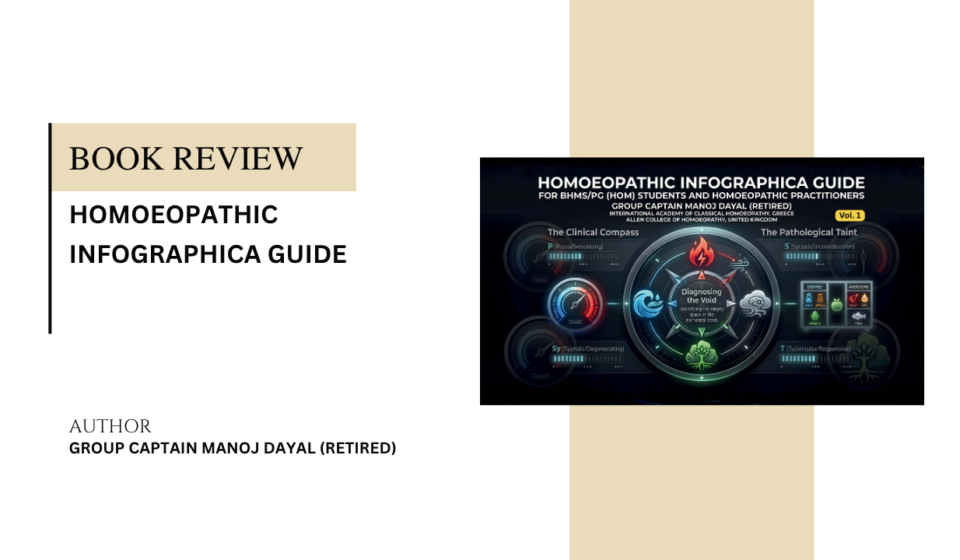
What immediately makes this book interesting is its presentation. Rather than following the usual textbook format, the author uses colourful illustrations, diagrams, comparison charts, and infographics to explain concepts from classical homoeopathy. The idea is quite simple: when information is presented visually, it may become easier to understand, compare, and remember.
In the preface, the author explains that the idea for this book came from his own experience of studying homoeopathy for many years. He found traditional Materia Medica books extensive and sometimes difficult to navigate. This experience encouraged him to develop a guide that could help students and practitioners review important concepts in a more accessible form.
The book begins by introducing the philosophy behind classical homoeopathy. It places considerable importance on understanding the individual rather than looking only at a particular symptom. This approach continues throughout the book, especially in sections that discuss personality, emotional characteristics, physical tendencies, and constitutional patterns.
One of the most interesting sections explores the four elements: Earth, Air, Fire, and Water. The author uses these elements to illustrate different personality and constitutional characteristics within the framework presented in the book.
Earth is associated with stability and practical thinking, Air with intellectual activity, Fire with confidence and ambition, and Water with emotional sensitivity. The book then explores combinations of these elements and connects them with different homoeopathic remedy profiles.
Whether someone is already familiar with these classifications or encountering them for the first time, the visual arrangement makes the author’s explanation easier to follow. Instead of searching through several paragraphs to understand a comparison, readers can examine a diagram and see how the characteristics are organised.
Another important part of the book focuses on miasmatic concepts. The author discusses Psora, Sycosis, Syphilis, and the Tubercular category, presenting their traditional associations through charts and illustrations.
The sections on temperament, psychological characteristics, skin conditions, physical indicators, and patterns of pain are particularly detailed. These pages demonstrate the author’s effort to bring different kinds of information together in one place.
However, readers should understand that these classifications belong to homoeopathic theory. They should not be treated as scientifically established diagnostic categories or substitutes for evidence-based medical assessment.
The remedy comparisons are another useful feature from an educational perspective. The book includes visual profiles of remedies such as Calcarea Carbonica, Nux Vomica, Arsenicum Album, Natrum Muriaticum, Pulsatilla, Lycopodium, and Sulphur.
Instead of discussing every remedy separately without comparison, the author frequently places related profiles alongside one another. This makes it easier to understand how traditional homoeopathic literature distinguishes between them.
For example, the comparison between Nux Vomica and Arsenicum Album uses visual indicators to highlight differences in their described characteristics. Similar comparisons appear in the sections on Pulsatilla and Natrum Muriaticum, and Lycopodium and Argentum Nitricum.
I found this comparative approach to be one of the book’s strongest qualities. When studying a subject filled with unfamiliar terminology, being able to compare concepts side by side can make the learning process less tiring.
The author’s background also adds an interesting dimension. Having served for thirty years in the Indian Air Force and studied counselling psychology, Group Captain Manoj Dayal brings together his interests in human behaviour, classical homoeopathy, and structured learning.
His attention to psychological descriptions is especially visible throughout the book. It becomes clear that understanding personality and behaviour is central to the way he has organised the material.
There are, of course, some limitations to this format. Certain pages contain considerable information, and readers who are unfamiliar with homoeopathic terminology may still need a detailed textbook to understand the concepts fully. An infographic can simplify a topic, but it cannot always explain its background or limitations.
Another important distinction is that making a theory easier to understand does not establish its medical effectiveness. Homoeopathy lacks reliable scientific evidence of effectiveness for treating health conditions, so the guide is best understood as an explanation of its own traditional framework.
Overall, Homoeopathic Infographica Guide succeeds in offering an unusual and visually engaging way to explore classical homoeopathic concepts.
Its greatest strength lies in transforming lengthy descriptions into organised visual learning material. For BHMS students and readers studying homoeopathic literature, it may serve as a convenient supplementary reference.
Group Captain Manoj Dayal has clearly invested considerable thought in how information can be presented differently. The result is a book that demonstrates how illustrations, structure, and visual comparisons can make a complicated body of literature easier to navigate.
For readers interested in the educational presentation of classical homoeopathy, this guide offers a distinctive perspective and an approach that stands apart from conventional text-heavy reference books.
Title: Homoeopathic Infographica Guide
Author: Group Captain Manoj Dayal (Retired)
Publisher: Evincepub Publishing