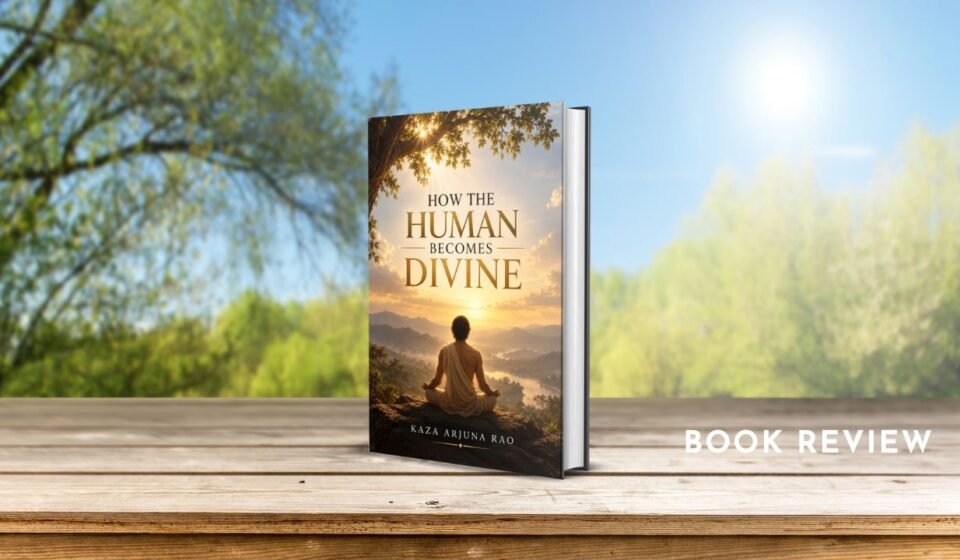
Book Review – HOW THE HUMAN BECOMES DIVINE by KAZA ARJUNA RAO: An Engineer’s Continuing Inquiry into Existence

Kaza Arjuna Rao’s professional background is a useful place to begin an assessment of How the Human Becomes Divine. A retired engineer, he approaches writing with an appreciation for precision and a longstanding interest in the deeper questions of existence. The combination matters because the book addresses subjects whose familiarity can conceal their difficulty. Creation, consciousness and destiny are words that invite expansive claims. Rao’s project places them within an inquiry about human transformation, asking readers to think about the potential carried within life itself. For Timeless Script House, the interest lies in this meeting of a disciplined mind and an enduring spiritual concern.
The book belongs within an established record of personal inquiry. Rao is also the author of Journey into Unknown, an autobiography, and Of Consciousness and Experience: Reflections, published in 2025. His writing brings the perspective of lived experience to an enduring concern with identity and awareness. The present book gives that concern a particular direction by considering the possibility of spiritual evolution. It is worth approaching as a contribution from someone who continues to examine fundamental questions across different forms of writing. The relationship between a life remembered, experience reflected upon and a future imagined gives his authorship an engaging context.
That continuity gives the act of writing a particular significance. Some questions become more demanding as a person returns to them, because familiar answers acquire new complications. Rao’s decades of reflection, as described in his biography, place his latest inquiry within that longer practice of reconsideration. A reader can approach the book with an interest in how a life of questioning finds expression on the page. The attraction is the opportunity to engage with a considered position and then examine one’s own. This gives the work a purpose beyond the simple transmission of a conclusion about where human development might lead.
Creation establishes the broadest horizon for that discussion. Once a book raises the question of how human beings become divine, it also raises questions about their place within existence. Where does individual consciousness belong in a larger account of life, and what does it mean to speak of an ultimate destiny? A question about origins can change how one understands direction: the significance assigned to the beginning of life may influence the possibilities imagined for its future. Rao’s subject opens this wider field of reflection. It invites readers to examine the assumptions through which human existence acquires a sense of purpose.
At the centre of that vision is the proposal that evolution reveals an immense potential already present within living beings. The distinction between creating a quality and uncovering it is conceptually important. It asks readers to consider whether development should be understood as the expression of an underlying nature. That question can be examined even before a reader decides what to make of the term divine. It creates room for close attention to the language of the title: what is human, what is potential, and what kind of change is implied by becoming? The vocabulary itself becomes part of the inquiry.
An engineer’s concern for precision is particularly relevant to such vocabulary, though a professional background cannot settle its meaning in advance. Consciousness, intelligence and wisdom name related but different concerns. A reflective discussion gains depth when readers keep those differences in view and ask what work each term performs. Rao’s biography emphasises technical clarity alongside spiritual sensitivity, making that combination an appropriate lens through which to approach his writing. The editorial challenge inherent in this kind of book is to make difficult ideas approachable while preserving their complexity. Its subject deserves clear language that leaves readers with something substantial to consider.
The author’s reliance on lived experience adds another dimension. Experience gives a writer a point of view, but making that perspective available to others requires an act of explanation. Readers arrive with their own memories, beliefs and uncertainties; they cannot simply inherit the author’s convictions. The value of reflective nonfiction often develops in that interval between a writer’s understanding and a reader’s response. Rao’s invitation to question conventional assumptions offers a productive basis for this encounter. It allows the work to be approached as a contribution to an ongoing conversation about identity, with space for readers to examine what they accept and why.
Accessibility is therefore an important part of the book’s stated intention. A work about consciousness has an opportunity to welcome readers who would otherwise regard the subject as remote from their lives. Accessibility, in this setting, means giving people a way into a difficult question without assuming that they already share a specialised vocabulary. The concerns identified in the book’s description are recognisable enough to support that invitation, even when their philosophical implications are extensive. Education, experience and reflection provide familiar points of contact. From there, readers can consider the more demanding proposal that these influences participate in revealing a deeper human possibility.
The emphasis on humanity’s future gives this inquiry a forward direction. It asks what sort of beings people may become as consciousness develops towards wisdom and harmony. This is a large ambition, and readers are entitled to examine the assumptions on which it rests. Its literary and intellectual interest lies in widening the question of the future to include the inner character of those who will inhabit it. Knowledge and achievement remain relevant, but the book gives moral awareness a place in the discussion. The resulting perspective encourages a reader to consider development as a matter of human purpose as well as expanding capability.
How the Human Becomes Divine is an appealing proposition for readers drawn to the meeting of personal reflection and philosophical speculation. Rao’s life of professional discipline and sustained inquiry provides a credible context for his interest, while the ideas themselves remain available for independent consideration. The work’s promise rests in the questions it brings into relation: the nature of consciousness, the meaning of human potential and the possibility of spiritual growth. It invites the kind of reading in which attention continues after the immediate argument has been considered. A worthwhile encounter with these themes can leave a reader better able to articulate the questions that matter to them.