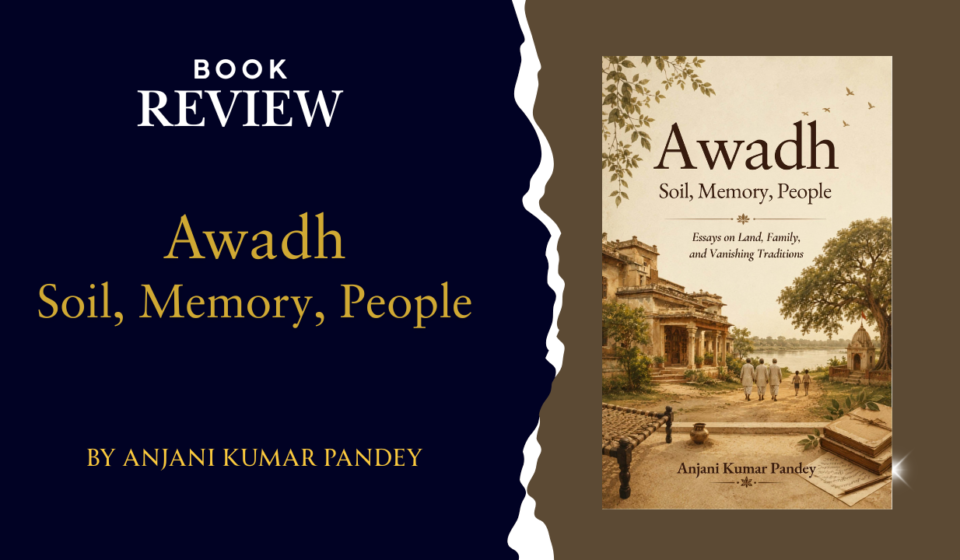
Awadh: Soil, Memory, People by Anjani Kumar Pandey – A Book Review of Memory, Culture and Vanishing Traditions

Anjani Kumar Pandey’s Awadh: Soil, Memory, People is best approached not as a conventional linear memoir but as a collection of memory-essays in which a region is reconstructed through people, rituals, food, journeys, trees, animals, family roles, and small household objects. The subtitle, Essays on Land, Family, and Vanishing Traditions, accurately describes its method: the book turns private recollection into a cultural record. Its stated intention is equally clear—the author wants to carry younger readers back to an older world and preserve something of a way of life that he believes is disappearing.
The book’s greatest strength is its attention to the ordinary. Pandey understands that memory rarely survives through major historical events alone; it survives through details. A soop beaten before dawn, a brass lota carried to a village feast, jaggery tea, children building clay houses for Diwali, sweet potatoes roasting in a winter kaura, the whistle of Punjab Mail, the shade of a tamarind tree, the daily presence of cattle, or a peepal tree functioning as a spiritual and social centre—such details give the book texture. They make Awadh feel inhabited rather than merely described. The extensive glossary at the end also shows an awareness that many local words carry a cultural weight that an English equivalent cannot fully reproduce.
The early essays establish the central conflict of the book: continuity versus change. “My Village, My Ancestors,” “School, Back in Those Days,” “The Village and Its Cattle,” “The Ways of the Village,” and “The Village Land” repeatedly contrast a materially limited but socially connected past with a more comfortable but emotionally fragmented present. The author remembers his village as a place where different occupational, caste, and religious communities depended upon one another and shared both happiness and hardship. He is especially effective when he allows a scene to carry this contrast naturally. A child waiting for Master Sahab, a family feeding cattle, villagers sharing wedding responsibilities, or relatives travelling for hours to reach the village conveys social change more convincingly than abstract argument.
Pandey’s prose has the warmth of oral storytelling. He often writes as though he is sitting among younger family members and saying, “This is how things used to be.” That directness makes the book accessible. His moral concerns—respect for elders, responsibility, gratitude, kinship, faith, community, and memory—are never hidden. The reader always knows what matters to him.
At the same time, this strong moral viewpoint creates the book’s main limitation. The past is frequently remembered through a golden light. The same world contained child marriage, severe purdah, corporal punishment in schools, exhausting domestic labour for women, widowhood stigma, poverty, hunger, and rigid family hierarchies. The author does acknowledge many of these realities, sometimes quite vividly, but he often returns quickly to the language of discipline, contentment, duty, or social harmony. As a result, the book sometimes romanticises structures that were comforting to some people while restrictive to others.
The chapter on modesty and purdah is a good example. It recognises the need for freedom and rejects compulsion, yet remains emotionally attached to older ideas of deference and social restraint. This tension is important because it reveals a narrator caught between admiration for inherited values and awareness that some customs could not remain unchanged. The book would have become even more intellectually powerful had it stayed longer with such contradictions rather than resolving them through nostalgia.
Another weakness is repetition. Several chapters arrive at a similar conclusion: cities have weakened community, technology has increased distance, festivals have lost depth, young people are disconnected from tradition, and material progress has not necessarily produced emotional richness. These ideas are central to the book, but repeating them at the end of many essays sometimes reduces the force of the individual stories. The strongest chapters are those in which Pandey trusts the memory itself and resists explaining its moral too heavily.
The photographs throughout the volume provide visual breaks and support its documentary mood, although some feel more illustrative than intimately tied to the specific people or places being remembered. The writing is frequently strong enough to create its own visual world.
The book’s architecture also deserves notice. Its movement from ancestry and village institutions toward festivals, individual portraits, journeys, trees, railway memories, childhood rites, and finally the epilogue creates the sense of moving through concentric circles of belonging. The closing return to Awadh as the place where the narrator wishes his physical and spiritual journey to end gives the collection an emotional frame. What begins as recollection becomes, by the final pages, a declaration that place can function almost like an inheritance of the soul.
Ultimately, Awadh: Soil, Memory, People is a sincere and culturally valuable work of remembrance. Its importance lies less in offering an objective social history than in preserving one man’s emotional geography of Awadh. It records not only what disappeared, but what it felt like to belong to a world before it disappeared. Readers willing to engage both with its tenderness and with its nostalgia-driven blind spots will find a deeply personal archive of rural memory. The book is most persuasive when it stops arguing that the past was better and simply shows us why it remains unforgettable.
Title: Awadh: Soil, Memory, People
Author: Anjani Kumar Pandey
Publisher: Evincepub Publishing