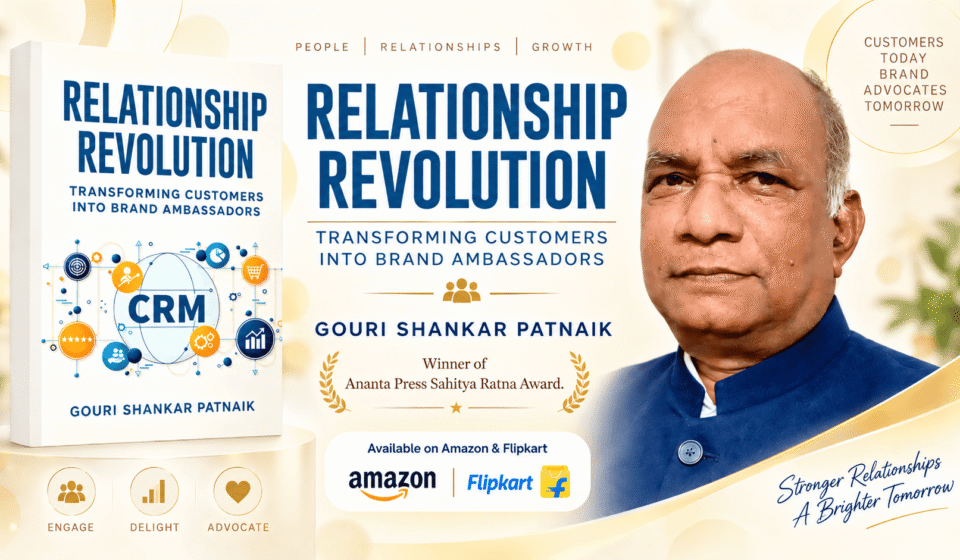

Relationship Revolution: Transforming Customers into Brand Ambassadors by Gouri Shankar Patnaik can be read as a book about Customer Relationship Management, but it is equally valuable as a book about leadership. The reason is simple: meaningful customer relationships are rarely the result of a single department or a single technology. They emerge from the choices an organization makes about quality, accountability, communication, service, information, culture, and long-term value creation. By presenting CRM as a strategic discipline connected with brand building and customer advocacy, Patnaik places the subject where it belongs: within the responsibilities of management and leadership.
The book begins from a compelling business reality. Customers today have more information, more alternatives, and more public ways to express satisfaction or dissatisfaction. A company can no longer assume that a purchase marks the successful end of a marketing or sales effort. The relationship continues through delivery, usage, service, renewal, recommendation, and sometimes recovery after a problem. CRM provides a framework for understanding and coordinating this ongoing relationship. The book’s emphasis on transforming customers into brand ambassadors gives leaders a clear picture of what excellent relationship management can ultimately achieve.
Brand advocacy is a particularly useful leadership objective because it cannot be produced by internal declarations. A company may call itself customer centric, but customers decide whether that claim is credible. They make that judgment through experience. If the organization is consistent, responsive, fair, relevant, and reliable, trust can grow. If the experience is fragmented or disappointing, no CRM technology can conceal the gap indefinitely. Patnaik’s approach therefore shifts attention from the appearance of customer focus to the systems that make customer focus real.
The book covers CRM concepts, benefits, technologies, and implementation strategies and connects them with marketing, sales, and service goals across the customer lifecycle. This comprehensive scope is important for leaders because customer strategy should not be designed in functional isolation. Marketing can generate expectations, sales can establish commitments, service can preserve or damage trust, and technology can support or complicate every stage. Senior management must create the alignment that allows these parts to work as one experience.
Patnaik is especially well positioned to make this argument because his career extends across more than four decades in the pulp and paper and manufacturing sector, with senior leadership roles at JK Paper Ltd. and ITC Limited. His expertise includes quality governance, ESG and sustainability oversight, enterprise risk management, regulatory compliance, and quality systems. He has advised senior leadership and board-level stakeholders on integrating ESG principles with business strategy, implementing Business Responsibility and Sustainability Reporting frameworks, strengthening compliance systems, supporting environmental stewardship, preparing organizations for audits, and improving internal control frameworks.
This background gives the book a leadership character that differentiates it from purely technical CRM guides. Customer relationship management depends on many of the same disciplines found in good governance. There must be clarity about objectives, ownership of processes, reliable information, appropriate controls, measurement, review, and continuous improvement. Without these foundations, customer initiatives can become temporary campaigns rather than durable capabilities.
Trust is the concept that connects CRM with governance most clearly. Customers provide organizations with money, time, attention, information, and often personal data. In return, they expect value and responsible behavior. A CRM system may help a company remember preferences or personalize communication, but the deeper relationship depends on whether that information is used respectfully and whether the company keeps its commitments. Leadership therefore matters because trust is shaped by policies, incentives, priorities, and ethical standards as much as by front-line behavior.
The book’s treatment of technology is also appropriate for senior readers. CRM technology is necessary in many modern organizations, particularly when customer bases are large and interactions occur across multiple channels. Yet technology can easily become the visible center of an initiative even when the real challenge is strategic. Patnaik keeps the focus on managerial application. The key question is not how many features a system has, but whether those features help the organization understand customers better, coordinate actions more effectively, and improve outcomes across the relationship lifecycle.
This is a significant strength because many business transformation projects confuse implementation with adoption and adoption with value. A platform can be installed on schedule without changing how people work. Employees can log activities without improving customer experience. Dashboards can multiply while decision quality remains unchanged. A leadership-oriented understanding of CRM asks what behavior the system is meant to support and how that behavior contributes to customer and business value. The book’s strategic framing encourages this more demanding evaluation.
The idea of customer advocacy also fits naturally with long-term stakeholder value. A brand ambassador is not only a repeat buyer; the customer becomes a source of reputation. This matters because reputation is cumulative and socially transmitted. Recommendations, reviews, professional conversations, and digital communities allow one customer’s experience to influence many others. Leaders therefore have strong reasons to treat customer relationships as assets that require protection and investment. Short-term practices that increase immediate revenue while reducing trust can be expensive over time.
Patnaik’s experience with ESG and sustainability adds further depth to this long-term perspective. Modern organizations are increasingly evaluated on how they create value, not only how much value they create. Environmental stewardship, governance, responsibility, transparency, and stakeholder treatment all contribute to corporate reputation. Customers may bring these concerns into purchasing and advocacy decisions. A leader who understands relationship management in a broader stakeholder context is better prepared to see CRM not as a narrow sales mechanism but as part of a company’s overall credibility.
The book is also useful because it remains accessible. Senior leaders often need conceptual clarity without becoming platform specialists. Students need enough structure to build foundational knowledge. Managers need practical relevance. Relationship Revolution serves these groups by keeping the subject focused on principles and applications. Its flexible reading structure, which allows readers to begin with chapters most relevant to their interests, makes it particularly suitable as a reference book for professionals with limited time.
For business students, the book provides an important corrective to the tendency to study functions in isolation. Strategy, marketing, sales, operations, service, technology, governance, and quality all meet in the customer experience. CRM offers a practical setting in which these disciplines become interconnected. Patnaik’s approach can help learners understand that management is ultimately about coordinating systems to create value for real stakeholders.
For middle and senior managers, the book can stimulate useful organizational questions. Who owns the customer relationship when multiple departments interact with the same customer? What information should be shared, and how should its quality be maintained? Are teams rewarded for short-term departmental outcomes that may weaken long-term relationships? How are complaints converted into learning? How does the organization distinguish between automation that improves experience and automation that makes customers feel ignored? What evidence demonstrates that CRM investments are creating genuine value?
These questions point toward another strength of the book: it treats CRM as a continuous management process rather than a one-time project. Customer needs change, markets evolve, technologies develop, and organizational structures shift. Relationship management must therefore be reviewed and improved. Patnaik’s background in quality systems makes this orientation especially credible. Quality professionals understand that sustainable excellence requires feedback loops, measurement, corrective action, and ongoing improvement. The same logic applies to customer relationships.
The author’s association with the Bureau of Indian Standards, TAPPI, IPPTA, and the Quality Council of India reinforces this connection with standards and institutional learning. His recognition as a Most Influential Quality Leader in 2025 and 2026 and as a Topmost Quality Leader by the International Quality Congress 2025 further demonstrates the consistency of his professional focus. He has also authored Quality Assurance in Industries, which makes Relationship Revolution feel like an extension of a broader interest in organizational excellence: first ensure the quality of systems and outputs, then ensure the quality of relationships and stakeholder experience.
Another attractive feature of the book is its impartiality. CRM is presented as a powerful discipline, but not as a shortcut. This is important for leaders because successful implementation requires realism. Different organizations have different customer models, market structures, capabilities, and maturity levels. A business-to-business manufacturer, a consumer brand, and a service organization may all use CRM differently. Principles such as customer understanding, lifecycle management, coordination, responsiveness, and value creation remain relevant, but their application must reflect context.
The book therefore rewards thoughtful reading rather than formulaic imitation. A leader can use its ideas to evaluate the organization’s current relationship strategy, identify gaps, and develop priorities appropriate to the business. A teacher can use it to connect theoretical CRM concepts with practical organizational questions. A professional can use it to understand how individual activities fit within a broader customer strategy.
Most importantly, Relationship Revolution makes the case that customer advocacy is an organizational achievement. It is the visible outcome of many invisible disciplines: reliable processes, capable people, trustworthy information, responsible technology, consistent quality, good governance, and leadership attention. When these elements reinforce one another, the customer receives an experience worth recommending. When they do not, CRM becomes little more than a database of disappointed people.
That is why this book stands out. It does not confine CRM to a technical corner of the business. It places relationship management within the wider pursuit of organizational excellence and sustainable growth. Gouri Shankar Patnaik’s extensive leadership, quality, governance, and sustainability experience gives the book a grounded perspective, while its accessible structure makes it useful across academic and professional audiences. Readers seeking a strategic understanding of how organizations can move from customer transactions to customer trust, loyalty, and advocacy will find Relationship Revolution a meaningful and practical contribution.
Amazon Purchase Link: https://amzn.in/d/04pCNjFr