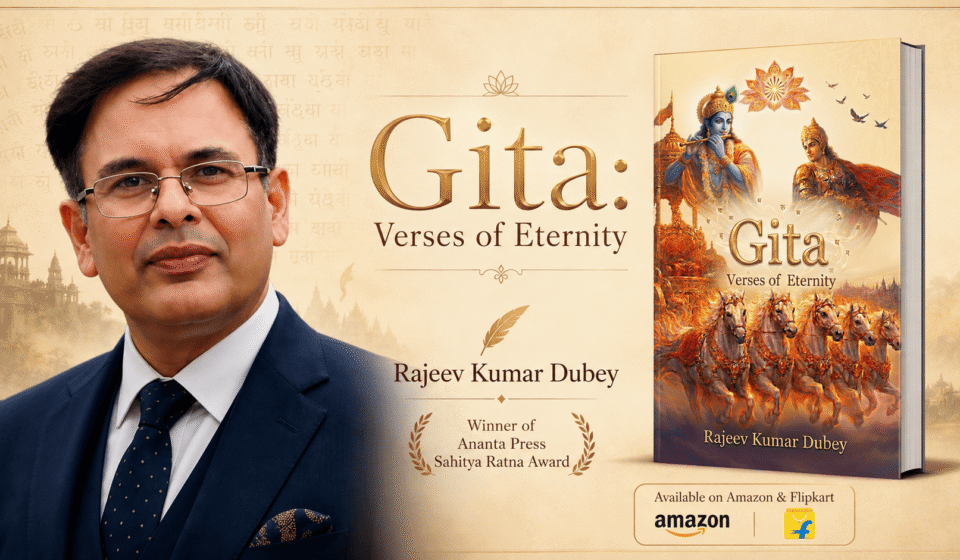

Gita: Verses of Eternity becomes especially interesting when read in the light of its author, Rajeev Kumar Dubey. The book is a poetic engagement with the wisdom of the Bhagavad Gita, intended to make its enduring ideas more accessible to modern readers. But its uniqueness is not limited to subject or form. It also emerges from the unusual convergence of the author’s worlds: medicine, teaching, literature, Indian cultural study, spirituality, meditation, and poetry. That convergence gives the project a distinctive human texture. The book is not presented as an academic commentary written from a single disciplinary viewpoint. It is the work of someone who has spent a professional life in science and healthcare while simultaneously cultivating a sustained inner and literary engagement with philosophical tradition.
Dubey is a Professor of Anaesthesiology at the Institute of Medical Sciences, Banaras Hindu University, Varanasi. His academic background includes anaesthesiology, critical care, and hospital administration. Each of these fields involves a particular kind of seriousness. Anaesthesiology requires precision and vigilance; critical care confronts fragility and uncertainty; hospital administration involves systems, responsibility, and decision-making. Teaching adds another demand: the ability to translate knowledge into a form that others can understand. When an author with this background turns toward the Gita, the choice feels natural rather than decorative. The Gita is itself deeply concerned with action under pressure, responsibility amid uncertainty, and the need for inner clarity when consequences matter.
At the same time, Dubey is described as a candid author and sensitive poet whose interests extend through Indian culture, literature, history, spirituality, meditation, and yoga. His poems have appeared in literary journals, been narrated on literary and poetic platforms, and broadcast on All India Radio. His poetic concerns include truth, social harmony, universal brotherhood, and human values. These are not incidental details. They help explain the tone and purpose of Gita: Verses of Eternity. The work seeks not merely to communicate information about a revered text, but to bring readers into a reflective relationship with its moral and spiritual questions.
This authorial position gives the book a valuable balance between discipline and sensitivity. Scientific education encourages clarity, evidence, structure, and careful observation. Poetry encourages attentiveness to ambiguity, emotion, metaphor, rhythm, and silence. Spiritual traditions encourage questions that may not be measurable at all: What is the self? What is duty? How should one relate to desire, fear, ego, or loss? A thoughtful life does not necessarily have to choose one mode of knowing over the others. Dubey’s book suggests that they can coexist and even enrich one another.
The poetic form is central to that synthesis. The original Gita speaks through verse, and a contemporary poetic rendering preserves something of the reflective cadence appropriate to spiritual teaching. Poetry allows the author to approach complex ideas without turning them into rigid definitions. This is useful because the Gita’s influence has never been limited to a single domain. It has inspired philosophers, reformers, saints, leaders, and people from many walks of life. Its language has been interpreted ethically, spiritually, metaphysically, psychologically, and practically. A poetic response can honour that multiplicity by leaving room for the reader’s own encounter.
Accessibility is another major strength. Many people feel genuine respect for the Gita but hesitate to read it because of unfamiliar Sanskrit, the complexity of commentary traditions, or the assumption that sacred texts require specialised preparation. Gita: Verses of Eternity is designed for those readers. Its audience includes first-time readers, seekers from varied backgrounds, professionals facing ethical choices, young people searching for meaning, and thoughtful readers more generally. This breadth is not a weakness; it is a statement of intent. The author wants the Gita’s conversation to remain alive beyond scholarly or ritual boundaries.
The phrase “conversation” is important. The Gita is not simply a collection of detached maxims; its philosophical force emerges from dialogue in a moment of crisis. A human being is confused, emotionally overwhelmed, and uncertain about action. That structure is one reason the work remains relevant. Modern readers may not share the epic circumstances, but they recognise paralysis, doubt, divided loyalties, fear of consequences, and the need for wise counsel. Dubey’s poetry keeps attention on that living relevance. It encourages readers to hear the ancient exchange as something that can continue within their own decisions.
The book also makes a meaningful contribution by emphasising engagement rather than withdrawal. The Gita’s wisdom is often most powerful when understood as guidance for action. This makes the work particularly compatible with the author’s life in medicine and education. A physician cannot solve suffering by retreating from responsibility; a teacher cannot educate by remaining silent; an administrator cannot lead without decisions. Similarly, a reader’s spiritual insight is tested not only during meditation or private reflection but in the quality of everyday choices. Gita: Verses of Eternity brings that principle into focus.
For professionals, the book may function as a reflective counterweight to the speed and pressure of institutional life. For young readers, it can provide a deeper vocabulary than ordinary success culture offers. For spiritual seekers, it may serve as an approachable doorway into Gita-inspired thought. For lovers of poetry, it offers the pleasure of encountering philosophical themes through a literary form. These overlapping readerships are part of what makes the book distinctive. It refuses to treat wisdom as the property of a narrow audience.
The book’s underlying values also deserve attention. Dubey’s interest in truth, social harmony, universal brotherhood, and human values points to an understanding of spirituality that has social consequences. Inner development is not presented merely as personal comfort. If reflection makes a reader more conscious of ego, responsibility, compassion, and the consequences of action, then it can influence relationships and communities. That broader ethical horizon keeps the work from becoming purely inward-looking.
One of the best ways to appreciate Gita: Verses of Eternity is therefore to see it as an act of cultural continuity. Traditions survive not only because texts are preserved, but because people repeatedly reinterpret, translate, teach, perform, and creatively respond to them. Every age has its own barriers of language and attention. A modern poetic adaptation is one way of ensuring that inherited wisdom can still be encountered by readers whose first language, education, profession, or reading habits may differ greatly from those of earlier generations.
The book does not need to claim finality to be valuable. In fact, its strength lies in invitation. It can encourage a newcomer to begin, a familiar reader to reconsider, or a busy professional to pause. It can lead someone toward the original text or simply help a reader carry one insight into a difficult day. That modest but meaningful function is central to spiritual literature.
Gita: Verses of Eternity stands out because the author brings together the analytical discipline of a medical academic, the communicative instinct of a teacher, the cultural curiosity of a lifelong student of Indian thought, and the sensitivity of a poet. The result is a work whose purpose is both literary and humane: to make enduring wisdom easier to approach without stripping it of seriousness. Rajeev Kumar Dubey’s contribution lies in keeping an ancient conversation available to the present, reminding readers that the deepest questions of duty, purpose, action, and self-understanding are not relics of the past. They remain part of the living work of being human.Amazon purchase link: https://amzn.in/d/0e2udQ4o