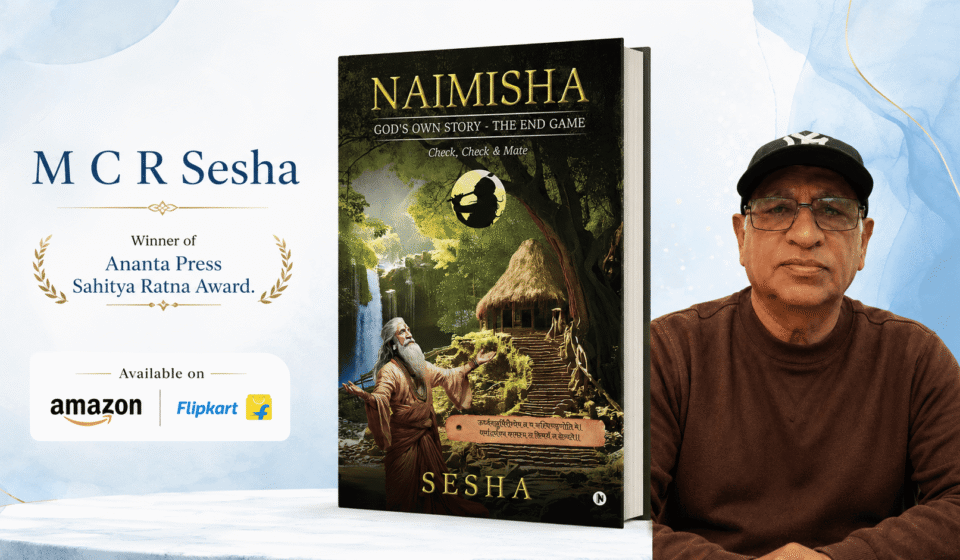

The final book of a trilogy has a special kind of emotional pressure. Readers do not arrive at it empty-handed. They bring memories of earlier characters, expectations created by previous conflicts, unanswered questions, and a desire to understand why the journey required three volumes rather than one. Naimisha – God’s Own Story – The End Game – Check, Check & Mate, the concluding work in M C R Sesha’s Naimisha Trilogy, embraces that pressure directly. Everything about its title announces finality, strategy, and reckoning. The narrative moves through the Kurukshetra War and the later Ashwamedha conflicts, seeks closure for the great Mahabharata figures including Krishna, and completes the very different journeys of the fictional characters Animish and Asareer. The book is therefore positioned as both an epic conclusion and a reflective meditation on how lives, wars, and ages come to an end.
What makes this premise compelling is that the Mahabharata is itself almost impossible to “finish” in a simple sense. Its plot has endings, but its questions do not. Generations of readers have continued to argue about dharma, justice, strategy, loyalty, sacrifice, gender, kingship, family duty, and divine intervention. Every decisive event generates another moral debate. A novelist who reaches the final phase of this epic tradition must therefore resist the temptation to confuse closure with certainty. The description of Sesha’s book, with its explicit reference to philosophical undertones and thought-provoking character endings, suggests an awareness that a proper conclusion can settle narrative threads while leaving interpretation alive.
The chess language of the subtitle is an elegant way to express this. Chess is governed by rules, yet every game produces an enormous range of possibilities. Players make choices within constraints, and the meaning of an early move may become clear only much later. That is remarkably close to the moral architecture of the Mahabharata. Characters inherit obligations before they fully understand them. A promise made in one generation can shape the suffering of the next. Pride can narrow choices until conflict appears inevitable. Wisdom often arrives after the position has already become dangerous. “Check, Check & Mate” therefore suggests more than clever strategy; it suggests the progressive closing of possibilities.
This is especially suitable for Kurukshetra. By the time the war begins, the epic has already shown how many opportunities for peace have been lost. The battle is the visible explosion of tensions that have been developing across years. In historical fiction, portraying such a war requires more than descriptive energy. The author must give readers a sense of accumulation. Each duel, death, reversal, and tactical decision matters because it is connected to relationships and histories already established. The third volume of a trilogy has an advantage here: it can draw on narrative investment built across earlier books. The war is not an isolated spectacle but the consequence of a world readers have had time to inhabit.
The book’s promise to give detailed attention to the Kurukshetra War is likely to attract readers who enjoy epic action, but its real uniqueness may lie in the refusal to stop there. By moving into the Ashwamedha wars, Sesha extends the narrative into the uneasy landscape after “victory.” This is one of the most fertile spaces in historical storytelling. The obvious enemy may have been defeated, yet governance, legitimacy, grief, guilt, and unresolved resistance remain. The Ashwamedha becomes not simply a ritual backdrop but a narrative mechanism for exploring how a new political order asserts itself after catastrophe.
That continuation also complicates the idea of checkmate. In chess, checkmate ends the game immediately. In history, no victory is so clean. One order gives way to another; one conflict resolves and another begins. The inclusion of post-Kurukshetra campaigns allows the book to question the finality promised by its own title. Perhaps “mate” applies not to history as a whole, but to particular characters, choices, or eras. That tension makes the title more philosophically interesting. Human beings long for decisive endings, yet life often gives transitions instead.
The closure of Krishna’s arc carries the largest symbolic weight. Krishna stands at the intersection of theology, ethics, strategy, and intimate human relationship. He can be read as divine guide, political thinker, protector, friend, provocateur, and embodiment of a cosmic order beyond ordinary understanding. A story that follows him toward the end of his earthly role inevitably becomes a meditation on impermanence. If even the presence that guided others through crisis eventually withdraws from the stage, then no political victory, dynasty, or age can claim permanence. The end of Krishna’s journey therefore gives the trilogy’s finality a scale larger than any individual battle.
Against that enormous background, Animish and Asareer become especially valuable. Fictional characters give the author the freedom to create endings that are not predetermined by tradition. Readers who already know the broad destinies of the Pandavas, Krishna, and other epic figures can still encounter genuine uncertainty through original characters. Their different conclusions also suggest that the book is willing to let multiple philosophies coexist. One person’s life may find meaning in action, another in withdrawal; one may achieve an outward goal while another arrives at inward understanding. The description does not tell us exactly how the two journeys end, and that uncertainty is part of their appeal.
The relationship between these invented lives and the epic framework is where the trilogy can distinguish itself from a straightforward retelling. Retellings are most successful when they contribute a perspective rather than simply repeat events. By creating characters who move alongside the established Mahabharata world, Sesha can ask what the epic looks like from a different emotional angle. The fictional figures may witness history, be altered by it, or illuminate themes that famous characters alone cannot carry. In a trilogy, those original arcs have enough space to develop rather than functioning as decorative additions.
M C R Sesha’s own path to authorship adds an admirable dimension to the project. His academic life included gold-medal achievements at Andhra University, followed by a long banking career that took him from direct officer entry to senior management. After retirement, he turned more deeply toward reading and writing and eventually completed all three volumes of the Naimisha Trilogy. This background makes the trilogy notable as an example of creative life continuing beyond conventional professional milestones. It also reflects the kind of long-term discipline required to finish an ambitious historical-fiction project.
There is a quiet thematic connection between that life story and a book about culmination. Retirement is often described as an ending, but Sesha treated it as a beginning of serious creative work. Likewise, The End Game appears interested in the possibility that endings contain transformations. Kurukshetra ends one political struggle but creates a new moral reality. Ashwamedha consolidates authority but opens questions about the nature of that authority. Characters complete their journeys but leave ideas behind. Krishna’s departure closes an age while making way for another. The author’s own completion of the trilogy turns a late-life literary beginning into a substantial finished body of work.
The book also has clear appeal for readers interested in the Indian tradition of historical and mythological fiction. It combines recognisable cultural material with an original trilogy structure. It promises war without treating war as the only source of drama. It uses Krishna and other epic figures without making them the sole imaginative focus. It allows fictional characters to carry fresh uncertainty. Most importantly, it places philosophical reflection at the culmination of the narrative rather than treating thought as a decorative layer.
A reader seeking a quick, self-contained adventure may naturally prefer to begin with the first volume of the trilogy. But for those who have followed Naimisha from its beginning, The End Game represents the reason long-form storytelling can be rewarding. Themes have room to mature. Characters can be understood across time. Consequences can return long after the decisions that created them. The final volume can transform earlier episodes by revealing what they were leading toward.
Naimisha – God’s Own Story – The End Game – Check, Check & Mate ultimately stands out because it takes finality seriously. It recognises that ending a story is not the same as stopping it. A true ending gathers meaning. It asks the reader to look backward as well as forward. It shows how a final move is shaped by everything that came before. And, in the spirit of the Mahabharata itself, it appears to leave enough philosophical space for readers to disagree about what the final position means. The pieces may come to rest, but the conversation continues. That is an appropriate checkmate for an epic-inspired trilogy: decisive in narrative, open in thought.
Amazon Purchase Link: https://amzn.in/d/0giaBcBM