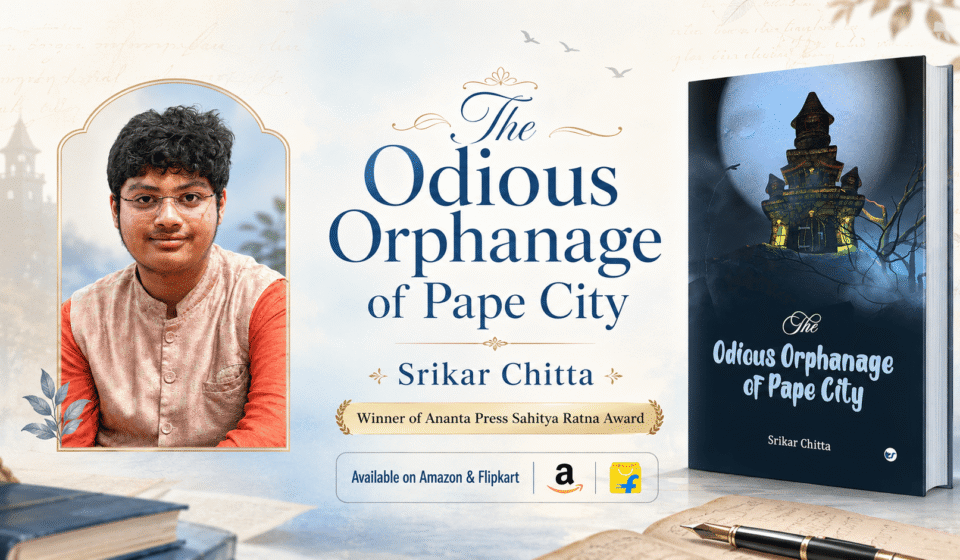

The Odious Orphanage of Pape City by Srikar Chitta is more than a suspenseful children’s book; it is a persuasive introduction to a distinctive new literary voice. In an era when young readers are surrounded by entertainment options competing for their attention, this novel reminds us of the enduring power of a well-told story. It offers mystery, menace, emotional tension, and a compelling central struggle, all while reflecting the imagination and narrative instinct of a promising young author. What makes the book special is not only its gripping plot, but also the sense of creative purpose that runs through it.
The story follows Chris, a young boy who is admitted to an orphanage called the “House of Victory.” At first glance, the name suggests a haven or a place where broken lives might be rebuilt. Instead, Chris discovers an institution ruled by fear. An evil warden dominates the orphanage with cruelty, strange punishments, and rigid control. The other children offer little comfort; many are mean, hostile, or emotionally closed off. Even the daily food—particularly the repeated presence of disgusting potato soup—becomes part of the institution’s bleak emotional landscape. Very quickly, Chris realizes he is not in a sanctuary but in a house of horrors. The novel then follows his attempt to survive, understand the dark reality around him, and search for a way out.
The first quality worth praising is the book’s atmosphere. Srikar Chitta constructs a world that feels ominous from the start. The orphanage has the qualities of a dark fairy tale or a middle-grade gothic setting, but it is rendered with enough concrete detail to feel immediate. The mood is built not only through large-scale menace, but through repeated discomforts: unpleasant routines, threatening adults, hostile social dynamics, and the knowledge that safety is nowhere in sight. This layered approach strengthens the book. The horror is not abstract. It is experienced through ordinary daily life made cruel.
Closely tied to this atmosphere is the novel’s strong sense of narrative momentum. The Odious Orphanage of Pape City is a short book, but it uses that compactness strategically. There is no indulgent delay, no excessive scene-building that slows the emotional current. Instead, the book moves decisively from one point of tension to the next. This makes the reading experience vivid and dynamic. For younger readers, that is especially important. Suspense depends on timing, and Srikar Chitta demonstrates a natural understanding of how to keep curiosity alive. The twists and turns are not there simply for decoration; they create forward drive and emotional investment.
Chris is an effective and sympathetic protagonist because he embodies the emotional center of the story. He is not a distant or ornamental hero. He feels exposed, uncomfortable, and increasingly alarmed by his surroundings. That vulnerability draws readers in. Yet the novel does not leave him in passive suffering. Over the course of the story, Chris becomes a figure of resilience. He begins to process the logic of the orphanage, recognize the dangers around him, and respond with determination. This gives the book an uplifting core beneath its dark surface. It is, finally, a story about refusing to surrender one’s spirit.
The theme of resilience is developed with admirable clarity. Children’s fiction is often at its strongest when it acknowledges that young people face structures larger than themselves—schools, families, institutions, systems of authority—and must find ways to act meaningfully within them. In this book, the orphanage represents a hostile structure of power. The warden’s tyranny is not random; it defines the rules of the world Chris inhabits. That makes Chris’s perseverance especially moving. He is not just dealing with a bad day or a single conflict. He is resisting an entire environment of oppression.
Another theme handled effectively is the illusion of sanctuary. The “House of Victory” sounds like a place of recovery or hope, and that makes its true nature all the more disturbing. The contrast between name and reality is one of the novel’s smartest devices. It encourages readers to think about appearances and hidden truths. In literature for young readers, such contrasts are often memorable because they sharpen moral perception. The orphanage’s name becomes a kind of cruel mask, and the process of seeing through that mask becomes part of Chris’s awakening.
A major reason the book feels unique is the author behind it. Srikar Chitta is not simply a young writer in the generic sense; he is part of a growing group of youth voices demonstrating that literary imagination can emerge early and with surprising force. His background as an imaginative author, anthology contributor, and tech enthusiast enriches the sense that this book is only one step in a larger creative journey. Yet what matters most is the book itself, and it already shows several strengths that suggest long-term promise: clarity of premise, confidence in pacing, a feel for mood, and a sharp understanding of what keeps readers engaged.
The novel’s readability is another major asset. Some books for young audiences sacrifice substance for simplicity, while others become so intent on being meaningful that they lose entertainment value. The Odious Orphanage of Pape City finds a strong middle ground. It is easy to read, but not empty. It is suspenseful, but not chaotic. It is emotionally direct, but not simplistic. Because of that balance, the book can reach a wide audience: committed readers who love thrillers, younger readers just building confidence, and even adults who enjoy observing new talent in youth literature.
There is also a quiet inspirational aspect to the book’s existence. Knowing that the author wrote with such imagination and confidence at a young age may encourage other children to take their own creativity seriously. Representation matters not only in the characters readers see, but also in the creators they encounter. A young reader discovering Srikar Chitta may think, perhaps for the first time, “Someone close to my age wrote this. Maybe I can write too.” That is a powerful contribution in itself.
Parents and educators may appreciate the book not only because it is engaging, but because it can serve as a bridge between entertainment and discussion. The story opens space for conversations about empathy, abuse of power, courage, and how institutions should care for vulnerable people. Yet these ideas arise naturally from the plot rather than being imposed artificially. That makes the book more effective as both a reading experience and a discussion starter.
In evaluating why this book stands out, three things become clear. First, it has a strong, hook-driven premise that immediately captures curiosity. Second, it handles suspense efficiently, making it highly suitable for young readers who need strong forward motion. Third, it carries the authenticity of a youthful imagination that has not lost its sense of intensity or wonder. These qualities together give the book a freshness that many formulaic children’s thrillers lack.
Overall, The Odious Orphanage of Pape City is an engaging, imaginative, and highly readable thriller that showcases the talent of Srikar Chitta. Chris’s journey through the sinister “House of Victory” is tense and absorbing, but it is also emotionally meaningful because it centers on resilience, bravery, and the refusal to accept cruelty as normal. The novel succeeds as entertainment, as a youth-centered story of courage, and as evidence of a rising author’s potential. For readers seeking a gripping middle-grade adventure with dark atmosphere and a strong heart, this book is well worth reading. It is a compact story, but its creativity and conviction make a lasting impression.
Amazon Link: https://www.amazon.in/Odious-Orphanage-Pape-City/dp/9394437614/