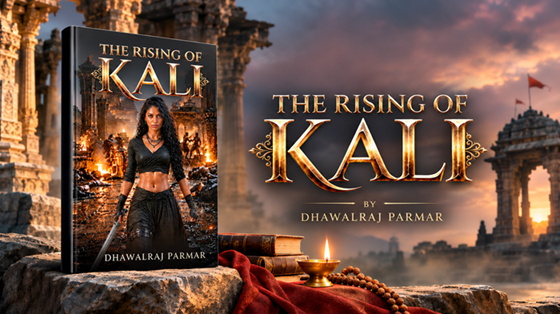

Dhawalraj Parmar’s The Rising of Kali places a family’s unresolved separation at the centre of a much larger conflict about power, responsibility, and identity. Its opening establishes two sisters whose different strengths are shaped by the same Gurukul. Adhira excels at weapons and direct confrontation; Saumya is drawn toward meditation, attention, and restraint. Their differences are not simply a way of distinguishing personalities. They establish the novel’s central question: what makes a person worthy of power, and what happens when strength is mistaken for entitlement?
Guru Kadambi’s instruction that genuine strength begins with stillness provides the story with an ethical foundation. His concern about Adhira is not that she lacks ability. She is clearly a gifted fighter, capable of facing multiple opponents. Rather, he worries that confidence is outrunning judgment. The prophecy surrounding the divine sword sharpens this distinction. It suggests that exceptional ability is not enough: the weapon is connected to a grave threat to the temple, and its rightful use requires timing, discipline, and clarity. The idea of worthiness therefore becomes a moral problem rather than a contest of physical skill.
The sisters’ relationship gives that philosophical argument emotional weight. Saumya admires Adhira and relies on her as protector and companion. When Adhira disappears after violating the rules surrounding the sacred vault, Saumya is left with an absence that shapes her development. Five years later, her martial progress has not erased her longing. Her search is driven less by curiosity about a prophecy than by the hope of recovering a person she loves. This distinction matters: the narrative’s largest stakes remain anchored to an intimate human need.
The Factory introduces a harsher vision of power. What is advertised as an elite training institution becomes a controlled environment in which armed guards, isolation, and lethal coercion replace the Gurukul’s ideal of instruction. The contrast is pointed. Both institutions claim to produce formidable fighters, but the novel asks readers to consider the purpose behind their methods. Training can cultivate self-command, or it can be used to break people into instruments of someone else’s ambition. That tension gives the action a social and moral dimension beyond spectacle.
Choice is equally complicated. Saumya boards the train voluntarily, but her decision is made under the pressure of grief and uncertainty. The offer of information about Adhira narrows what freedom feels like. Once she reaches The Factory, the promise of choice becomes openly hollow. This progression invites reflection on manipulation: an apparent opportunity can conceal a system that denies agency altogether.
The title’s invocation of Kali gains significance through these opposing forms of strength. The back-cover description presents Kali not merely as a name but as a choice. Within the story’s framework, that choice can be understood as a decision about how to meet violence without surrendering one’s own identity. The novel’s most engaging thematic achievement is the way it links its supernatural and martial elements to recognizable dilemmas: loyalty versus duty, ambition versus wisdom, and survival versus conscience. Readers looking for action grounded in questions of character and responsibility will find a clear thematic through-line here.
Amazon Link: https://www.amazon.in/Rising-Kali-Dhawalraj-Parmar/dp/9373356755