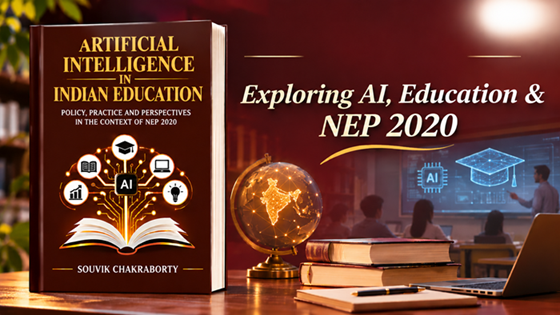

Artificial intelligence is often discussed in education as a collection of powerful tools. In Artificial Intelligence in Indian Education: Policy, Practice and Perspectives in the Context of NEP 2020, Souvik Chakraborty places those tools within a larger question: what should India’s education system become as digital technologies grow more capable? The book’s central achievement is its insistence that technological adoption cannot be separated from policy, pedagogy, social inclusion and human judgement. Rather than presenting AI as a self-sufficient solution, it examines the conditions under which AI might meaningfully improve educational opportunities.
The opening chapters establish a foundation for that discussion. Chakraborty explains the meaning and evolution of AI before turning to the historical development and continuing challenges of Indian education. This sequence matters because it prevents the reader from treating every educational difficulty as a software problem. Access, learning gaps, institutional capacity and inequality existed before current AI systems; the book asks readers to consider how technology interacts with those longstanding realities. Its treatment of the National Education Policy 2020 provides the organising policy context for subsequent chapters on classrooms, universities and administration.
A recurring theme is the relationship between personalisation and fairness. The chapters on teaching and learning explore intelligent tutoring, adaptive learning, learning analytics and assessment. Such applications may help educators recognise different learning needs and respond more effectively. Yet their potential depends on reliable infrastructure, appropriate data and thoughtful teaching practice. The book is most persuasive when it places these possibilities alongside questions of who has access to them and who may be left behind. The dedicated chapter on inclusive and equitable education considers rural learners, gender equity, students with disabilities and the danger that a digital divide could develop into an intelligence divide.
Another significant theme is the continuing importance of teachers. The author devotes substantial attention to AI competencies, lesson planning, professional development, institutional leadership and change management. This is an important corrective to simplistic narratives about automated classrooms. Educational relationships involve encouragement, ethical judgement, cultural awareness and responsibility; the book’s human-centred approach recognises that useful automation should support these qualities rather than displace them. Its attention to teacher readiness also makes clear that implementation requires professional learning, not merely purchasing a platform.
The discussion of ethics and governance gives the argument necessary weight. Student data privacy, algorithmic bias, cybersecurity, intellectual property and institutional accountability are not treated as marginal concerns. They belong to the same conversation as learning efficiency and innovation. International perspectives on the United States, China, Finland, Singapore and the United Kingdom broaden the analysis without removing its Indian focus. The comparative material invites reflection on which approaches might be adapted and which must be judged against India’s own linguistic, economic and institutional circumstances.
The book is broad in scope, and readers seeking detailed empirical evaluations of particular products or district-level implementations may want additional specialised research. Nevertheless, its thematic coherence is clear. The final chapters return to infrastructure, teacher capacity, policy recommendations and a future roadmap, reinforcing the argument that responsible AI adoption is a long-term educational project. Chakraborty’s contribution is to frame AI not as the destination of reform but as one possible means of building a more inclusive, capable and future-ready system. That perspective makes this a useful contribution to discussions about NEP 2020 and the direction of Indian education.
Amazon Link:https://www.amazon.in/Artificial-Intelligence-Indian-Education-Perspectives/dp/B0HQ3WC8QQ